
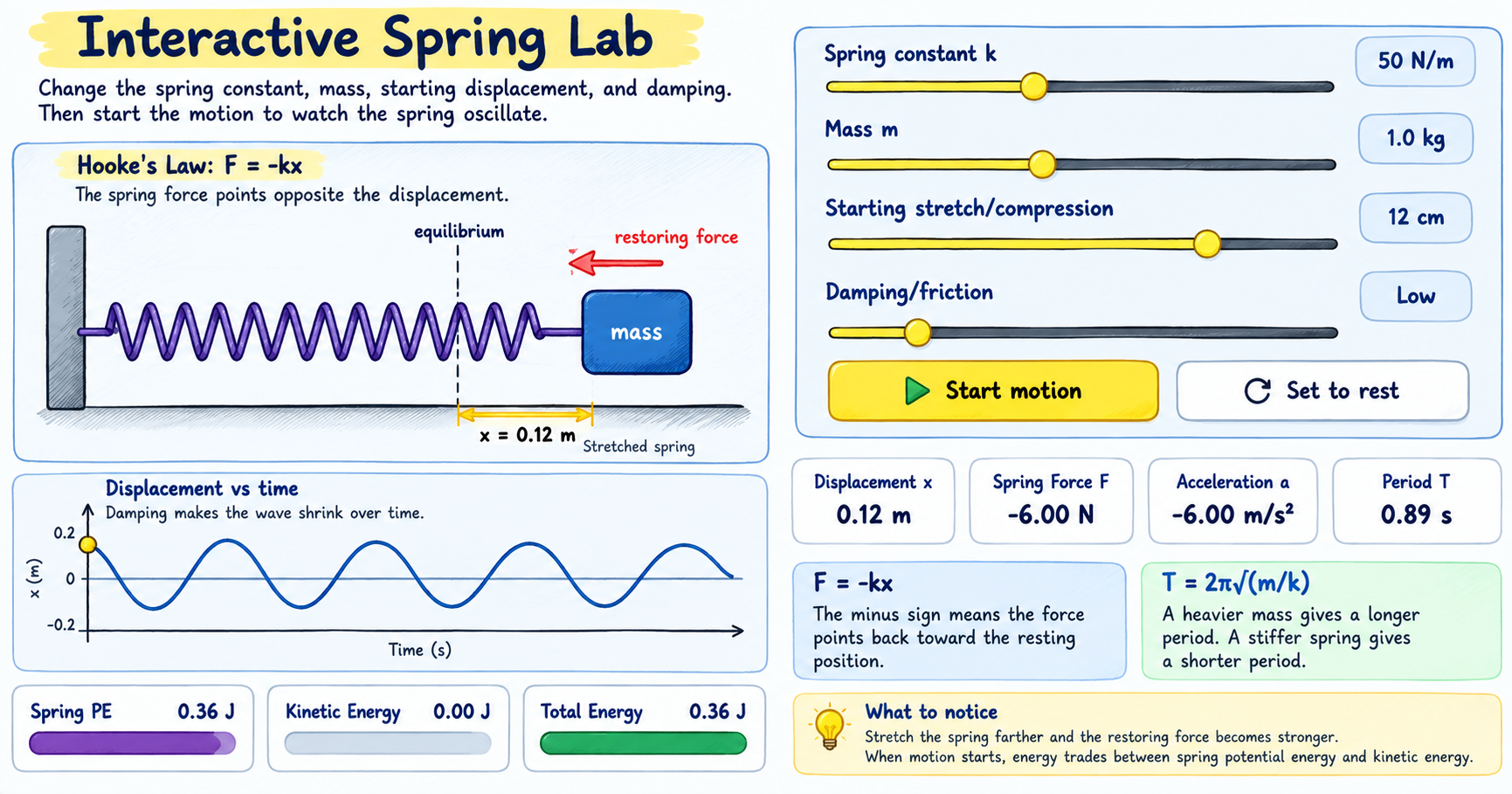
Use this Hooke’s Law spring motion simulator to pull or compress a spring and watch the restoring force, acceleration, period, and energy change in real time.
How to use the Hooke’s Law simulator
Pull or compress the spring
Move the displacement slider left or right. The spring force points back toward the resting position.
Change spring stiffness
Increase the spring constant k to make a stiffer spring with a stronger restoring force.
Change the mass
Use a heavier or lighter mass and compare the period of the motion.
Start the motion
Press Start Motion to watch the mass oscillate and see energy trade between spring potential energy and kinetic energy.
Core idea
Hooke’s Law says that the force from a spring is proportional to how far the spring is stretched or compressed. If the displacement doubles, the restoring force doubles too. The force always tries to bring the spring back to equilibrium.
Formulas used in the tool
Hooke’s Law
F = -kxF is spring force, k is spring constant, and x is displacement from equilibrium.
Acceleration
a = F / mThe same spring force gives less acceleration to a heavier mass.
Spring potential energy
PE = 1/2 kx2A stretched or compressed spring stores energy.
Period of motion
T = 2π√(m/k)Mass and spring stiffness control how quickly the spring oscillates.
Ideas for practice
- Set x = 10 cm and then x = 20 cm. Compare the spring force.
- Increase k and notice that the force becomes stronger for the same displacement.
- Increase mass and watch the period become longer.
- Turn damping higher and explain why the motion fades away faster.
Frequently asked questions
What is Hooke’s Law?
Hooke’s Law describes how a spring pushes or pulls back when it is stretched or compressed. The force is proportional to displacement.
What does the minus sign mean in F = -kx?
The minus sign means the spring force acts in the opposite direction of the displacement.
What is the spring constant?
The spring constant k tells how stiff the spring is. A larger k means a stronger force for the same stretch.
Why does damping make the motion smaller?
Damping represents friction or resistance. It removes mechanical energy from the motion over time.