
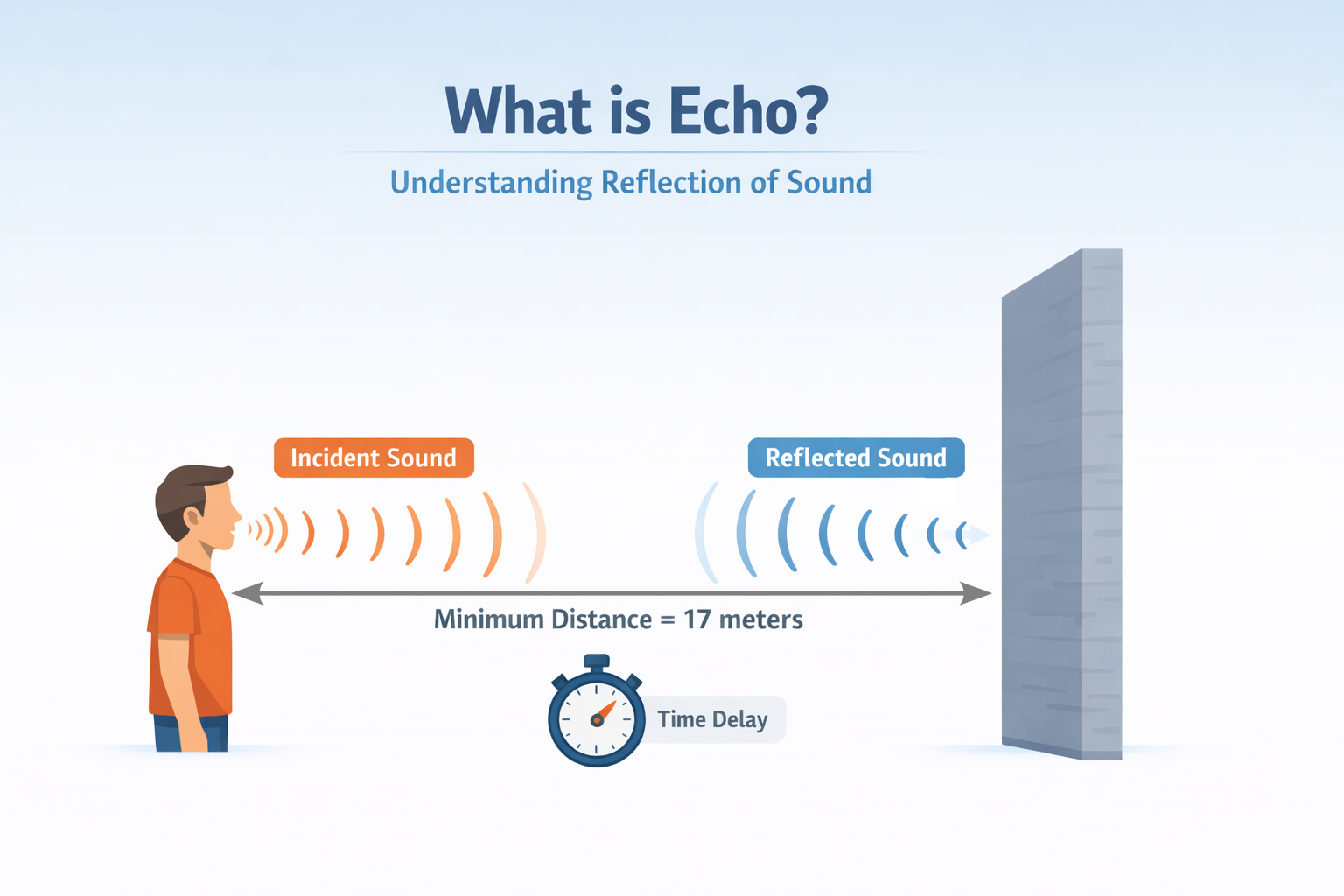
Have you ever shouted in a large empty hall or near a mountain and heard your voice come back to you? That repeating sound is called an echo. Echoes are a fascinating example of how sound travels and interacts with objects around us.
What Is an Echo?
An echo is the repetition of a sound caused when sound waves bounce back (reflect) from a distant surface and return to the listener’s ears.
In simple words, an echo is your own sound heard again after a short delay.
How Does an Echo Work?
To understand how an echo works, let’s break it down step by step:
- Sound Is Produced
When you speak, clap, or shout, your vocal cords or hands create sound waves. These waves travel through the air in all directions. - Sound Travels Through a Medium
Sound needs a medium like air, water, or solids to travel. In open spaces, sound usually travels through air. - Sound Hits a Surface
When sound waves reach a hard surface such as a wall, cliff, mountain, or tall building, they cannot pass through easily. - Sound Gets Reflected
Instead of passing through, the sound waves bounce back toward the source. This bouncing back of sound is called reflection of sound. - Sound Returns to the Listener
The reflected sound waves reach your ears after a short time delay. Your brain recognizes this delayed sound as a separate sound — this is what we hear as an echo.
Why Don’t We Hear Echoes Everywhere?
We don’t hear echoes all the time because for an echo to be heard clearly,the reflected sound must reach our ears at least 0.1 seconds after the original sound. This is because our brain cannot distinguish two sounds separately if they arrive within 0.1 seconds of each other.
Now we know that human ear needs about 0.1 seconds to hear echo. Lets find out what should be the minimum distance for an echo to be heard.
To calculate the distance, we need to know the speed of sound in the air. At room temperature, the speed of sound is about 340 m/s. As we know the speed and time, then using the below formula:
Distance=Speed×Time
We find out that
Distance =340×0.1= 34 meters
The sound travels to the reflecting surface and then comes back to the listener. So, the total distance (to and fro) must be 34 meters. Therefore the minimum distance for an echo to be heard would be half of that distance i-e;
Minimum Distance to hear echo = 34/2 =17 meters
Hence the minimum distance required for an echo to be heard is 17 meters.
If the surface is closer than 17 m, the reflected sound returns too quickly and merges with the original sound, producing reverberation instead of a clear echo.
Difference Between Echo and Reverberation
An echo is distinct repetition of sound heard after a delay whereas reverberation is multiple reflected sounds that overlap, making sound last longer but not clearly repeat.
Where Can Echoes Be Heard?
Echoes are commonly heard in:
- Mountains and valleys
- Large empty halls
- Tunnels
- Near tall buildings or cliffs
Practical Applications of Echo
Echoes are not just interesting—they are useful too:
- SONAR: Ships use echoes of sound waves to detect underwater objects.
- Medical Imaging: Ultrasound machines use reflected sound waves to create images of the human body.
- Animal Navigation: Bats and dolphins use echoes (echolocation) to find food and navigate.
An echo is a simple yet powerful demonstration of how sound travels and reflects. It helps us understand important concepts like sound waves, reflection, and time delay. From playful shouting in mountains to advanced technologies like SONAR, echoes play a vital role in both nature and science.