
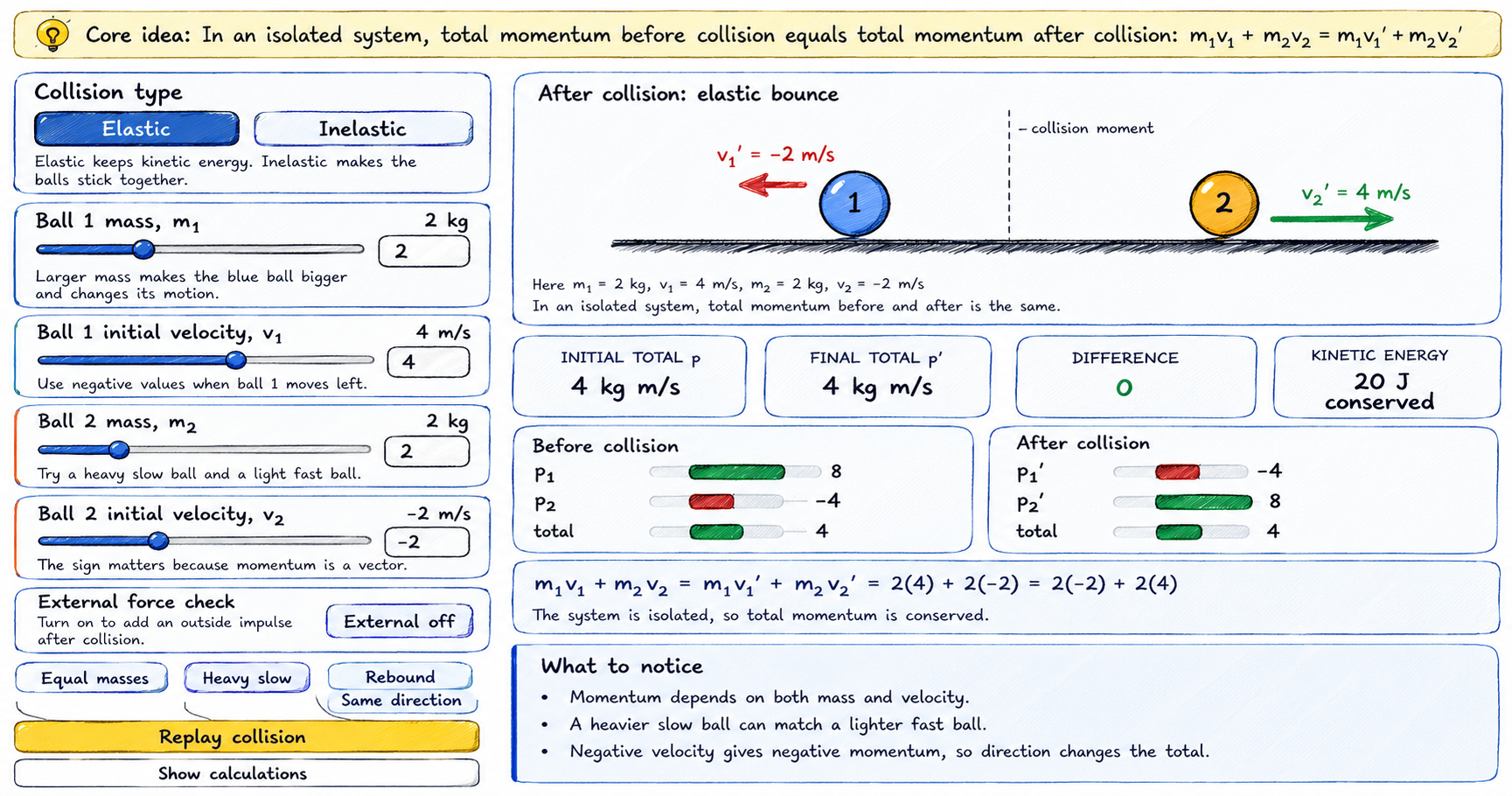
Use this Momentum Conservation and Collision simulator to change the mass and velocity of two balls, choose elastic or inelastic collision, and see why total momentum stays the same in an isolated system.
How to use the Momentum Conservation and Collision simulator
Set the two balls
Use the sliders to choose mass and signed initial velocity for ball 1 and ball 2.
Choose collision type
Switch between elastic collision and inelastic collision to compare different final velocities.
Watch signed momentum
The bars show positive momentum to the right and negative momentum to the left.
Show calculations
Open the calculations panel to see each general expression first, followed by substituted values.
Core idea
Momentum depends on both mass and velocity. A heavy ball moving slowly can have the same momentum as a light ball moving quickly. In an isolated collision, total momentum before collision equals total momentum after collision.
Physics formulas used
Momentum of one ball
p = mvMomentum increases when mass or velocity increases. The sign of velocity gives the direction.
Total momentum
ptotal = m1v1 + m2v2Add the signed momenta of both balls to get the system momentum.
Conservation statement
m1v1i + m2v2i = m1v1f + m2v2fThis equality holds for an isolated system with no external impulse.
Inelastic final velocity
vf = (m1v1i + m2v2i) / (m1 + m2)When the balls stick together, they share one final velocity.
Ideas for practice
- Set equal masses and opposite velocities. Explain why the balls swap velocities in an elastic collision.
- Make one ball heavy and slow, then make the other ball light and fast. Compare their momenta.
- Try negative velocities and describe how direction changes the total momentum.
- Change from elastic to inelastic collision and compare kinetic energy before and after.
- Turn on external impulse and explain why total momentum is no longer conserved.
- Use Show calculations to compare total momentum, final velocities, and total kinetic energy.
Frequently asked questions
What is linear momentum?
Linear momentum is mass multiplied by velocity. It describes how much motion an object has in a chosen direction.
Why can momentum be negative?
Velocity has direction. If right is positive, an object moving left has negative velocity and negative momentum.
What is the difference between elastic and inelastic collision?
In an elastic collision, kinetic energy is conserved. In a perfectly inelastic collision, the objects stick together and kinetic energy decreases, but momentum is still conserved if the system is isolated.
When is momentum not conserved?
The momentum of the two-ball system changes when an external force or impulse acts on it. If the outside object is included in a larger system, the larger system can still conserve momentum.