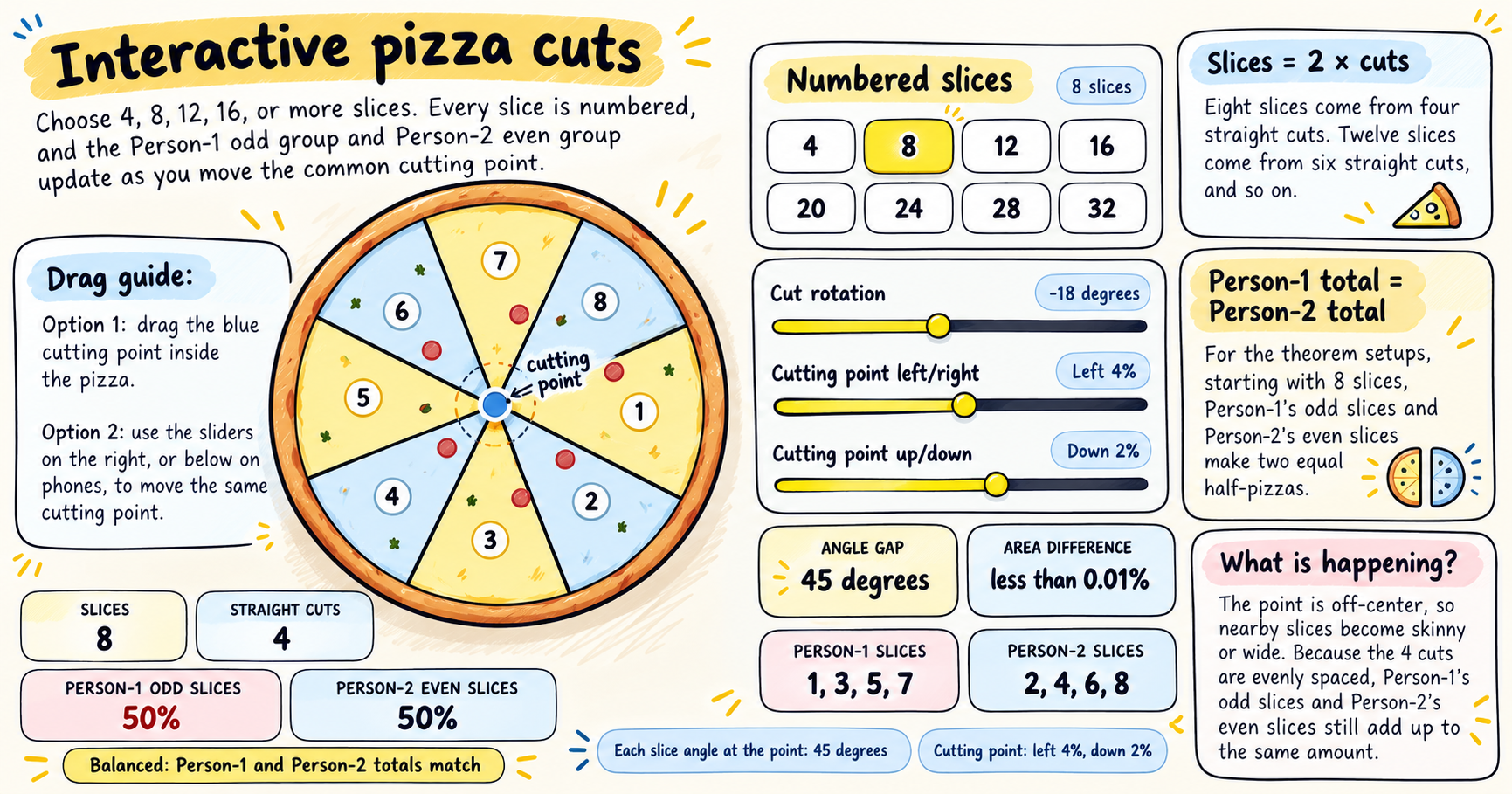
Use this Pizza Theorem explorer to divide a circular pizza with equally spaced cuts. Move the common cutting point, choose 4, 8, 12, 16, or more slices, and compare Person-1’s odd-numbered slices with Person-2’s even-numbered slices.
How to use the Pizza Theorem explorer
The tool shows a circular pizza cut by straight lines that all pass through one point. Move one control at a time and watch the odd and even slice totals.
Choose the slice count
Pick 4 as a warm-up, then try 8, 12, 16, or another multiple of 4 for the theorem pattern.
Move the cutting point
Drag the blue point inside the pizza or use the sliders on the right, below on phones, to move it left, right, up, and down.
Read the slice numbers
Person-1 takes the odd-numbered slices, and Person-2 takes the even-numbered slices.
Compare the totals
The individual slices can look very different, but the two alternating groups stay equal.
What does the Pizza Theorem say?
The Pizza Theorem says that if a circle is cut into the classic 8-slice setup, or other supported higher multiple-of-4 setups, alternate slices have the same total area. The common point does not need to be the center.
Common cutting point
Every line must pass through the same point. In the tool, this is the blue point.
Equally spaced cuts
The angles around the cutting point must be equal, such as 45 degrees for 8 slices.
Person-1 odd slices
Slices 1, 3, 5, and 7 may not match each other, but their total is half the pizza.
Person-2 even slices
Slices 2, 4, 6, and 8 make the other half of the pizza.
Pizza Theorem pattern
Even when the cutting point moves away from the center, Person-1 and Person-2 have equal total area in the theorem setups. The 4-slice option is included so students can compare it with the classic 8-slice case.
Ideas for practice
- Start with 8 slices and move the cutting point close to the edge.
- Switch to 16 slices and notice that each angle around the point becomes smaller.
- Use the slice area notebook to find the largest individual slice.
- Rotate the cuts and check whether the two totals remain balanced.
Frequently asked questions
Does the cutting point have to be the center?
No. That is the surprising part. The point can move away from the center as long as all the cuts still pass through it.
Why do some slices look bigger?
When the cutting point is off-center, some slices reach across more of the circle than others. The theorem compares alternating totals, not each slice one by one.
Why use multiples of 4 slices?
The classic classroom version starts with 8 slices. The tool also includes higher multiple-of-4 choices, plus 4 slices as a warm-up comparison.