
Neon signs are bright, colorful, and easy to recognize. We often see them outside shops, restaurants, hotels, and theaters. Their glowing light can make words and shapes stand out beautifully in the dark.
But how does a glass tube filled with gas produce such bright light?
The answer comes from electricity, atoms, and a special type of glowing gas.
What Is a Neon Sign?
A neon sign is a light-up sign made from glass tubes. These tubes are bent into letters, shapes, or designs. Inside the tube, there is a small amount of gas. When electricity passes through the gas, the gas begins to glow.
The name “neon sign” comes from the gas neon, but not all neon signs contain only neon gas. Some signs use other gases, such as argon, or special coatings inside the glass to create different colors.
The Main Parts of a Neon Sign
A neon sign has a few important parts:
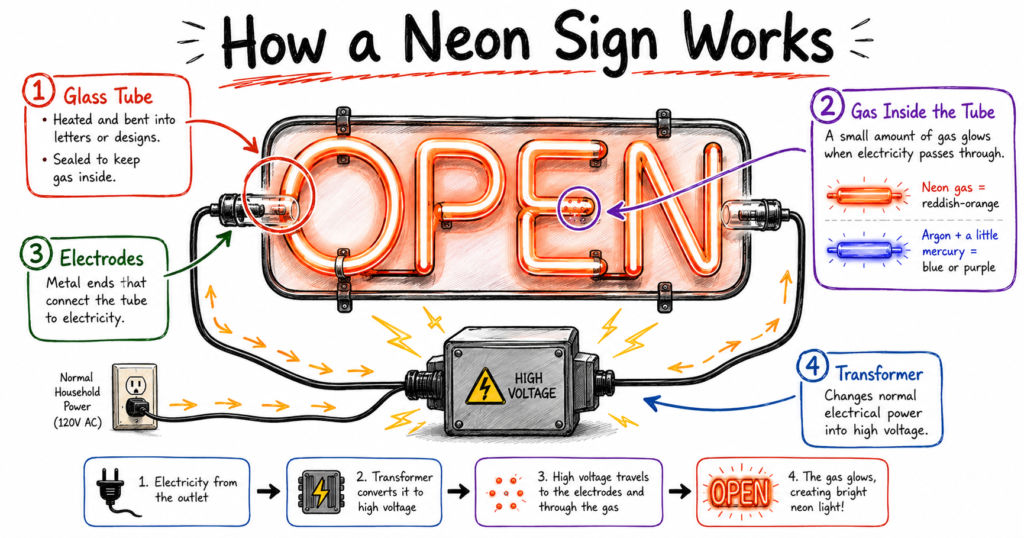
1. Glass Tube
The glass tube forms the shape of the sign. Skilled workers heat and bend the glass carefully to make letters or designs. The tube is sealed so the gas inside cannot escape.
2. Gas Inside the Tube
A small amount of gas is placed inside the tube. The type of gas affects the color of the light.
Neon gas usually gives a bright reddish-orange glow. Argon gas is often used with a little mercury to make blue or purple light.
3. Electrodes
At both ends of the glass tube are metal parts called electrodes. These connect the tube to an electrical supply.
4. Transformer
A neon sign needs a high voltage to work. A transformer changes normal electrical power into a much higher voltage. This high voltage is needed to push electricity through the gas inside the tube.
How Does the Gas Start Glowing?
To understand neon signs, we need to look at atoms.
Everything around us is made of tiny particles called atoms. Inside each atom are even smaller particles called electrons. When a neon sign is switched on, high-voltage electricity passes through the gas inside the tube.
This electricity gives energy to the electrons in the gas atoms. The electrons become excited and move to a higher energy level. But they cannot stay excited forever. Soon, they fall back to their normal energy level.
When the electrons return to their normal state, they release the extra energy as light.
This is why the gas glows.
In simple words:
Electricity gives energy to gas atoms. The atoms release that energy as light.
Why Does Neon Glow Reddish-Orange?
Different gases produce different colors because their atoms release different amounts of energy. The color of light depends on how much energy is released.
Neon gas naturally produces a bright reddish-orange color. That is the classic color of old neon signs.
Other colors are made by using different gases, mixing gases, or adding special coatings inside the glass tube.
How Are Different Neon Sign Colors Made?
Although people call many glowing signs “neon signs,” the color may come from different materials.
Red and Orange
Red-orange light usually comes from neon gas itself.
Blue and Purple
Blue or purple colors often come from argon gas mixed with a tiny amount of mercury vapor.
Green, Pink, Yellow, and White
These colors are often made by coating the inside of the glass tube with special fluorescent powders. When the gas glows, it gives energy to the coating, and the coating produces a different color.
This is similar to how some fluorescent lamps work.
Why Does the Tube Need High Voltage?
Gas does not conduct electricity easily at normal voltage. The atoms inside the gas are mostly neutral, meaning they do not naturally carry electric current.
A high voltage is needed to pull electrons away from some gas atoms. This creates charged particles called ions. Once there are enough charged particles, electricity can flow through the gas.
This glowing flow of charged gas is called a plasma.
Plasma is sometimes called the fourth state of matter, after solids, liquids, and gases. In a neon sign, the plasma gives off light.
Is the Glass Tube Hot?
Neon signs can become warm, but they usually do not become extremely hot like old-style incandescent bulbs. In an incandescent bulb, a thin metal wire becomes so hot that it glows.
A neon sign works differently. Its light comes from excited gas atoms, not from a hot wire. This makes neon signs more efficient than many older types of lighting.
Why Are Neon Signs So Bright at Night?
Neon signs are easy to see at night because they produce direct, glowing light. The glass tube itself becomes the light source. Unlike a lamp hidden behind a shade, the glowing tube is clearly visible from many directions.
The bright colors also stand out strongly against dark backgrounds, which is why neon signs became popular for advertising.
Neon Signs vs. LED Neon Signs
Real neon signs use glass tubes filled with gas. They need high voltage and skilled glass bending.
LED neon signs use small light-emitting diodes. They usually run at lower voltage and are made from flexible materials.
Both can look beautiful, but they work in very different ways.
Why Neon Signs Are Important
Neon signs are not just decorations. They are a great example of science in everyday life. They show how electricity can interact with gases to produce light.
The same basic idea is also used in other technologies, such as fluorescent lamps, plasma globes, and some types of display screens.
Conclusion
Neon signs work by passing high-voltage electricity through gas inside a sealed glass tube. The electricity gives energy to the gas atoms. When the atoms release that energy, they produce light.
Neon gas gives a reddish-orange glow, while other gases and coatings can create blue, green, pink, yellow, and white colors.
So the next time you see a glowing neon sign, remember: it is not magic. It is electricity exciting tiny gas atoms and making them shine.