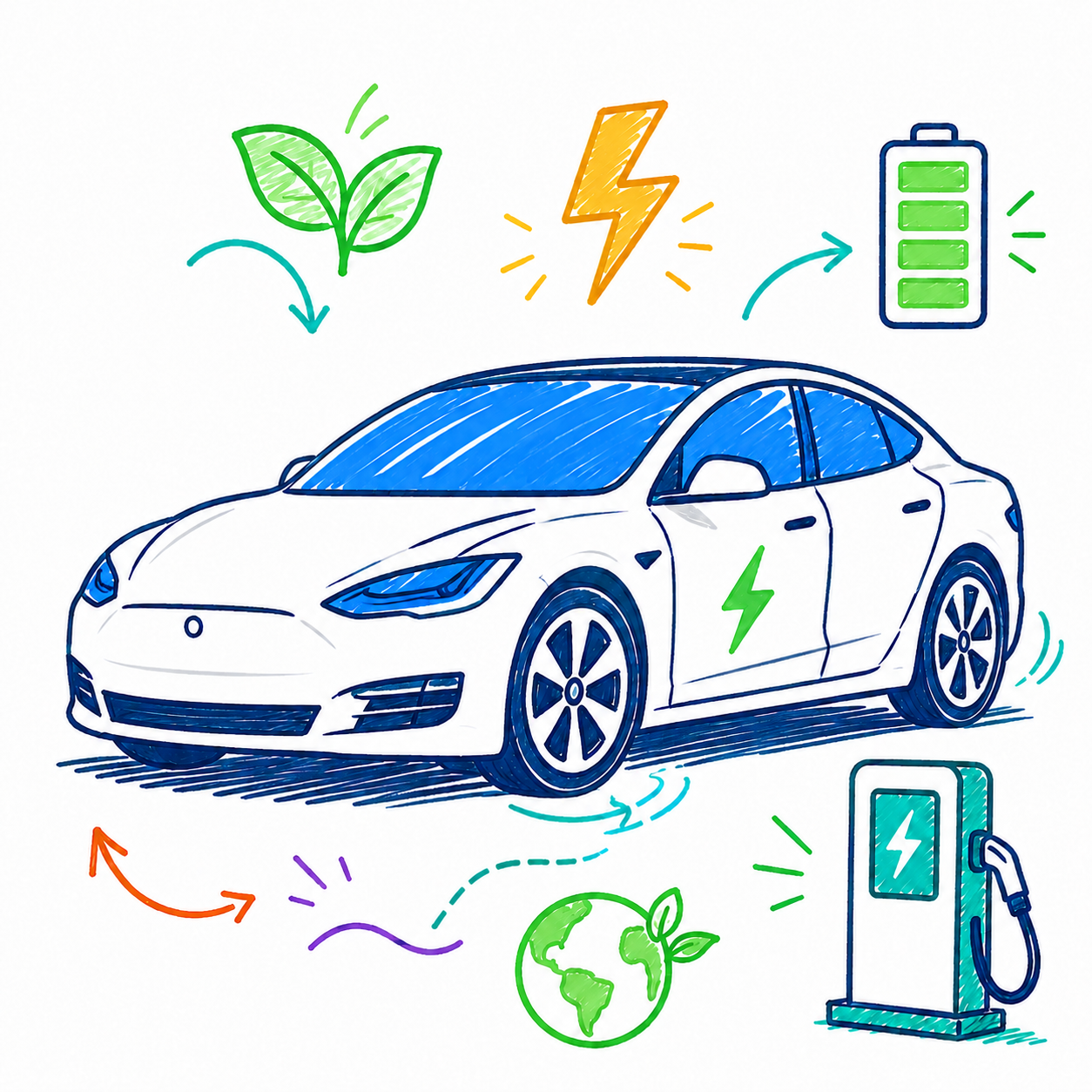
Electric cars are becoming more common on roads around the world. They look similar to normal cars from the outside, but inside they work in a very different way. Instead of using petrol or diesel, electric cars use electricity stored in a battery to move.
In this article, we will understand how electric cars work, what parts they use, and why they are considered an important part of the future of transportation.
What is an Electric Car?
An electric car, also called an EV, is a vehicle that runs using an electric motor instead of a petrol or diesel engine. The energy needed to move the car comes from a rechargeable battery pack.
A normal petrol car burns fuel inside an engine to create motion. An electric car does not burn fuel. Instead, it uses electricity to power a motor, which turns the wheels.
Main Parts of an Electric Car
Electric cars have several important parts that work together.
1. Battery Pack
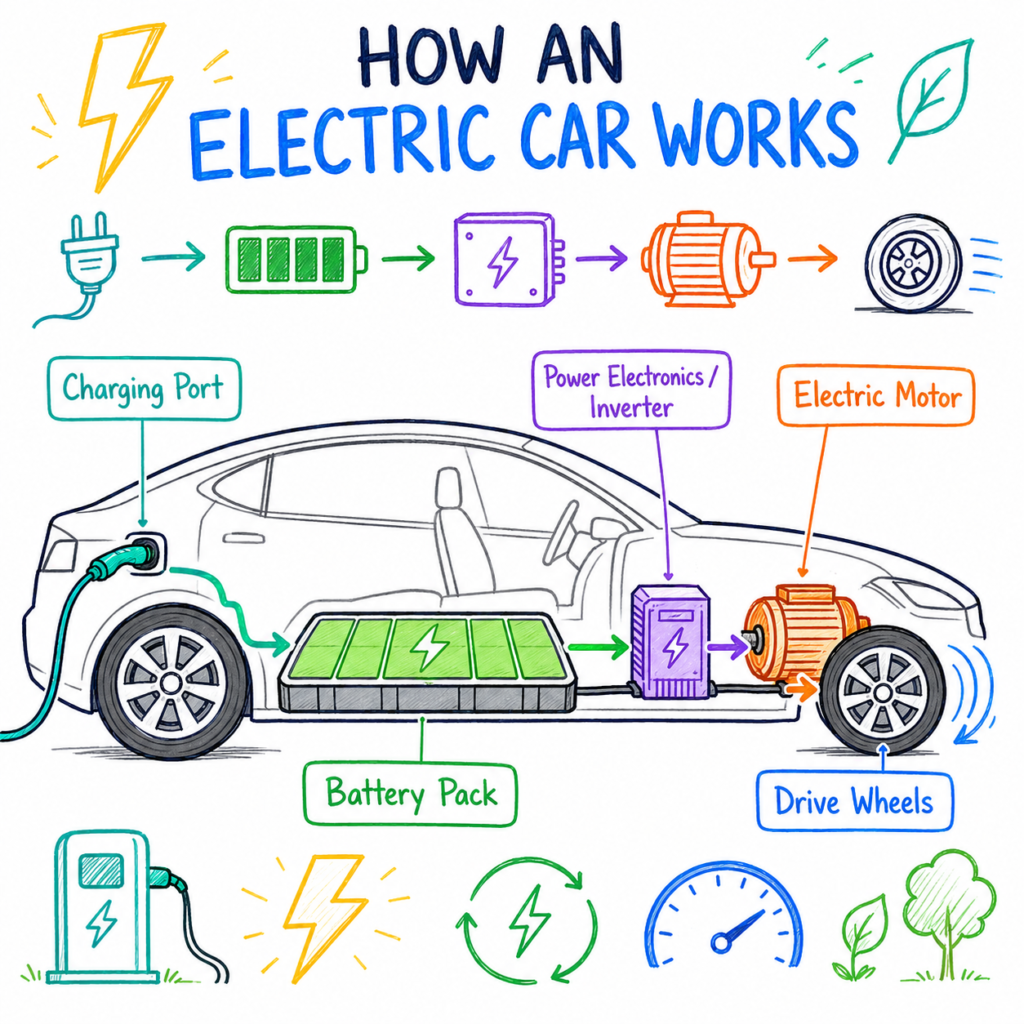
The battery pack is like the fuel tank of an electric car. It stores electrical energy that the car uses to move. Most electric cars use lithium-ion batteries because they can store a lot of energy and can be recharged many times.
The bigger the battery, the farther the car can usually travel on one charge.
2. Electric Motor
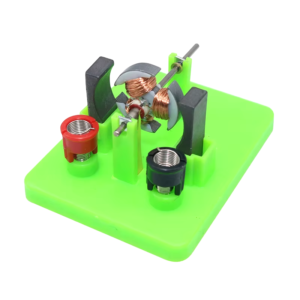
The electric motor is the part that actually moves the car. When electricity from the battery reaches the motor, the motor spins. This spinning motion is transferred to the wheels, making the car move forward or backward.
Electric motors are very efficient and can provide power quickly. That is why many electric cars feel smooth and fast when they start moving.
3. Power Electronics Controller
The power electronics controller manages how much electricity goes from the battery to the motor. When the driver presses the accelerator pedal, the controller increases the flow of electricity to the motor. When the driver slows down, it reduces the power.
In simple words, it acts like the “brain” that controls the power flow.
4. Charging Port
The charging port is where the car is plugged in to recharge the battery. It works somewhat like charging a mobile phone, but on a much larger scale.
Electric cars can be charged at home, at public charging stations, or at fast-charging stations.
5. Regenerative Braking System
One special feature of many electric cars is regenerative braking. In a normal car, braking wastes energy as heat. In an electric car, when driver put the brakes, some of the energy is captured while slowing down the car and sent back to battery.
This helps improve efficiency and can slightly increase the driving range.
Step-by-Step: How an Electric Car Moves
The working of an electric car can be understood in simple steps:
- The battery stores electrical energy.
- The driver presses the accelerator pedal.
- The controller sends electricity from the battery to the electric motor.
- The electric motor starts spinning.
- The spinning motor turns the wheels.
- The car moves forward.
- When the car slows down, regenerative braking can send some energy back to the battery.
So, instead of burning fuel, an electric car uses stored electricity to create motion.
How Is an Electric Car Charged?
Electric cars need to be recharged when their battery becomes low. Charging can be done in different ways.
1. Home Charging
Many people charge their electric cars at home overnight. This is usually convenient because the car can be ready by morning.
2. Public Charging
Public chargers are available in many cities, shopping centers, parking areas, and highways. These chargers are useful when drivers travel longer distances.
3. Charging Station
Fast chargers can charge an electric car much more quickly than normal chargers. However, charging speed depends on the car, the charger, and the battery condition.
Why Are Electric Cars Quiet?
Petrol and diesel cars have engines with many moving parts and controlled explosions inside the engine. This creates noise and vibration.
Electric cars do not have this type of engine. Their motors are much quieter, which is why electric cars often feel smooth and silent while driving.
Electric Cars vs Petrol Cars
Electric cars and petrol cars both help people travel, but they work differently.
A petrol car needs fuel, an engine, exhaust pipes, and many moving mechanical parts. It burns fuel and releases gases from the exhaust.
An electric car uses a battery and motor. It does not have an exhaust pipe because it does not burn petrol or diesel while driving. This means it produces no tailpipe emissions.
Benefits of Electric Cars
Electric cars have several benefits.
They are quieter, smoother, and more energy-efficient than petrol cars. They also produce no exhaust smoke while driving. Since electric motors have fewer moving parts than petrol engines, electric cars may also require less regular maintenance.
Electric cars can also be powered by renewable energy, such as solar or wind power, if the electricity used for charging comes from clean sources.
Challenges of Electric Cars
Electric cars also have some challenges.
They need charging stations, and charging can take longer than filling a petrol tank. The driving range depends on battery size, driving style, weather, and road conditions. Batteries can also be expensive, although technology is improving over time.
Another important point is that electric cars are cleaner during driving, but making batteries and producing electricity can still affect the environment. This is why clean electricity and battery recycling are important.
Final Thoughts
Electric cars work by using electricity stored in a battery to power an electric motor. The motor turns the wheels and moves the car without burning petrol or diesel.
They are quiet, efficient, and produce no exhaust smoke while driving. As battery technology improves and charging stations become more common, electric cars are likely to play a bigger role in the future of transportation.
Understanding how electric cars work helps us see how science, electricity, and engineering come together to create cleaner and smarter ways to travel.