
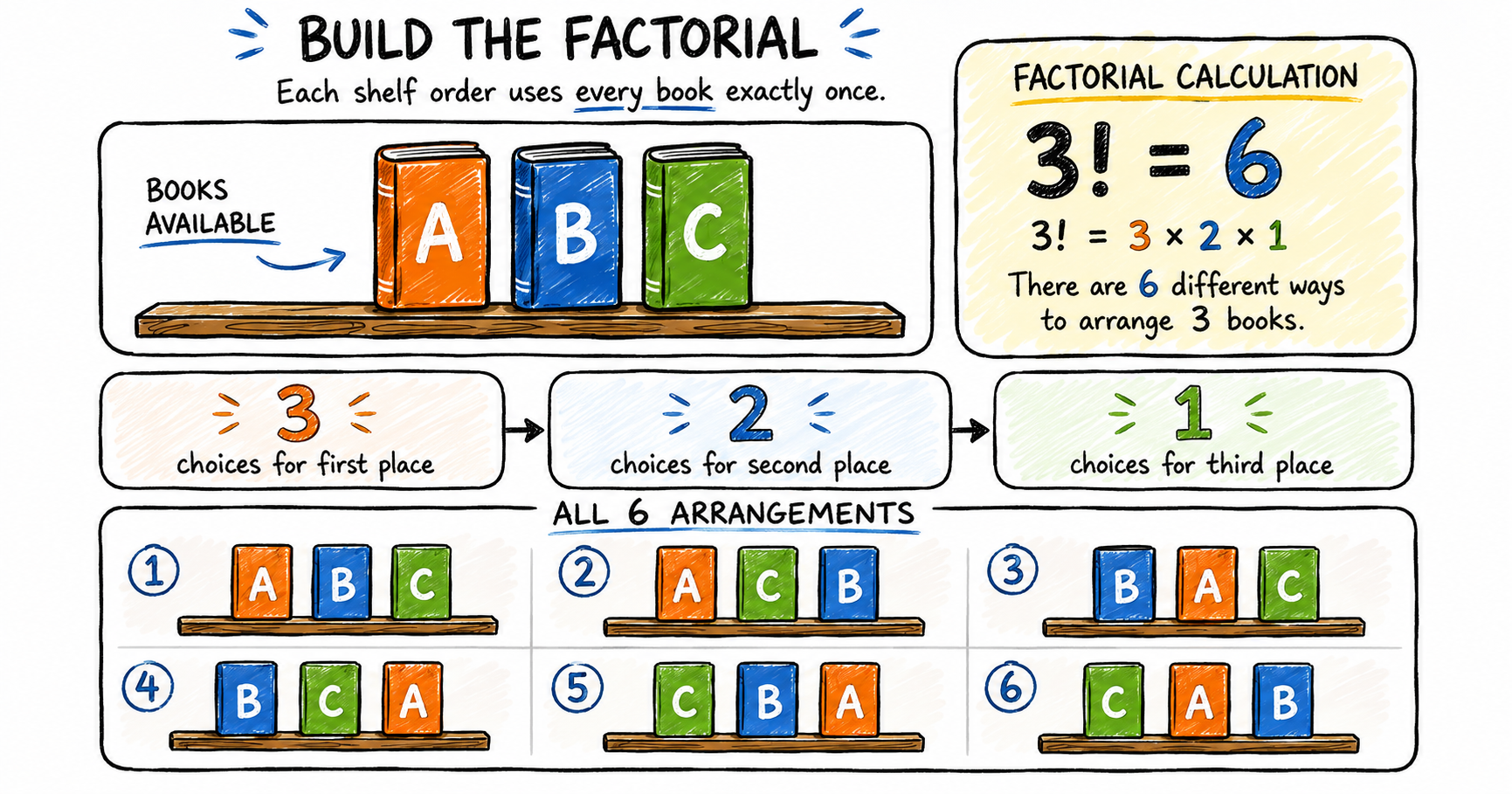
How many different ways can books be placed on a shelf? Explore factorials visually by changing the number of books, following the multiplication pattern, and browsing every possible arrangement.
How to use the factorial book arranger
Choose between one and six books. The activity calculates the factorial and displays the unique shelf orders in manageable pages.
Choose the books
Select how many different books will be placed on the shelf.
Read the multiplication
Follow the factorial from the selected number down to one.
Connect choices to places
Notice how the number of choices decreases after each shelf position is filled.
Browse the arrangements
Use Previous and Next to explore every order without loading hundreds of rows at once.
What is a factorial?
A factorial counts how many different orders can be made from a group of distinct objects when every object is used exactly once. It is written with an exclamation mark.
The factorial symbol
The expression n! is read as “n factorial.” For example, 4! means 4 x 3 x 2 x 1.
Why the choices decrease
After one book is placed, it cannot be used again. One fewer choice remains for the next position.
Order matters
A-B-C and C-B-A contain the same books, but their order is different, so they count as separate arrangements.
Permutations
An arrangement where order matters is called a permutation. Arranging all n distinct objects gives n! permutations.
Worked factorial example
Suppose there are four different books: A, B, C, and D.
There are 4 choices for the first shelf position. After choosing one book, 3 choices remain for the second position, then 2 choices, then 1.
4! = 4 x 3 x 2 x 1 = 24, so four different books can be arranged in 24 unique ways.
Ideas for practice
- Predict the number of arrangements before changing the selector.
- Compare 3! and 4!. How many times larger is 4!?
- Find two arrangements that begin with the same book.
- Explain why six books produce 720 arrangements even though only eight are displayed per page.
- Use small objects at home and check whether the activity lists every possible order.
Frequently asked questions
What does the exclamation mark mean in mathematics?
After a whole number, the exclamation mark means factorial. Multiply that number by every positive whole number below it.
Why is 1 factorial equal to 1?
There is exactly one way to arrange one object, so 1! = 1.
What is 0 factorial?
By mathematical definition, 0! = 1. There is one empty arrangement containing no objects.
Why does order matter in this activity?
The goal is to count different shelf orders. Changing which book comes first, second, or third creates a new permutation.
Why are only eight arrangements shown at once?
Six books have 720 arrangements. Pagination keeps the activity responsive while still allowing every arrangement to be explored.

That interactive widget is a really clever way to visualize factorials – I found a similar concept explained with traffic flow on https://tinyfun.io/game/chasing-traffic, which helped me understand it even more. It’s interesting to see how quickly the number of arrangements grows with each additional book.
Hello! I just would like to offer you a big thumbs up for your excellent info you have got
here on this post. I am returning to your website for more soon.
This is such a clever way to teach factorials — my kid finally understood why five books have 120 arrangements when she saw the pattern visualized. The interactive shelf really turns an abstract concept into something tangible. Keep these math tools coming!