
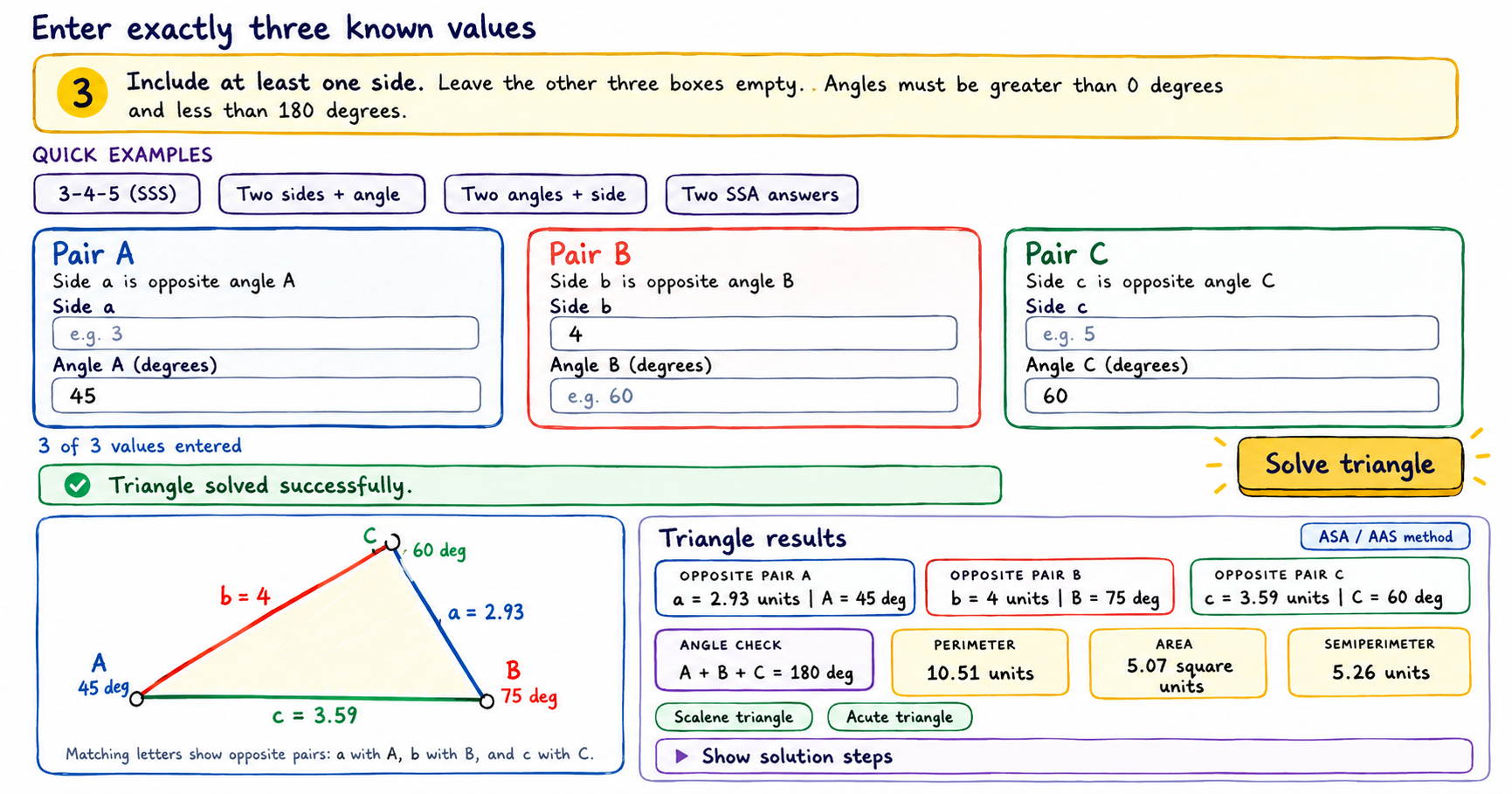
Use this interactive triangle calculator to enter three known measurements, solve the missing sides and angles, view a proportional diagram, and follow the calculation method.
How to use the triangle calculator
Enter exactly three known measurements and leave the other three boxes empty. At least one known measurement must be a side.
Match opposite pairs
Side a is opposite angle A, side b is opposite angle B, and side c is opposite angle C.
Enter three values
Use positive side lengths and angles between 0 and 180 degrees. Do not include units inside the boxes.
Solve the triangle
The calculator chooses SSS, SAS, ASA/AAS, or SSA and finds every valid solution.
Study the results
Compare the diagram, missing measurements, area, perimeter, classifications, and solution steps.
Triangle solving methods
SSS: three sides
Law of CosinesWhen all three sides are known, the calculator first checks the triangle inequality and then calculates the angles.
SAS: two sides and included angle
a2 = b2 + c2 – 2bc cos(A)The Law of Cosines finds the side opposite the known included angle.
ASA or AAS
a / sin(A) = b / sin(B) = c / sin(C)The third angle comes from the 180-degree angle sum, then the Law of Sines finds the missing sides.
SSA: two sides and a non-included angle
sin(B) = b sin(A) / aThis case may produce no triangle, one triangle, or two different valid triangles.
Worked 3-4-5 triangle example
Enter a = 3, b = 4, and c = 5. The three sides satisfy the triangle inequality.
The Law of Cosines gives A = 36.87 degrees, B = 53.13 degrees, and C = 90 degrees.
The perimeter is 12 units, and Heron’s formula gives an area of 6 square units. The result is a scalene right triangle.
Why can SSA have two answers?
In the SSA case, the given measurements may allow a side to swing into two different positions. For example, a = 7, b = 10, and A = 30 degrees create two valid triangles. The calculator displays Solution 1 and Solution 2 so both diagrams and measurements can be compared.
Understanding the calculated results
Perimeter
The perimeter is the total distance around the triangle: a + b + c.
Area
The calculator uses Heron’s formula after all three side lengths are known.
Side classification
A triangle can be equilateral, isosceles, or scalene according to the equality of its sides.
Angle classification
A triangle is acute, right, or obtuse according to its largest angle.
Triangle calculator practice ideas
- Solve the 3-4-5 example and explain why it is a right triangle.
- Enter three equal sides and observe the angles and classifications.
- Compare the two solutions in the SSA quick example.
- Create an obtuse triangle using three side lengths.
- Predict the missing angle in an ASA example before solving it.
Frequently asked questions
How many values are needed to solve a triangle?
Three suitable measurements are generally needed, including at least one side. Three angles alone determine the shape but not the size.
Why must side a be opposite angle A?
This is standard triangle notation. Each lowercase side is paired with the uppercase angle at the opposite vertex.
Why are my three side lengths invalid?
The sum of any two sides must be greater than the third side. Otherwise, the sides cannot close to form a triangle.
Can a triangle calculator return two answers?
Yes. Some SSA measurements create two valid triangles because the inverse sine calculation has two possible angles.
What units should I use?
You may use any consistent length unit. The perimeter uses that unit, and the area uses the corresponding square unit.
This article offers clear idea in support of the new viewers of blogging, that truly how to do blogging and site-building.