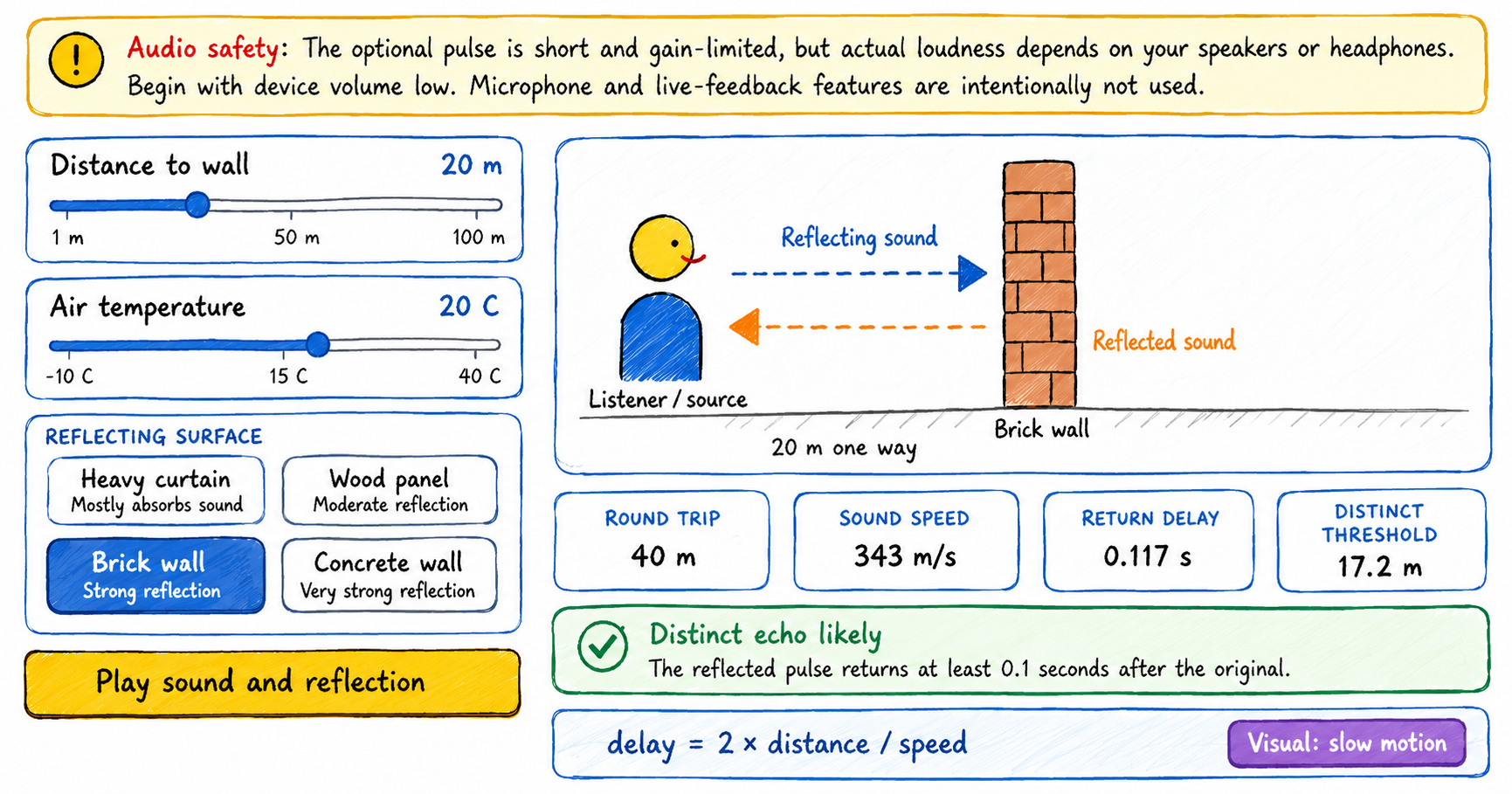
Use this interactive echo simulator to change the distance to a wall, air temperature, and reflecting surface, then observe the outgoing sound and its returning reflection.
How to use the echo simulator
Choose the distance
Move the distance slider to place the reflecting wall from 1 to 100 metres away.
Set the air temperature
Change temperature and observe the small change in sound speed and return time.
Choose a surface
Compare curtain, wood, brick, and concrete. The surface changes reflection strength rather than travel time.
Launch the sound
Keep device volume low, then play the short pulse. Use slow motion to follow the wave visually.
How echo delay is calculated
The sound travels from the listener to the wall and then back again. Therefore, the total path is twice the one-way distance.
Echo delay = (2 x distance to wall) / speed of soundAt 20°C, the simulator uses a sound speed of approximately 343 m/s. A wall 20 m away gives a 40 m round trip and a delay of approximately 0.117 seconds.
When does a reflection become a distinct echo?
A common classroom approximation says a reflected sound becomes separately noticeable when it returns about 0.1 seconds after the original. At 20°C, this corresponds to a wall about 17.15 m away. A closer wall still reflects sound, but the reflection generally overlaps the original and contributes to reverberation rather than a clearly separated echo.
How temperature affects the speed of sound
For the temperature range in this activity, the simulator uses the classroom approximation:
Speed of sound = 331 + 0.6 x temperature in °CWarmer air gives a slightly higher sound speed. At the same wall distance, the reflected pulse therefore returns slightly sooner in warm air than in cold air.
How surfaces affect echoes
Absorbing surfaces
Heavy curtains and soft furnishings absorb more sound energy, producing a weaker reflection.
Hard surfaces
Brick and concrete reflect more sound energy and can produce stronger, clearer echoes.
Travel time
Changing only the surface does not change the round-trip distance, so the calculated delay stays the same.
Real environments
Wall size, shape, texture, angle, air absorption, and competing sounds also influence the echo heard in practice.
Worked echo example
A person stands 30 m from a cliff at 20°C.
The sound travels 60 m for the complete outward and return journey.
Delay = 60 / 343 = approximately 0.175 seconds.
Because this exceeds 0.1 seconds, a separate echo is likely if the reflection is strong enough.
Learn more about echoes
For a fuller explanation of sound reflection, echo formation, reverberation, and everyday examples, read What Is an Echo and How Does It Work?
Frequently asked questions
Why is the distance doubled?
The entered distance is only from the source to the wall. The reflected sound must travel that distance again to return to the listener.
Does a wall closer than 17 m produce no reflection?
It still produces a reflection. The delay is simply too short for the reflection to be easily separated from the original sound under the classroom 0.1-second approximation.
Why does concrete make a stronger echo than a curtain?
Hard concrete reflects a larger share of incident sound energy, while a heavy curtain absorbs more of it.
Does temperature affect echo distance?
Temperature changes sound speed. The distance itself does not change, but the travel time and approximate distinct-echo threshold change slightly.
Why was live microphone echo removed?
Sending a microphone directly to nearby speakers can create loud acoustic feedback. The short generated pulse demonstrates timing more safely and consistently.