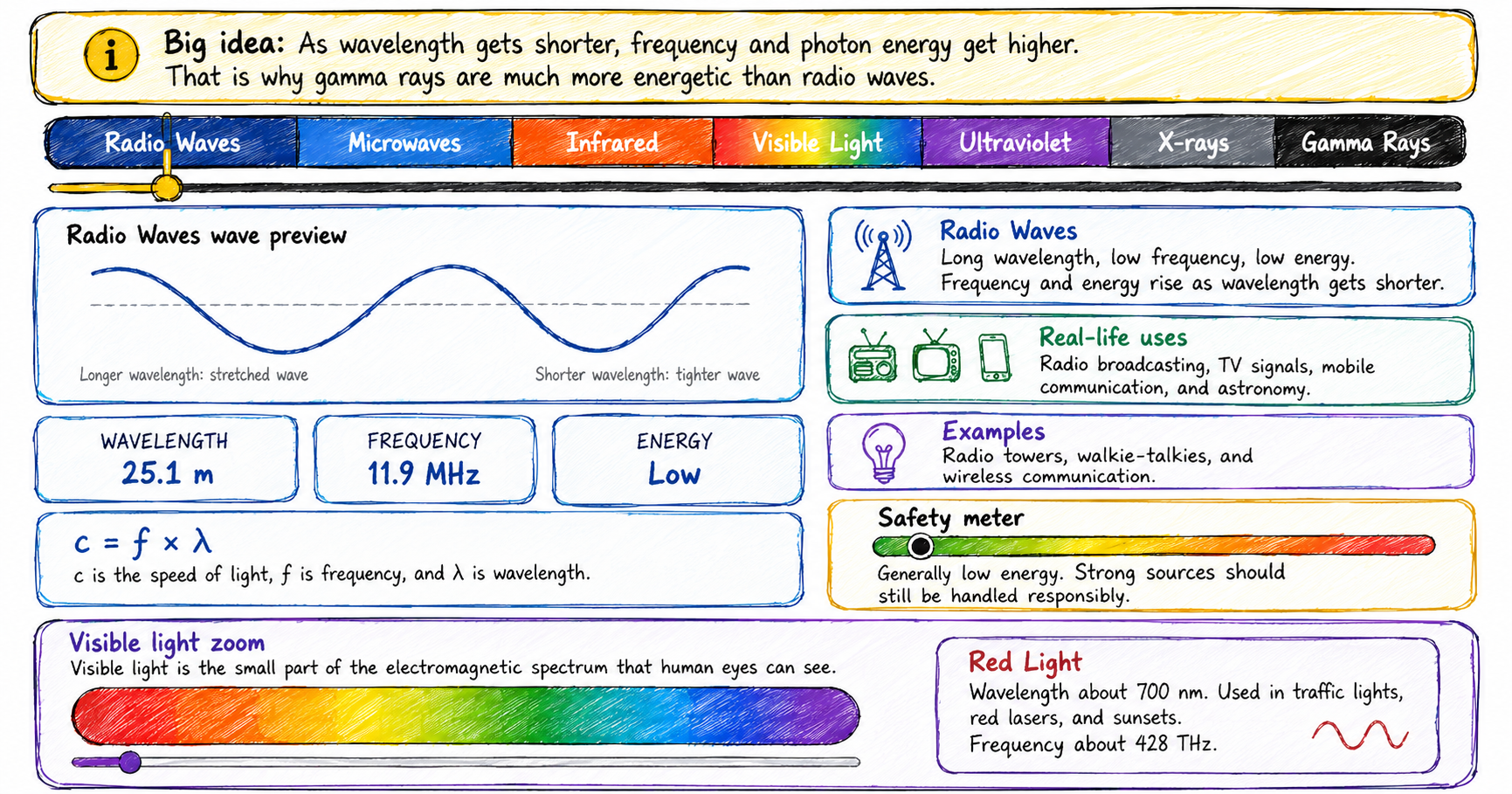
Use this electromagnetic spectrum explorer to slide from radio waves to gamma rays. Watch wavelength, frequency, photon energy, examples, uses, and safety ideas update in real time.
How to use the electromagnetic spectrum explorer
Drag across the spectrum
Move the slider from radio waves to gamma rays. The selected wave type changes on the colorful bar.
Compare the numbers
Watch wavelength get smaller while frequency and energy get larger.
Look at the wave
The animated preview stretches for long wavelengths and becomes tightly packed for short wavelengths.
Zoom into visible light
Use the visible light slider to compare red, orange, yellow, green, blue, and violet light.
Core idea
The electromagnetic spectrum is a family of waves that all travel at the speed of light in a vacuum. Long wavelengths have lower frequency and lower energy. Short wavelengths have higher frequency and higher energy.
Formula used
Wave relationship
c = f × λc is the speed of light, f is frequency, and λ is wavelength.
What it means
If wavelength becomes shorter, frequency must become larger because the speed of light stays the same.
Real-life uses across the spectrum
| Spectrum region | Examples and uses |
|---|---|
| Radio waves | Radio broadcasting, TV signals, and long-distance communication. |
| Microwaves | Microwave ovens, radar, Wi-Fi, and satellite communication. |
| Infrared | Remote controls, heat cameras, night vision, and warmth from hot objects. |
| Visible light | Human vision, cameras, photosynthesis, screens, and lamps. |
| Ultraviolet | Sterilization, tanning, detecting minerals, and black lights. |
| X-rays | Medical imaging, dental scans, airport scanners, and crystal studies. |
| Gamma rays | Cancer treatment, sterilizing equipment, nuclear reactions, and space events. |
Safety note for learners
Some waves carry more energy than others. Radio waves and visible light are usually low risk in everyday situations, while ultraviolet, X-rays, and gamma rays can damage living cells if exposure is too strong. High-energy waves are useful in science and medicine, but they must be handled carefully.
Frequently asked questions
What is the electromagnetic spectrum?
It is the complete range of electromagnetic waves, from long radio waves to very short gamma rays.
Why does frequency increase when wavelength decreases?
Electromagnetic waves travel at the speed of light, so a shorter wavelength means more wave cycles pass each second.
Where is visible light on the spectrum?
Visible light is a small section between infrared and ultraviolet. It includes red, orange, yellow, green, blue, and violet light.
Are all electromagnetic waves dangerous?
No. The risk depends on the wave energy and exposure amount. Higher-energy waves need more careful safety controls.