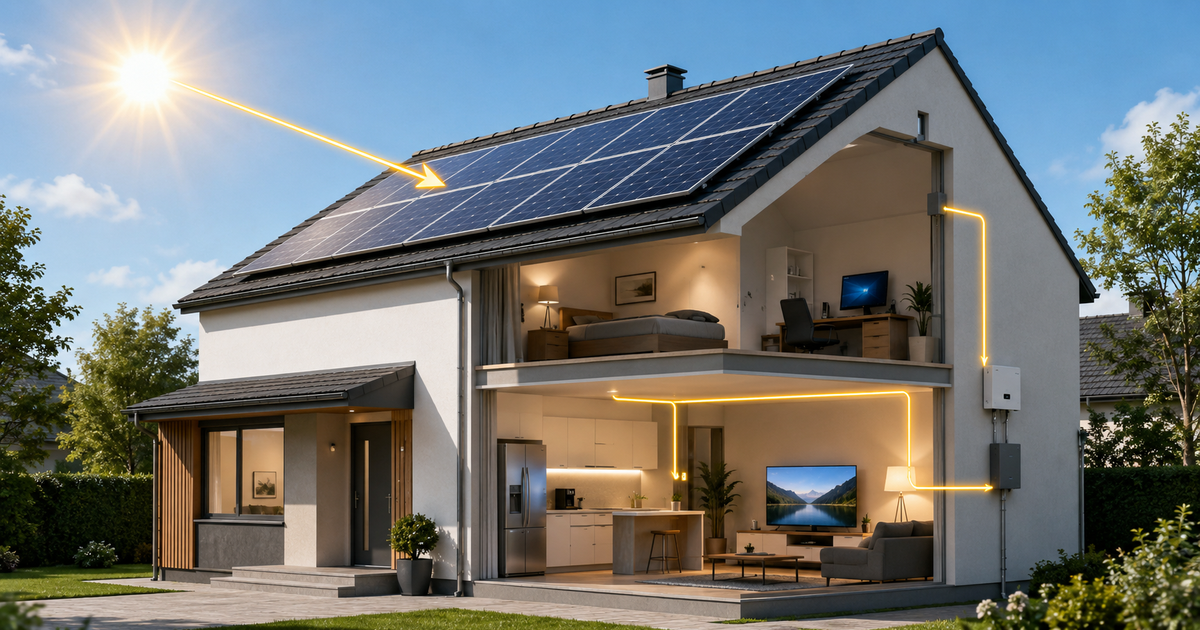
Have you ever wondered how sunlight can power a home, charge a battery, or even run a calculator? The answer lies in solar panels—devices that convert sunlight directly into electricity. Solar energy is one of the cleanest and most renewable sources of power available today.
What Is a Solar Panel?
A solar panel is a collection of many small units called solar cells. These cells are usually made from a material called silicon, which is a semiconductor. When sunlight strikes these cells, they produce an electric current.
The Science Behind Solar Panels
Solar panels work through a process called the photovoltaic effect.
The word “photovoltaic” comes from:
- Photo = light
- Voltaic = electricity
Photovoltaic effect works as follows:
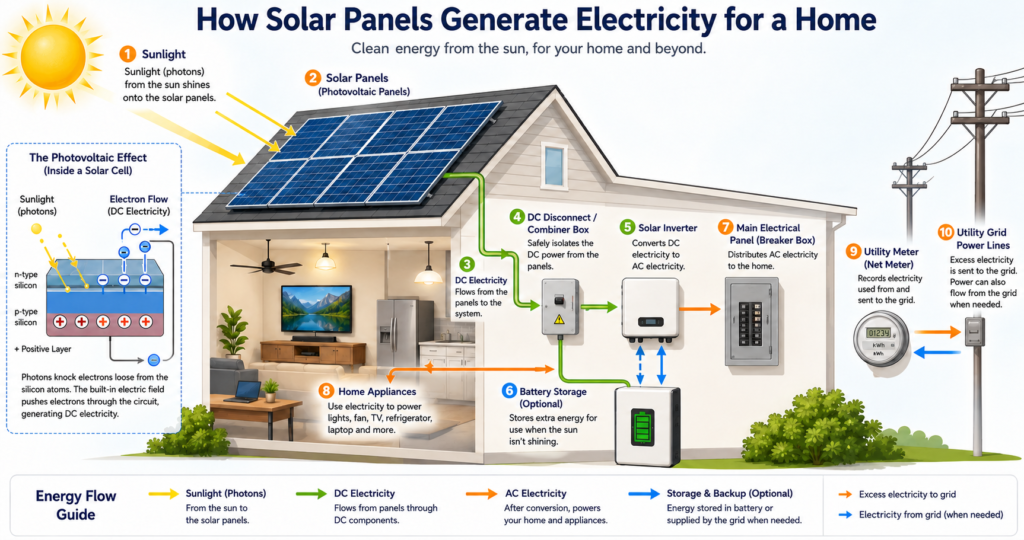
- Sunlight is made of tiny packets of energy called photons. When these photons strike a solar cell, they transfer their energy to the silicon atoms inside the cell.
- The incoming energy knocks some electrons loose from their atoms. These electrons begin to move freely within the solar cell.
- Solar cells are designed with an internal electric field that directs the movement of these free electrons. As electrons flow through the cell, an electric current is generated. This flow of electrons is electricity.
- Metal contacts on the solar cell collect the moving electrons and channel them into wires. The electricity can then be sent to power electrical devices.
Why Do Solar Cells Have Positive and Negative Layers?
A solar cell contains two specially treated layers of silicon:
- A negative (N-type) layer with extra electrons
- A positive (P-type) layer with fewer electrons
Where these layers meet, an electric field is created. This field acts like a one-way road that pushes electrons in a specific direction, allowing electricity to flow.
Why Inverters are used with Solar Panels?
The electricity produced by solar panels is called Direct Current (DC).
However, most homes use Alternating Current (AC) electricity (for more details on AC and DC Current, please refer to Understanding the basics of Electrical Circuit ). Therefore, solar power systems include a device called an inverter.
The inverter converts DC electricity into AC electricity so that household appliances can use the energy.
A modern solar inverter does more than just convert electricity. It can also manage how electricity moves through the system.
For example, it can help decide whether solar power should:
- Go directly to home appliances
- Charge a battery
- Be sent to the utility grid
- Be taken from the grid when solar power is not enough
What Happens on a Cloudy Day?
Solar panels work best in direct sunlight, but they can still generate electricity on cloudy days.
Clouds reduce the amount of sunlight reaching the panels, so electricity production decreases. However, modern solar panels are efficient enough to continue producing power even under less-than-perfect conditions.
Can Solar Panels Store Energy?
Solar panels themselves do not store electricity.
If energy storage is needed, the system can be connected to rechargeable batteries. During sunny periods, excess electricity charges the batteries. The stored energy can then be used at night or during power outages.
Advantages of Solar Energy
Solar energy offers many benefits:
- Renewable and sustainable source of power
- Produces no air pollution during operation
- Reduces electricity bills
- Requires relatively little maintenance
- Can be installed on rooftops and open land
Limitations of Solar Energy
Like all technologies, solar power has some challenges:
- Electricity production depends on sunlight
- Initial installation costs can be high
- Energy storage systems add extra expense
- Large-scale solar farms require significant land area
Interesting Facts About Solar Panels
☀️Sunlight reaching Earth in one hour contains more energy than humanity uses in an entire year.
☀️ Some spacecraft use solar panels as their primary power source.
☀️ The first practical silicon solar cell was developed in the 1950s.
☀️ Modern solar panels can often last 25 years or more.
Conclusion
Solar panels generate electricity using the photovoltaic effect. When sunlight strikes a solar cell, photons energize electrons inside silicon, causing them to flow and create an electric current. This electricity can then be used to power homes, schools, businesses, and even spacecraft. As technology continues to improve, solar energy is becoming an increasingly important part of the world’s clean energy future.