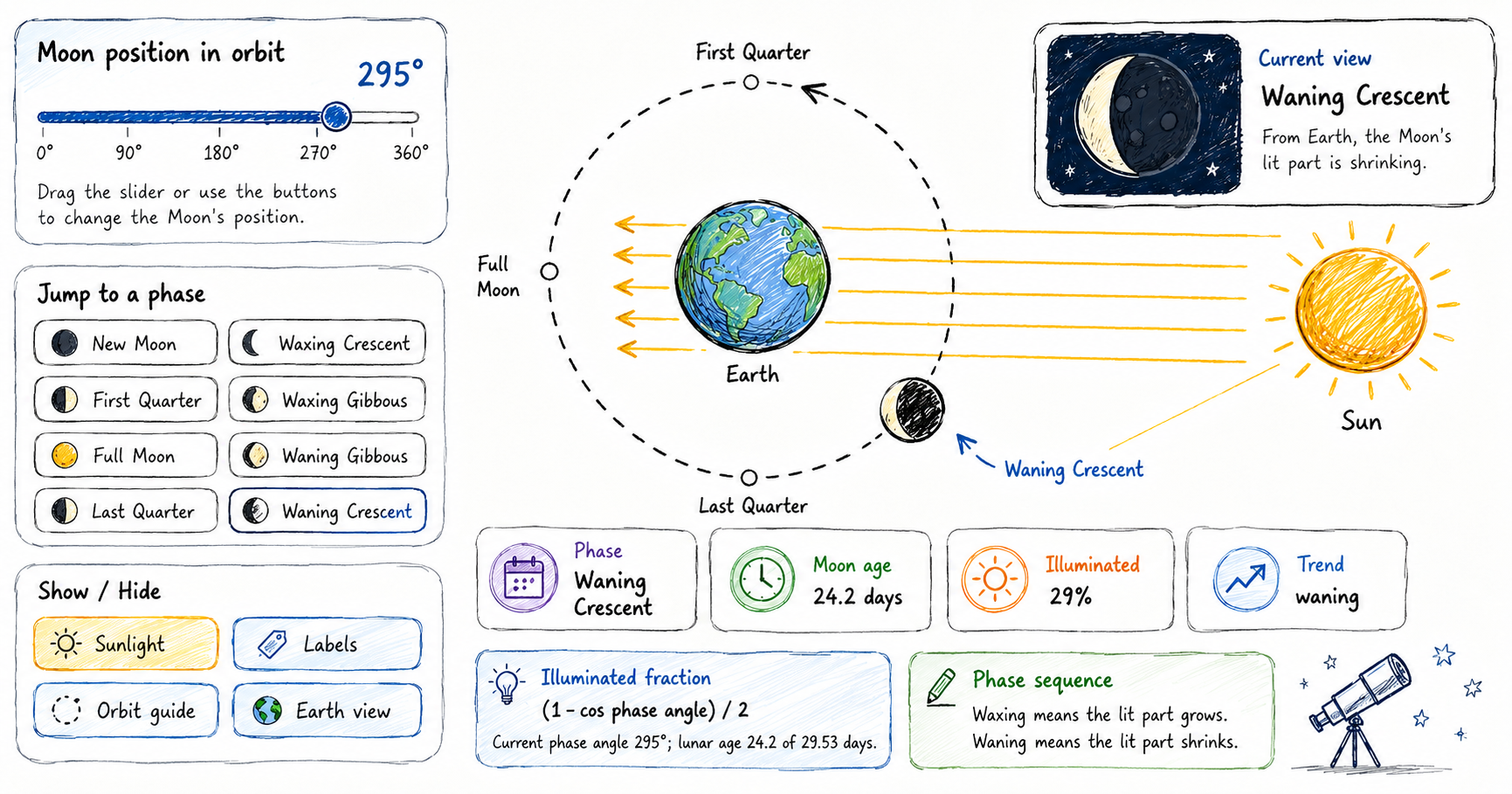
Use this moon phases learning tool to see why the Moon appears to change shape during a lunar month. Drag the Moon around Earth and compare New Moon, waxing crescent, First Quarter, waxing gibbous, Full Moon, waning gibbous, Last Quarter, and waning crescent.
How to use the moon phases learning tool
Drag the Moon
Move the Moon around Earth and watch the view from Earth change at the same time.
Use phase buttons
Jump to New Moon, First Quarter, Full Moon, Last Quarter, or an in-between crescent or gibbous phase.
Compare waxing and waning
Waxing means the visible lit part is growing. Waning means the visible lit part is shrinking.
Check tonight
Enter a city for a quick tonight estimate, or open live Timeanddate details for local moonrise and phase information.
Why does the Moon have phases?
The Moon does not make its own light. It reflects sunlight. One half of the Moon is always lit by the Sun, but as the Moon orbits Earth, we see different amounts of that lit half. In the top-down model, the Moon revolves counter clockwise around Earth. Because the Moon is tidally locked, observers on Earth see nearly the same side of the Moon throughout the month.
Waxing crescent
After New Moon, a small bright crescent appears and grows larger each night.
First Quarter
The Moon is about one quarter through its cycle and looks half lit from Earth.
Full Moon
The side of the Moon facing Earth is almost completely sunlit.
Last Quarter
The Moon is about three quarters through the cycle and looks half lit again.
About the model
This simulator is not drawn to scale. It shows the Sun to the right and the Moon’s orbit from above Earth’s north pole. The Moon phase disk uses the common Northern Hemisphere view: the right side is lit during waxing phases and the left side is lit during waning phases. The real Moon’s orbit is tilted and slightly elliptical, but this simplified model correctly shows the main Sun-Earth-Moon geometry that causes phases.
How to check tonight’s Moon phase
The tool includes a quick tonight estimate based on the user’s local date and time. Since exact moonrise, moonset, and local observing details depend on location, the live lookup button opens Timeanddate Moon Phases, which provides current Moon phase and city-specific lunar calendars.
Frequently asked questions
Why is New Moon included?
New Moon is the beginning of the standard eight-phase sequence, so it is included even when a short phase list starts with waxing crescent.
What does waxing mean?
Waxing means the visible illuminated part of the Moon is increasing from New Moon toward Full Moon.
What does waning mean?
Waning means the visible illuminated part is decreasing from Full Moon toward the next New Moon.
Why are quarter moons half lit?
The word quarter describes the Moon’s position in its monthly cycle, not the fraction of the disk that looks bright. First Quarter is about one quarter through the cycle, and Last Quarter is about three quarters through.
Do we always see the same side of the Moon?
Yes, nearly the same side faces Earth because the Moon’s rotation is synchronized with its orbit. Small wobbles called libration let observers see a little more than half over time.