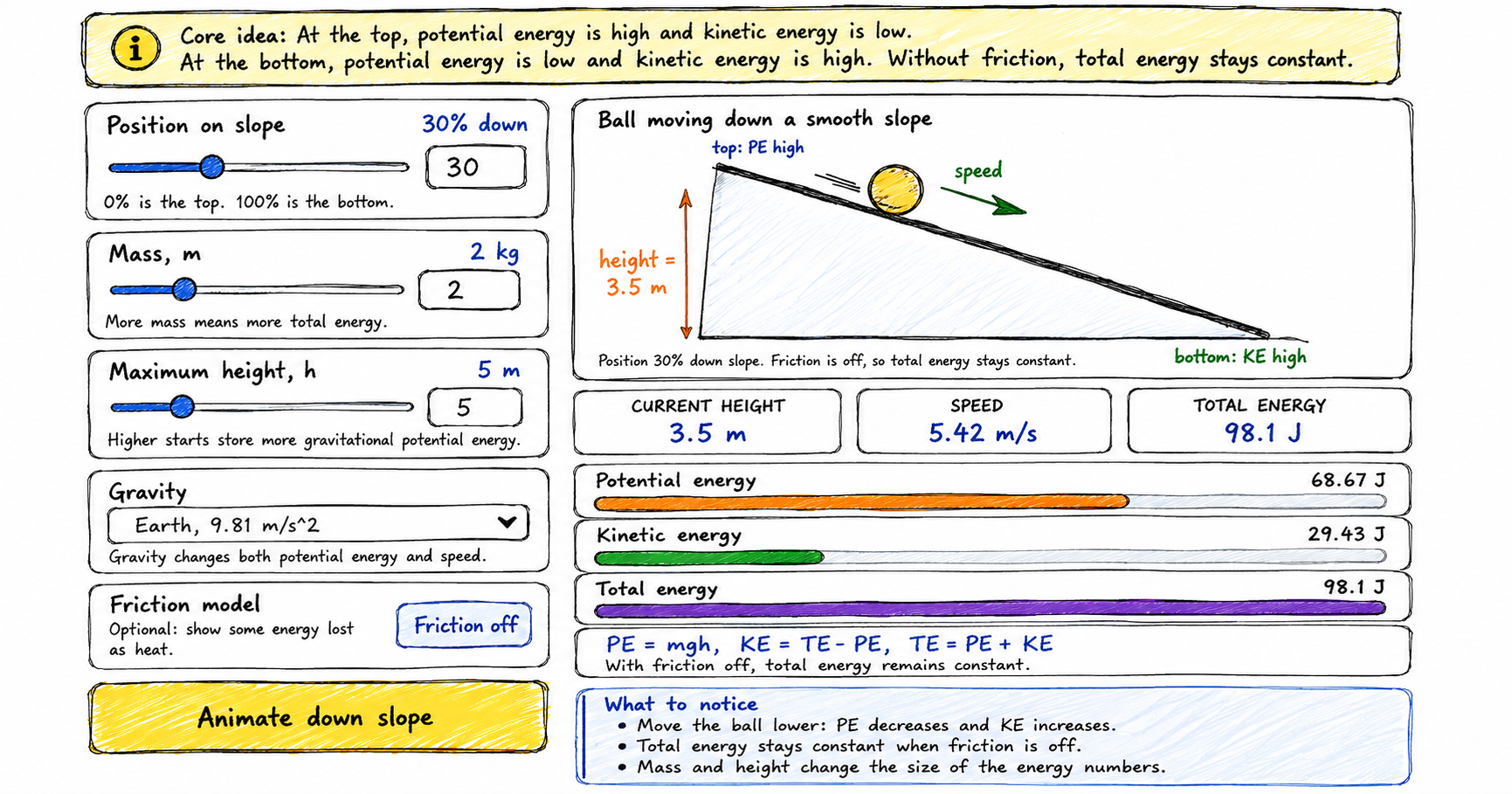
Use this potential and kinetic energy simulator to move a ball down a smooth slope. Watch height, speed, potential energy, kinetic energy, and total energy change together.
How to use the potential and kinetic energy simulator
Move the ball
Use the position slider to move the ball from the top of the slope to the bottom.
Watch the bars
Potential energy decreases as kinetic energy increases. With friction off, total energy stays constant.
Change mass and height
Increase mass or maximum height to increase the total amount of energy.
Try gravity and friction
Compare Earth, Moon, and Mars gravity, then turn friction on to show energy lost as heat.
Core idea
At the top of the slope, height and potential energy are high while speed and kinetic energy are low. At the bottom, height and potential energy are low while speed and kinetic energy are high. If friction is ignored, total energy remains constant.
Physics formulas used
Potential energy
PE = mghPotential energy depends on mass, gravity, and height.
Kinetic energy
KE = 1/2 mv2Kinetic energy depends on mass and speed.
Total energy
TE = PE + KETotal energy is the sum of potential and kinetic energy.
Frictionless motion
KE = TE – PEAs PE goes down, KE goes up by the same amount.
Ideas for practice
- Move the ball to the top, middle, and bottom. Compare PE and KE each time.
- Double the mass and notice that all energy values get larger.
- Increase the maximum height and watch the final speed increase.
- Turn friction on and explain why total mechanical energy becomes smaller.
Frequently asked questions
What is potential energy?
Potential energy is stored energy due to position. On a slope, a higher object has more gravitational potential energy.
What is kinetic energy?
Kinetic energy is energy of motion. A faster moving object has more kinetic energy.
Why does total energy stay constant?
When friction is ignored, energy changes form but is not lost. Potential energy becomes kinetic energy.
What happens when friction is turned on?
Some mechanical energy is shown as energy lost as heat, so PE plus KE becomes smaller than the starting total.