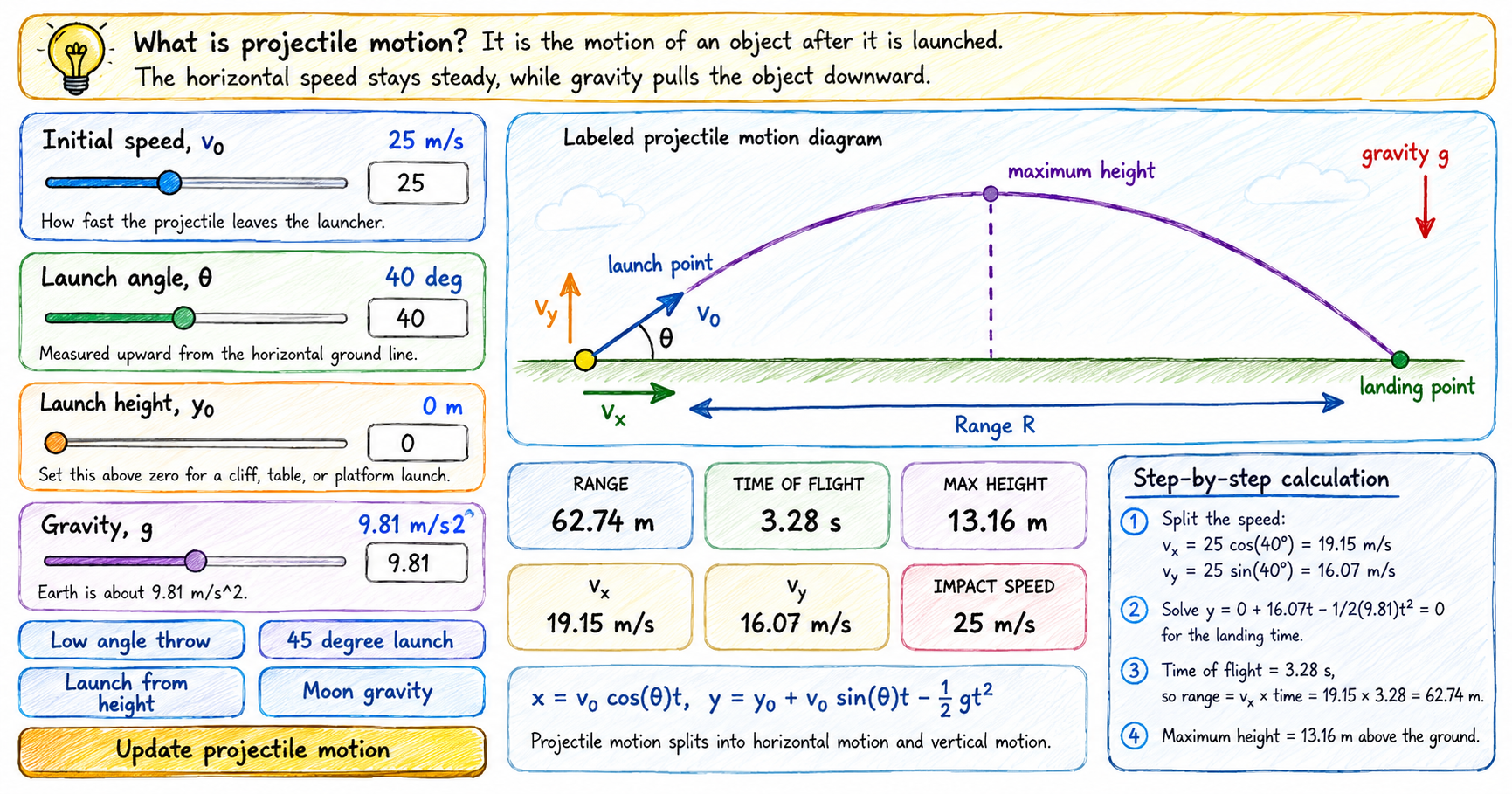
Use this projectile motion calculator to explore how launch speed, launch angle, starting height, and gravity affect the path of an object. The interactive diagram shows the trajectory, range, time of flight, maximum height, and velocity components.
How to use the projectile motion tool
Set the launch speed
Choose the initial speed v0. A faster launch usually makes the projectile travel farther and higher.
Change the angle θ
Move the launch angle slider and watch the path rotate. The blue v0 arrow stays tangent to the trajectory.
Try a starting height
Set y0 above zero to model a launch from a table, platform, hill, or cliff.
Read the results
Compare range, time of flight, maximum height, vx, vy, and impact speed.
What is projectile motion?
Projectile motion is the motion of an object after it is launched. In this learning model, air resistance is ignored. That means the horizontal velocity stays constant while gravity changes the vertical velocity.
Symbols used in the calculator
Initial speed v0
This is how fast the object is moving at the moment it is launched.
Launch angle θ
The angle is measured upward from the horizontal ground line.
Velocity components
vx is the horizontal velocity. vy is the vertical velocity.
Gravity g
On Earth, gravity is about 9.81 m/s2. A smaller value makes the projectile stay in the air longer.
Projectile motion formulas used
Horizontal position
x = v0 cos(θ)tHorizontal motion uses the steady velocity component vx.
Vertical position
y = y0 + v0 sin(θ)t – 1/2 gt2Vertical motion includes gravity pulling downward.
Horizontal velocity
vx = v0 cos(θ)This stays constant when air resistance is ignored.
Vertical velocity
vy = v0 sin(θ)This changes during flight because of gravity.
Worked projectile motion example
Suppose a ball is launched at 25 m/s with an angle of 40° from ground level.
The calculator splits the launch speed into components: vx ≈ 19.15 m/s and vy ≈ 16.07 m/s.
With Earth gravity, the ball stays in the air for about 3.28 s, reaches about 13.16 m high, and lands about 62.74 m away.
Why the launch angle matters
A lower launch angle sends more of the motion forward. A higher launch angle sends more of the motion upward. The best angle depends on whether the goal is to reach a tall height, travel far, or land from a raised starting point.
Frequently asked questions
Does this projectile motion calculator include air resistance?
No. It uses the standard beginner model where air resistance is ignored.
What is range in projectile motion?
Range is the horizontal distance from the launch point to the landing point.
What is time of flight?
Time of flight is the total time the projectile stays in the air before landing.
Why does the path curve?
The horizontal motion keeps moving forward while gravity pulls downward. The combination creates a curved path.
Why does changing gravity affect the result?
Stronger gravity pulls the projectile down faster. Weaker gravity lets it stay in the air longer and usually travel farther.