
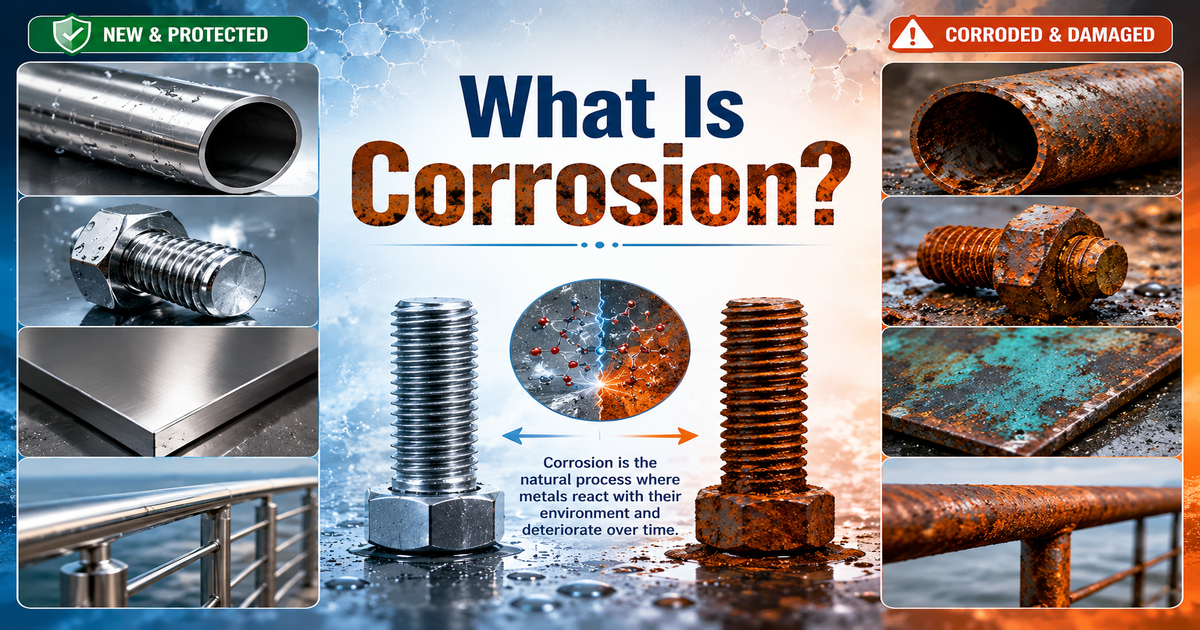
Have you ever seen an old bicycle with reddish-brown spots? Or maybe a rusty iron gate after heavy rain? That reddish material is called corrosion. Corrosion forms when certain metals react with air and water over time.
Let’s explore why some metals corrode and why others do not!
What Is Corrosion?
Corrosion is the slow damage or wearing away of a metal caused by chemical reactions with substances in the environment, such as air, water, or chemicals. It can weaken metals over time and change their appearance. Rusting is one type of corrosion that happens mainly to iron and steel.
Rust is a type of chemical change called oxidation. This happens when iron reacts either with oxygen from air or with water or moisture.
The reaction slowly changes strong metal into weak, crumbly rust.
How Does Corrosion Form?
When iron is exposed to air and water for a long time, a chemical reaction takes place.
The basic reaction can be shown as:
This eventually changes into rust, also known as hydrated iron oxide.
Step-by-Step Process
- Water reaches the metal surface.
- Oxygen from the air mixes with the water.
- Iron atoms react with oxygen.
- Rust slowly forms on the surface.
This process can continue deeper into the metal, damaging it over time.
Why Do Only Some Metals Corrode?
Not all metals corrode because different metals react differently with air and water.
Rust mainly happens to iron or those materials that contains iron such as steel, cast iron, wrought iron. These material react with oxygen and water to form rust.
Metals That Do Not Corrode Easily
The following metals do not form rust like iron does:
- Aluminum
- Copper
- Gold
- Silver
- Platinum
- Titanium
- Zinc
- Nickel
- Chromium
Some of these metals may still react slowly with air, but they do not produce the reddish-brown rust seen on iron.
The above metals do not corrode because of one of the followng reasons:
- They form a thin protective layer on their surface that stops oxygen and water from reaching the metal underneath. For example, aluminum quickly forms a strong oxide coating that protects it from further damage.
- Some metals do not react easily with air or water. Gold and platinum comes under this category and do not easily react with air or water.
How Can We Prevent Corrosion?
There are many ways to protect metals from corrosion.
- Paint blocks air and water from touching the metal therefore no chemical reaction takes place between metal and air or between metal and water.
- Oil creates a protective barrier on the surface between metal surface and air / water.
- Keeping metal dry slows down the rate of rusting. Hence metal can remain corrosion free for a long period of time.
- Sometimes the chromium is added to the iron and the mixture is commonly known as stainless steel. The chromium gives the steel its rust-resistant property by forming a protective layer on the surface.
Difference Between Rust and Corrosion
Rust and corrosion are related, but they are not exactly the same thing. Corrosion is the general process in which metals slowly get damaged by reacting with air, water, or chemicals in the environment. Rust is a special type of corrosion that happens only to iron and metals containing iron, such as steel, cast iron, wrought iron etc. While rust forms a reddish-brown coating, other metals may corrode in different ways. For example, copper develops a green layer, and silver becomes tarnished and dark.
Conclusion
Corrosion forms when metal reacts with oxygen and water. Some metals rust because they contain iron, while others resist corrosion due to protective surface layers.
Understanding corrosion helps us protect buildings, vehicles, and tools so they last longer and stay safe to use.