
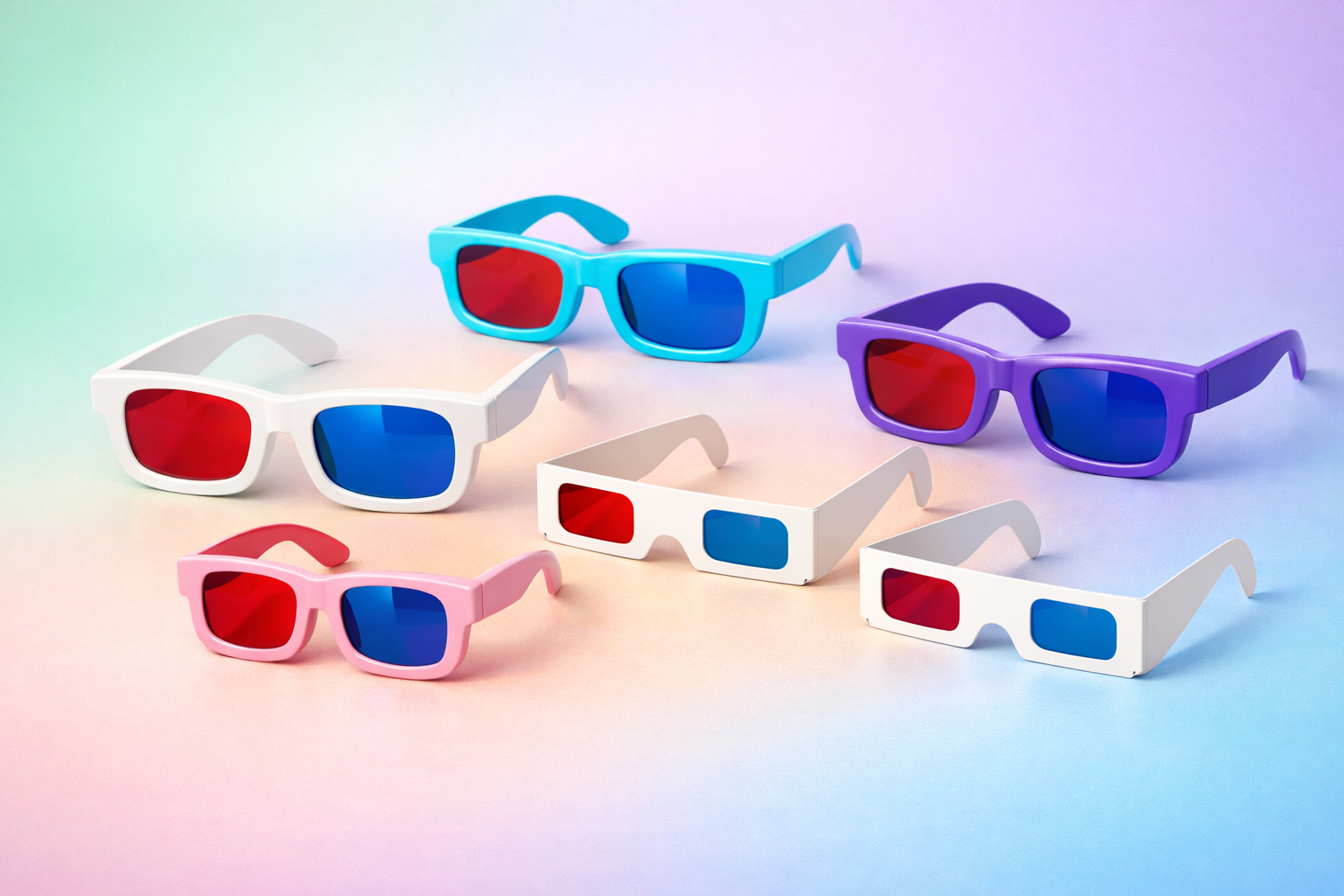
Have you ever watched a movie where objects seem to jump out of the screen or feel as if they are far away in the background? This exciting visual effect is made possible by 3D glasses. These special glasses help our brains see images in three dimensions, making movies more immersive and realistic—just like real life.
Let’s explore what 3D glasses are, why cinemas use them, and how they create a sense of depth.
What Are 3D Glasses?
3D glasses are specially designed eyewear used in cinemas to allow viewers to see images in three dimensions. Unlike normal glasses, they work together with specially projected movies to trick our eyes and brain into seeing depth—making flat images on a screen appear closer, farther, or layered in space.
Why Are 3D Glasses Used in Cinemas?
Our eyes are about 6–7 cm apart, and each eye sees the world from a slightly different angle. This small difference is called binocular vision, and it helps our brain understand depth and distance.
Cinemas use 3D glasses because they:
- Enhance realism and immersion
- Make action scenes more exciting
- Create a “you are inside the movie” feeling
- Help viewers better understand depth, distance, and movement
Without 3D glasses, 3D movies would look blurry or doubled.
How Do 3D Glasses Create a Sense of Depth?
In a 3D movie, two slightly different images are projected onto the screen at the same time:
- One image is meant for the left eye
- The other image is meant for the right eye
The images are almost identical but shifted slightly—just like how our eyes naturally see the world.
3D glasses make sure that the left eye sees only the left image and the right eye sees only the right image
This separation is done using different technologies such as:
- Polarized lenses (used in most modern cinemas)
- Color filtering (red–blue or red–cyan glasses)
- Active shutter lenses (electronically controlled)
Once each eye receives its correct image, the brain:
- Combines both images
- Calculates the differences between them
- Creates a single 3D image with depth
This process is called stereoscopic vision.
As a result, objects can appear:
- Very close to your face
- Deep inside the screen
- Floating in mid-air
Why Some Objects “Pop Out” of the Screen?
When the difference between the left and right images is large, the brain interprets the object as being very close. When the difference is small, the object appears far away. Filmmakers use this effect creatively to make scenes more thrilling and realistic.
3D glasses turn ordinary flat images into breathtaking experiences by mimicking how our eyes naturally see depth. By delivering different images to each eye and letting the brain combine them, 3D movies come alive—making cinema more exciting, immersive, and memorable.
The next time you wear 3D glasses in a theater, remember:
You’re not just watching a movie—you’re experiencing science in action!