Explore Euclid’s theorems with interactive diagrams. Drag points, change measurements, and observe which geometric relationships remain true.
How to use the Euclid’s theorems explorer
Choose a theorem
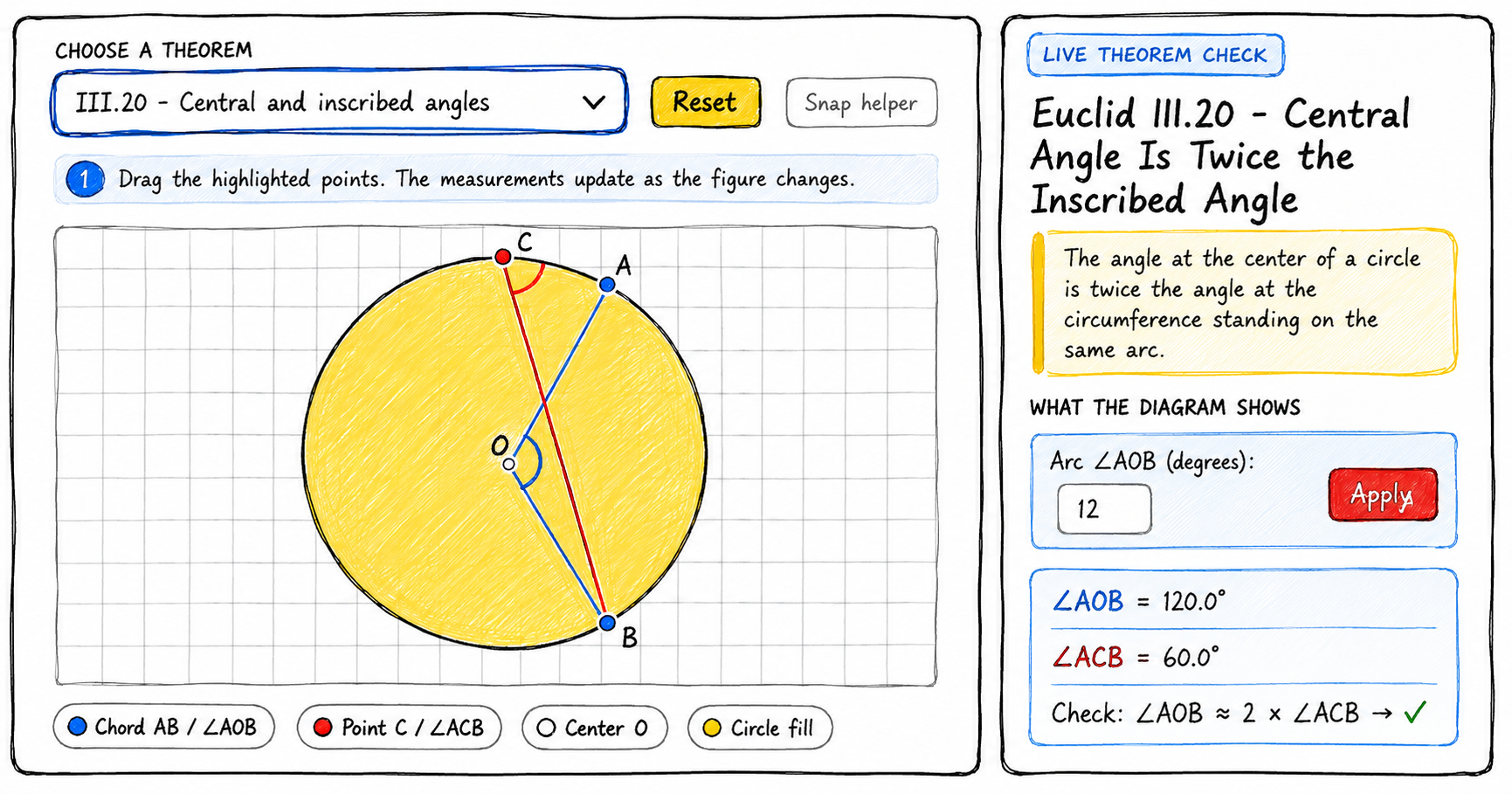
Open the theorem menu and select a result from Book I or Book III of Euclid’s Elements.
Move the points
Drag the colored points on the diagram. Some points move freely, while others stay on a line or circle.
Watch the measurements
Compare the live lengths and angles with the theorem statement. Look for the relationship that does not change.
Check the reasoning
Open Why it works for a short proof sketch, or use Reset and Snap helper to begin a new experiment.
Book I: lines, angles, triangles, and parallelograms
The Book I activities introduce foundational relationships used throughout plane geometry.
Angles and parallel lines
- I.13: adjacent angles on a straight line
- I.15: vertical opposite angles
- I.29: alternate interior angles
Triangles
- I.5: base angles of an isosceles triangle
- I.20: triangle inequality
- I.32: interior and exterior angle results
- I.47: Pythagorean theorem
Parallelograms
Proposition I.34 explores equal opposite sides, equal opposite angles, and the two equal triangles formed by a diagonal.
What to observe
Change a diagram substantially. A theorem describes the equality, sum, or inequality that remains valid through every permitted change.
Book III: interactive circle theorems
The circle activities connect radii, tangents, chords, arcs, central angles, and inscribed angles.
Chords and inscribed angles
- III.14: equal chords and distance from the center
- III.20: central and inscribed angles
- III.21: angles in the same segment
- III.31: semicircle and segment angle results
Tangents
- III.18: radius perpendicular to a tangent
- III.32: tangent-chord theorem
- A demonstration based on the tangent construction in III.17
Why the proposition numbers matter
The explorer pairs familiar modern theorem names with proposition numbers from The Elements. The number identifies the original location of the result. One external-tangent demonstration is labeled based on III.17 because it combines Euclid’s construction with the modern observation that two tangent lines pass through an external point.
Geometry exploration challenges
- Make an isosceles triangle taller and flatter. What remains equal?
- Move a triangle vertex and check whether the three interior angles still total 180 degrees.
- Change both equal chords while keeping them the same distance from the center.
- Move two points through the same circle segment and compare their inscribed angles.
- Predict the tangent-chord angle before reading the live measurement.
Frequently asked questions
What are Euclid’s theorems?
They are geometric propositions developed from definitions, postulates, common notions, and earlier results in Euclid’s Elements. The work covers much more than the selected theorems in this explorer.
Does moving a point prove a theorem?
No. An interactive diagram helps you discover and test a pattern, but a mathematical proof explains why the result must hold for every valid case.
Why can some points move only on a circle or line?
Those constraints preserve the conditions of the selected theorem. For example, an inscribed-angle point must remain on the circumference.
What does Snap helper do?
It restores or creates a useful exact arrangement for the selected activity. Some demonstrations do not need a snap arrangement, so the button is disabled.
Which school topics does this tool support?
It supports lessons on angle relationships, triangle properties, parallel lines, the Pythagorean theorem, parallelograms, and common circle theorems.
This widget is licensed under the MIT License — see the LICENSE file for details.