

You might have wondered why leaves are green, apples are red, crows are black. In short, why different objects have different colors?
The colors we see are the result of light, objects, and our eyes working together.
When white light (such as sunlight) hits the surface of an object, then depending upon the nature of an object, it happens that the object absorbs some of the wavelengths and reflect some others. Those wavelengths of light that are reflected off by the objects then enters our eyes. Our eyes have special cells called cones that help us see colors corresponding to the reflected wavelengths.
Take for example leaves, when white light (typically sunlight) hit upon leaves, it absorbs all the wavelengths and only reflect the wavelength corresponding to green color. That’s why we leaves appear to be green.
Similarly if you have a bicycle whose color is blue, then the paint done on that bicycle have the characteristics that it reflects blue light and absorb light of all other wavelengths.
Light and the Visible Electromagnetic Spectrum
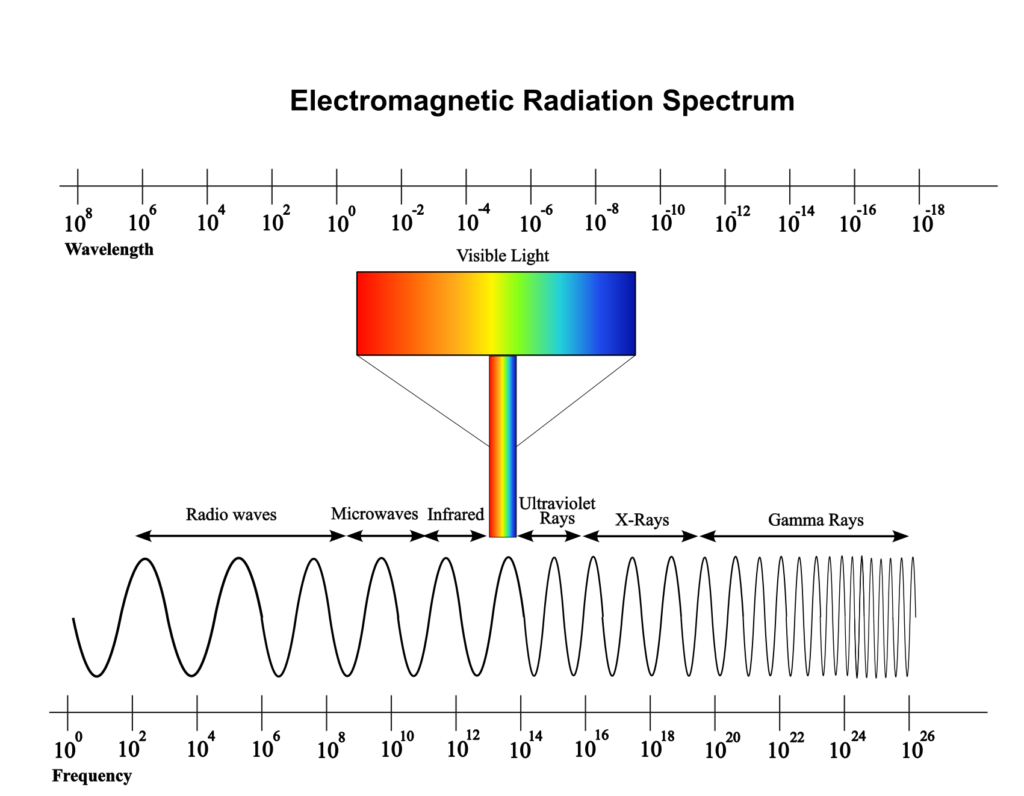
Light is actually a small part of a much larger family called the electromagnetic spectrum. This spectrum includes many types of energy waves, such as radio waves, microwaves, infrared rays, ultraviolet rays, X-rays, and gamma rays. Our eyes can only detect a tiny portion of this spectrum, known as visible light. Visible light ranges from red (with longer wavelengths) to violet (with shorter wavelengths). All the colors we see—whether in a rainbow or on everyday objects—come from this narrow band of the electromagnetic spectrum.
Next time whenever you see an object of any color, you may appreciate the fact that it is really a reflected light of particular color coming off from that object.