
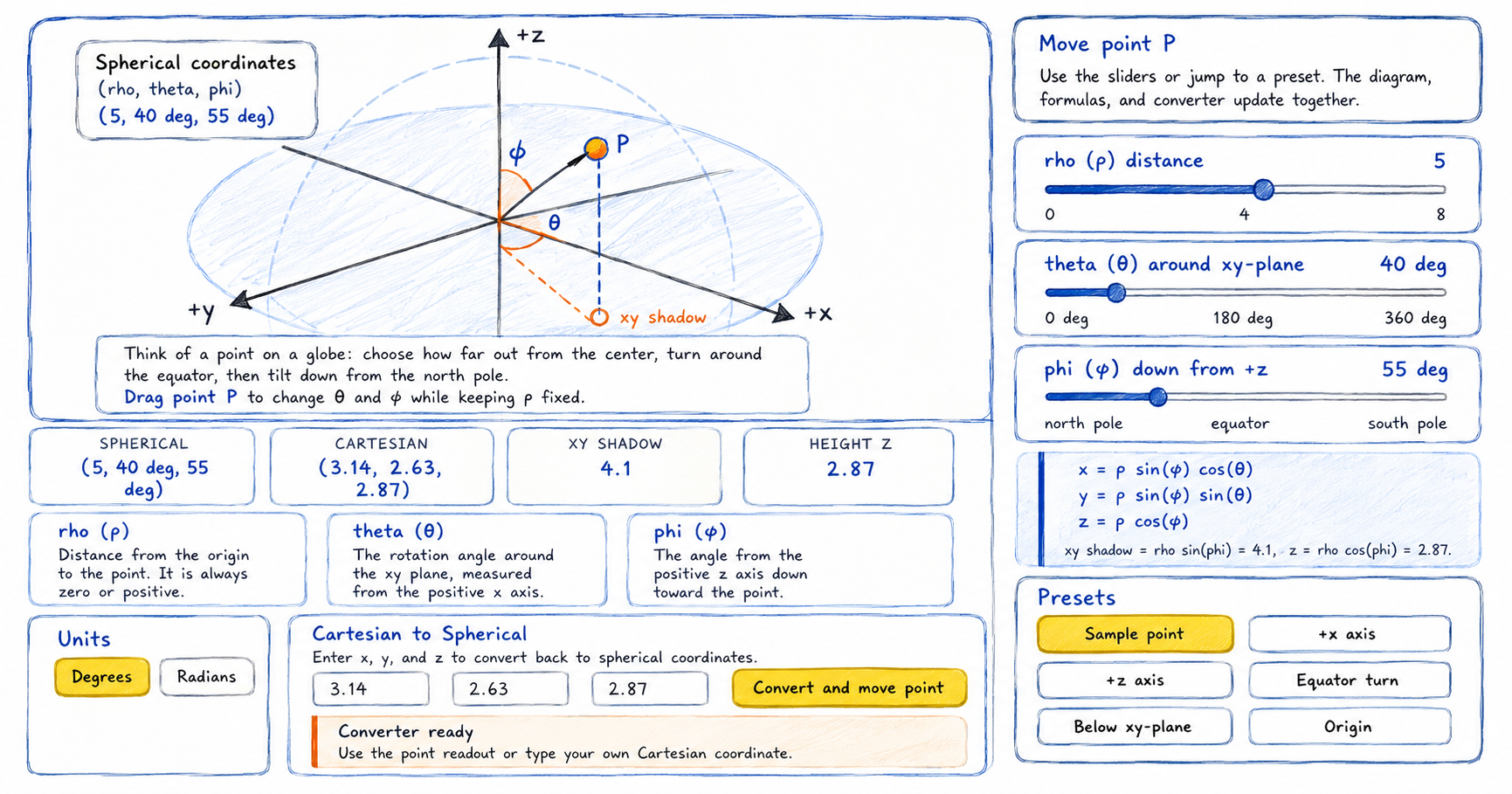
Explore spherical coordinates with an interactive 3D-style diagram. Drag point P, compare spherical and Cartesian coordinates, and learn how rho (ρ), theta (θ), and phi (φ) describe a point in space.
How to use the spherical coordinates interactive tool
This activity extends the idea of polar coordinates into 3D space. Instead of only radius and angle on a flat plane, spherical coordinates add a second angle for height.
Set rho (ρ)
Move the rho slider to choose how far point P is from the origin.
Turn theta (θ)
Use theta to rotate the point around the xy-plane, starting from the positive x-axis. You can also drag point P on the diagram to change theta.
Change phi (φ)
Use phi to move down from the positive z-axis toward the equator and then below the xy-plane. Dragging point P changes phi too.
Convert coordinates
Compare spherical and Cartesian coordinates, then enter x, y, and z values to convert back.
What are spherical coordinates?
Spherical coordinates describe a point in three-dimensional space using one distance and two angles. The convention used here is common in mathematics courses:
rho (ρ)
rho is the distance from the origin to the point. It works like the radius in polar coordinates, but in 3D.
theta (θ)
theta is the angle around the xy-plane, measured from the positive x-axis.
phi (φ)
phi is measured down from the positive z-axis. A point on +z has phi = 0, while a point on the xy-plane has phi = 90 degrees.
xy shadow
The shadow of the point on the xy-plane has length rho sin(phi). That shadow then behaves like a polar coordinate radius.
Spherical to Cartesian formulas
First find the xy shadow using rho sin(phi). Then split that shadow into x and y using the same cosine and sine idea from polar coordinates. The height is rho cos(phi).
Ideas for practice
- Keep rho fixed and move phi from 0 degrees to 180 degrees. Describe how point P moves from top to bottom.
- Set phi to 90 degrees and change theta. Notice that the point stays on the xy-plane.
- Compare the +x axis preset and +z axis preset. Which angle changes the height?
- Switch to radians and connect 90 degrees with pi/2 radians.
- Enter Cartesian point (3, 4, 0) and compare it to polar coordinates in the xy-plane.
Frequently asked questions
Is rho the same as radius?
Yes. rho is the 3D distance from the origin to the point.
Why are there two angles?
One angle turns around the xy-plane, and the other angle controls how far the point is above or below that plane.
Why is phi measured from the z-axis?
This is a common mathematics convention. Some subjects use a different convention, so always check how theta and phi are defined.
What happens at the origin?
At the origin, rho is zero. The angles do not identify a unique direction because every direction reaches the same point.