
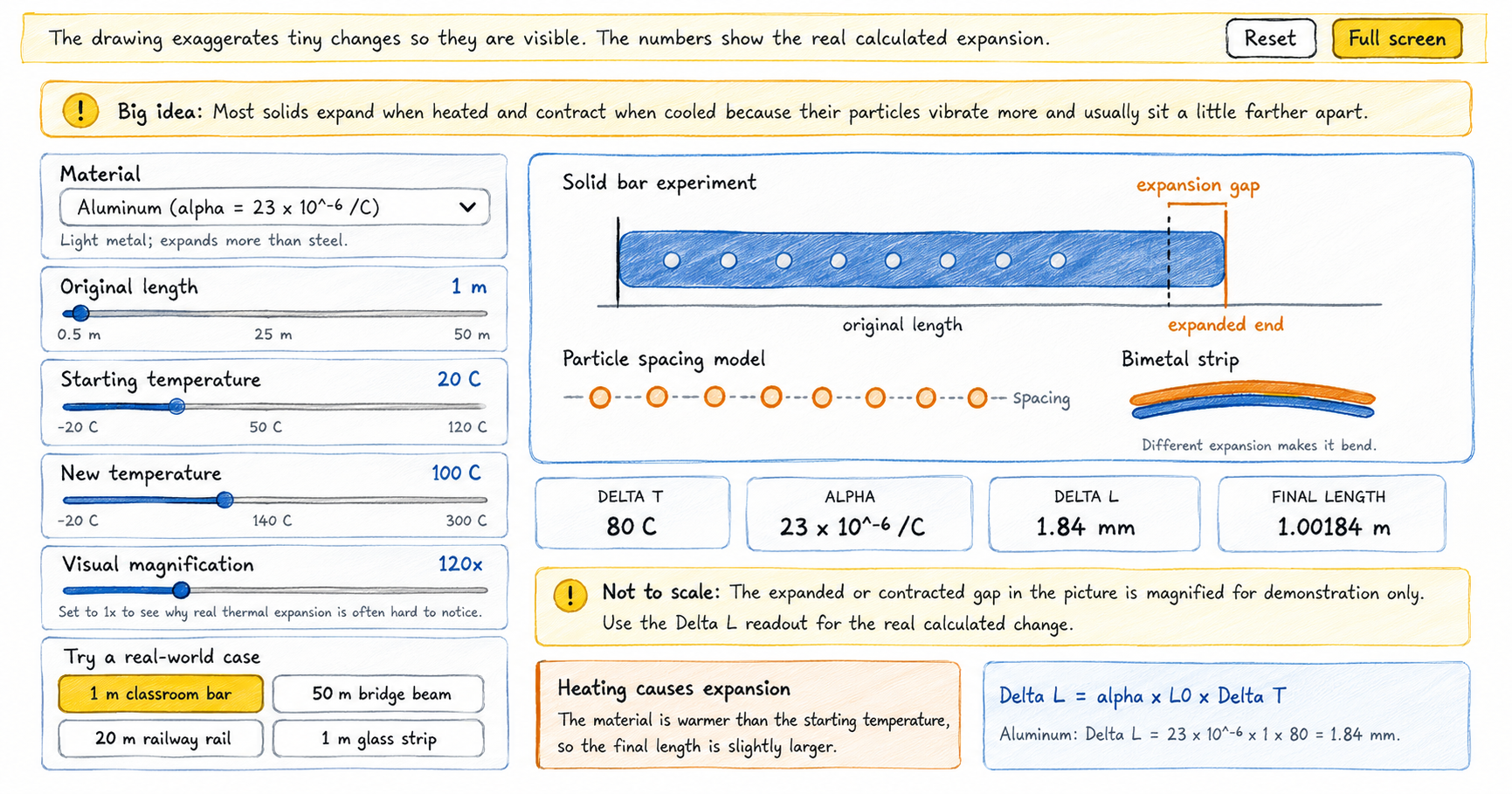
Use this thermal expansion visualizer to heat and cool different materials, compare real length changes, and discover why small expansions matter in bridges, rails, glass, and metal strips.
How to use the thermal expansion visualizer
Choose a material
Pick aluminum, brass, copper, steel, glass, concrete, or invar. Each one has a different expansion coefficient.
Change the temperatures
Move the starting and new temperature sliders. Heating usually gives expansion, while cooling gives contraction.
Compare real and visible changes
The drawing can magnify tiny changes, but the readout shows the real change in millimeters.
Try real-world cases
Use the presets for a bridge beam, railway rail, classroom bar, or glass strip.
What is thermal expansion?
Thermal expansion is the change in size that often happens when a material’s temperature changes. In a warmer solid, particles usually vibrate more strongly and their average spacing increases slightly. In a cooler solid, the spacing may decrease slightly.
Linear expansion
For a long bar, the most useful change is often the change in length.
Delta L = alpha x L0 x Delta TAlpha depends on the material, L0 is the original length, and Delta T is the temperature change.
Small changes add up
A 1 m object may expand by only a few millimeters, but a bridge or rail can be many meters long. That is why engineers leave expansion gaps.
Different materials expand differently
Aluminum expands more than steel for the same length and temperature change. Invar expands very little compared with common metals.
Bimetal bending
When two bonded metals expand by different amounts, the strip bends. This idea is used in some thermostats and temperature switches.
Why the visual is magnified
Real thermal expansion in solids is often too small to see clearly on a screen. The expanded or contracted gap shown in the picture is not to scale and is magnified only for demonstration purposes. Always use the millimeter readout for the real calculated change.
Frequently asked questions
Does every material expand when heated?
Most everyday solids expand when heated over ordinary temperature ranges, but there are special materials and temperature ranges where behavior can be unusual.
Why does glass sometimes crack when heated?
If one part of glass warms much faster than another, different parts try to expand by different amounts. That uneven expansion can create stress and cracking.
Why do bridges have expansion joints?
Long structures can grow or shrink noticeably as temperature changes. Expansion joints give the structure room to move safely.
What does the coefficient alpha mean?
Alpha tells how much one meter of a material changes in length for each 1 C temperature change. A larger alpha means more expansion.