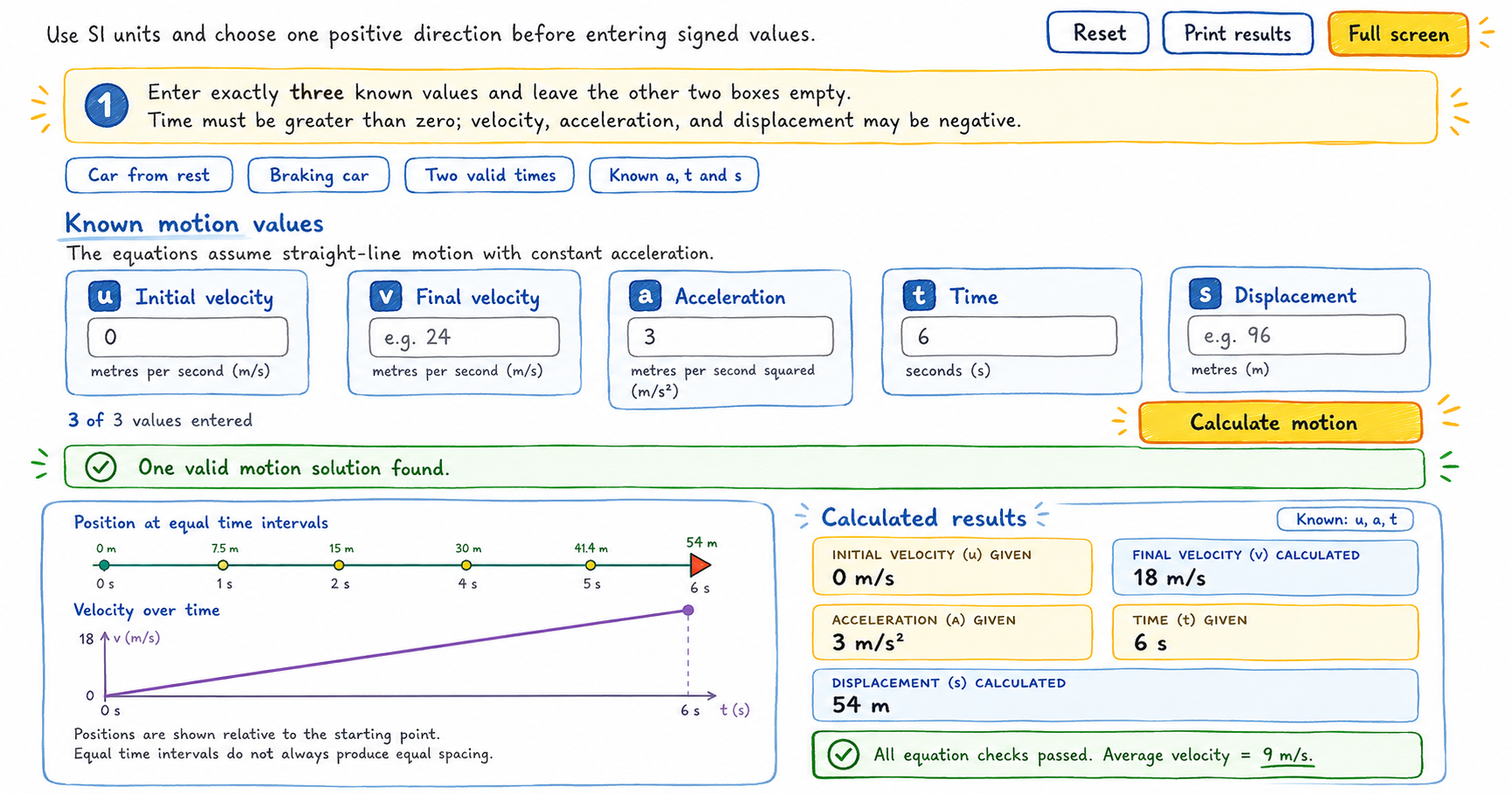
Use this equations of motion calculator to find missing velocity, acceleration, time, or displacement values for straight-line motion with constant acceleration.
How to use the equations of motion calculator
Choose a positive direction
Decide which direction is positive. Enter velocity, acceleration, and displacement in the opposite direction as negative values.
Enter three values
Fill exactly three of the five boxes and leave the two unknown quantities empty. Use metres and seconds.
Calculate the motion
Select Calculate motion to solve the two unknown values and verify the result against the constant-acceleration equations.
Inspect every answer
If two positive-time answers are possible, use the solution buttons to compare both velocities, times, steps, and diagrams.
Symbols used in the motion equations
Initial and final velocity
u is the velocity at the beginning of the interval. v is the velocity at the end. Both use metres per second.
Acceleration and time
a is the constant rate of change of velocity in m/s2. t is the elapsed time in seconds.
Displacement
s is the signed change in position in metres. It is not necessarily the total distance travelled.
Negative values
A negative number means the vector points opposite to your chosen positive direction. Negative acceleration does not always mean an object is slowing down.
The four equations of uniformly accelerated motion
Velocity and time
v = u + atUse this when displacement is not needed.
Displacement from initial velocity
s = ut + 1/2 at2Use this when final velocity is not known.
Velocity and displacement
v2 = u2 + 2asUse this when time is not known.
Average velocity
s = (u + v)t / 2For constant acceleration, average velocity is halfway between u and v.
Worked motion equation example
A car starts from rest, so u = 0 m/s. It accelerates at 3 m/s2 for 8 s.
Final velocity: v = u + at = 0 + 3(8) = 24 m/s.
Displacement: s = ut + 1/2 at2 = 0 + 1/2(3)(82) = 96 m.
Why can a motion problem have two answers?
Squaring velocity can produce positive and negative roots. Both may be physically valid. For example, a ball can pass the same height once while moving upward and again while moving downward. The calculator keeps every solution with a real, positive time and shows each one separately.
When these equations can be used
These equations apply only when acceleration is constant during the entire time interval and the motion is treated along one straight line. They are not suitable for changing acceleration, air resistance that varies significantly, circular motion, or situations where the direction convention changes partway through the calculation.
Frequently asked questions
What is the difference between distance and displacement?
Distance is the total path length and is nonnegative. Displacement is the signed change from starting position to final position, so it can be positive, negative, or zero.
Can acceleration be negative?
Yes. Negative acceleration means it points opposite to the chosen positive direction. Whether the object speeds up or slows down also depends on the sign of its velocity.
Why must time be positive?
The calculator solves an elapsed motion interval. A zero or negative time does not describe the intended interval and can make some combinations non-unique.
Why does the calculator ask for exactly three values?
Three independent values normally determine the remaining two under the constant-acceleration model. Entering more values can over-specify the problem and introduce conflicting measurements.
What happens when no unique answer exists?
The calculator reports that the data are inconsistent or underdetermined instead of inventing a value. For example, equal velocities with zero acceleration do not determine a unique time or displacement.