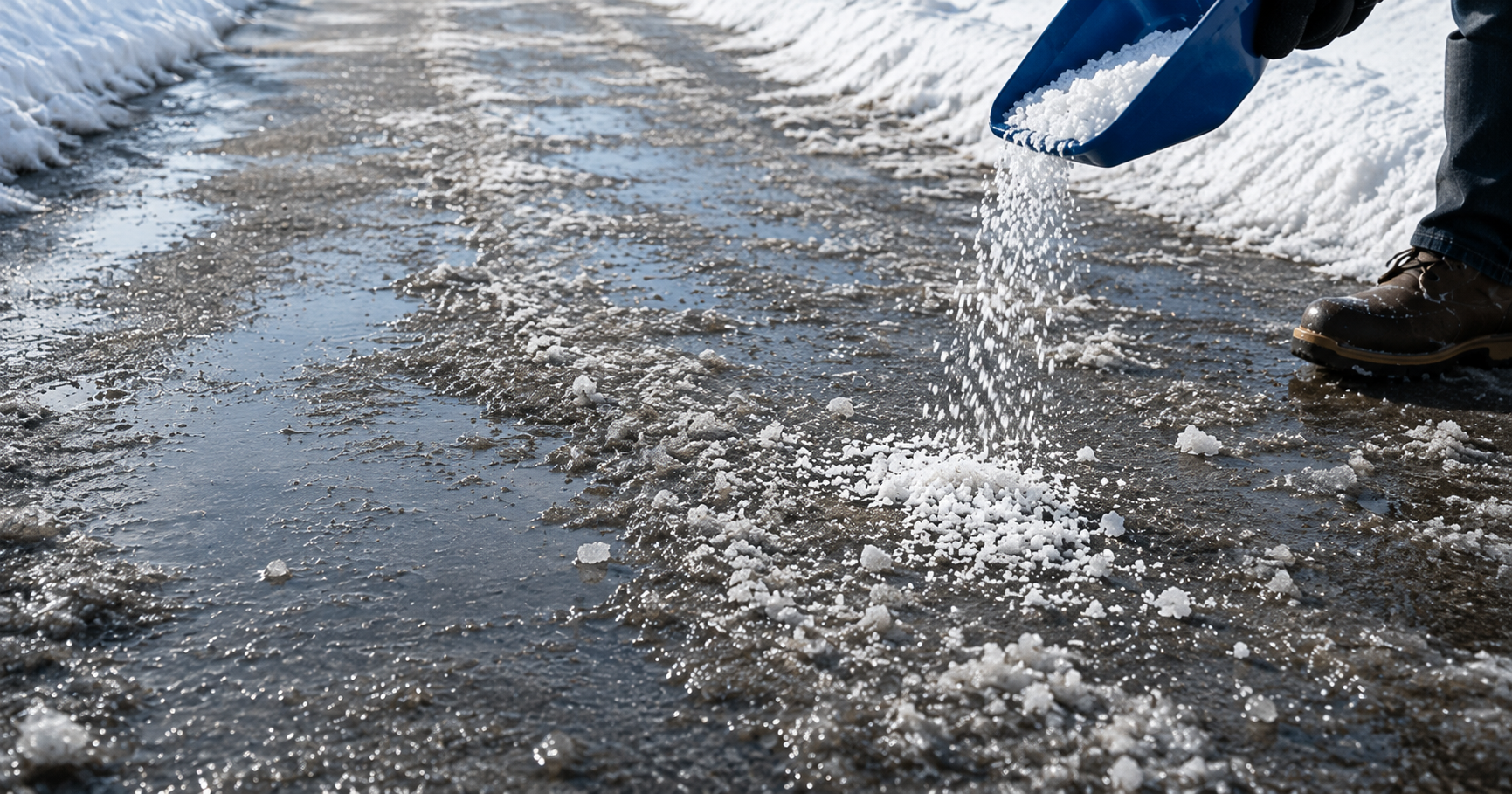
On a freezing winter morning, a road can look perfectly normal until you notice the shiny layer of ice covering it. That thin sheet can make driving and walking dangerous. To solve the problem, road crews often spread something surprisingly ordinary across the surface: salt.
Before long, some of the hard ice becomes wet and slushy. But why?
Salt is not hot. It does not work like a tiny heater. So why does salt melt ice?
The answer comes from an important scientific idea called freezing-point depression. Salt changes the temperature at which water can freeze, making it harder for liquid water to turn back into solid ice. Let’s see how it works.
Water Freezes at About 0°C
Under ordinary atmospheric conditions, pure water freezes at about 0°C (32°F).
At temperatures above this point, water normally remains liquid. Below it, water can freeze and form ice.
Freezing and melting are really two directions of the same process.
When water freezes, its molecules arrange themselves into an organized solid structure. When ice melts, those molecules gain enough energy to move more freely again as liquid water.
Imagine a group of people standing in neat rows. That is a little like the molecules in ice.
Now imagine everyone leaving their positions and moving around a room. That is more like liquid water.
At around the freezing point, molecules can move between these two states depending on the surrounding conditions.
This becomes important when salt enters the picture.
Ice Is Not Completely Dry
A block of ice may look completely solid and dry, but its surface can contain an extremely thin layer of liquid water.
That tiny amount of water is important because salt works best when it can dissolve.
When salt crystals are scattered over ice, some of the salt dissolves in this thin surface layer. Instead of having pure water sitting on the ice, we now have saltwater, also called a salt solution.
And saltwater behaves differently from pure water. In particular, it freezes at a lower temperature.
What Happens When Salt Dissolves in Water?
Ordinary table salt and the salt used on road contain sodium chloride, whose chemical formula is: NaCl
Sodium chloride is made from electrically charged particles called ions.
When salt dissolves in water, it separates mainly into:
- Sodium ions, Na⁺
- Chloride ions, Cl⁻
These ions become mixed among the water molecules.
The water molecules can still move around, but forming an organized ice crystal now becomes more difficult.
A simplified way to imagine this is to picture water molecules trying to line up neatly to build an ice structure. Salt ions are scattered among them, disrupting this organization.
This analogy is not a complete description of the molecular physics, but it helps us understand the basic effect: dissolved salt makes freezing less favorable.
As a result, the water must become colder before it freezes.
What Is Freezing-Point Depression?
Salt lowers the freezing point of water.
The lowering of a liquid’s freezing temperature when another substance is dissolved in it is called freezing-point depression.
For our salt-and-ice example, the important idea is simple:
Pure water freezes at about 0°C. Saltwater can remain liquid below 0°C.
That is why adding salt to ice can cause melting even when the surrounding air is still below the normal freezing point of water.
Suppose the temperature outside is −3°C.
Pure water at that temperature would normally tend to freeze. But after salt dissolves in water on the surface of the ice, the resulting salty water may have a freezing point lower than −3°C.
At that temperature, the salty water can remain liquid. The balance between freezing and melting has changed.
So How Does Salt Actually Melt the Ice?
The process can be understood step by step.
- A thin layer of liquid water is present on the ice.
- Salt dissolves in this water.
- The dissolved salt creates a saltwater solution.
- The freezing point of the solution becomes lower than that of pure water.
- At the existing temperature, some water that would normally freeze can now stay liquid.
- More ice melts and mixes with the salty water.
- The icy surface gradually becomes wetter and more slushy.
This explains an important misconception.
Salt does not simply melt ice by producing heat.
Instead, salt changes the conditions under which liquid water and solid ice can exist.
Thermal energy still has to come from somewhere. The ice can absorb energy from the surrounding air, road surface, sunlight, vehicles, or other nearby materials.
Salt simply makes it possible for more of the water to remain liquid at temperatures where pure water would normally freeze.
Why Is Salt Used on Icy Roads?
Road salt is useful because many winter temperatures are only a few degrees below freezing.
Without salt, melted water on a road could easily freeze again and produce a dangerous slippery surface.
When salt is spread across the road, it mixes with water and creates a salty solution known as brine.
Because brine freezes at a lower temperature than pure water, it can help:
- Melt existing ice
- Reduce the formation of new ice
- Keep roads less slippery
- Make snow and ice easier to remove
This is the basic answer to the question how does road salt work?
It lowers the freezing point of water.
Does Salt Work at Any Temperature?
No. Salt has limits.
Ordinary sodium chloride works well only within a certain temperature range. As the temperature gets colder, melting becomes slower and salt becomes less useful.
A sodium chloride-and-water mixture can theoretically remain liquid down to roughly −21°C (about −6°F) when the salt concentration is just right. This temperature is associated with what scientists call the eutectic point. But that does not mean throwing road salt onto ice at −20°C will quickly clear a highway.
In real-world conditions, sodium chloride becomes much less effective well before reaching its theoretical lowest freezing temperature. Why?
Several factors matter, including:
- Temperature
- Amount of salt
- Amount of liquid water
- Thickness of the ice
- Traffic
- Sunlight
- Wind
- How quickly the salt can dissolve
So there is an important difference between the lowest possible freezing temperature of a saltwater mixture and the temperature at which road salt remains practically useful.
Why Are Calcium Chloride and Magnesium Chloride Sometimes Used?
In very cold conditions, road crews may use chemicals other than ordinary sodium chloride.
Two examples are:
Calcium chloride
and
Magnesium chloride
These substances also lower the freezing point of water and can remain useful at temperatures where ordinary road salt becomes less effective.
Calcium chloride has another helpful property: when it dissolves in water, the process can release heat.
That extra heat can help speed up melting.
However, different de-icing chemicals have different costs, environmental effects, and practical advantages, so road crews choose them according to local conditions.
Why Does Salt Make Ice Cream Colder?
Salt does not just help melt icy roads. It can also help make ice cream. Traditional homemade ice-cream makers often place the ice-cream container inside a mixture of ice and salt. At first, that may sound strange. If you are trying to freeze ice cream, why would you deliberately melt the ice around it?
The answer again involves freezing-point depression.
Ordinary melting ice tends to stay near 0°C.
When salt is added, the freezing point drops. Some of the ice melts, and melting requires energy. That energy is absorbed from the surrounding mixture and the ice-cream container.
As a result, the ice-and-salt mixture can become colder than ordinary melting ice. This colder environment removes heat from the ice-cream ingredients and helps them freeze. So the same principle that makes roads safer can also help make dessert.
Why Doesn’t the Ocean Freeze at 0°C?
The ocean provides another huge example of freezing-point depression.
Seawater contains many dissolved salts. Because of those dissolved substances, seawater generally freezes at a temperature below 0°C. Typical seawater begins freezing at around:
−1.9°C (about 28.6°F)
The exact value depends on how salty the water is. That is why ocean water can remain liquid even when temperatures are slightly below the normal freezing point of fresh water.
The ocean, road salt, and homemade ice cream may seem completely unrelated, but all three demonstrate the same important principle:
Dissolved substances can change the freezing point of water.
Common Misconceptions About Salt and Ice
Here are some common misconceptions about salt and ice.
Misconception: Salt is hot, so it melts ice.
Ordinary salt is not melting the ice because the salt itself is hot.
Instead, dissolved salt lowers the freezing point of water.
Misconception: Salt destroys water molecules.
Salt does not destroy the H₂O molecules.
The water molecules are still there. The dissolved salt changes the conditions under which those molecules can organize themselves into solid ice.
Misconception: Salt melts ice at any temperature.
It does not. As temperatures become extremely low, ordinary road salt becomes much less effective.
Misconception: More salt always means more melting.
Not necessarily.The result depends on the temperature, salt concentration, amount of water present, and other environmental conditions. Simply adding unlimited salt will not continue improving the melting process forever.
Try It: Salt and Ice Experiment
You can observe the effect of salt with a very simple experiment.
You will need:
- Two similar ice cubes
- Two small plates
- A little table salt
Place one ice cube on each plate.
Leave the first cube alone. Sprinkle a small amount of salt over the second cube.
Watch both cubes for several minutes. You may notice that the salted cube develops small pits, grooves, and wet areas. Liquid water may collect around it more quickly. Why?
The salt dissolves in water on the ice surface and lowers its freezing point. This allows more of the ice to become liquid.
For a stronger experiment, you can compare several ice cubes with different amounts of salt. Young children should carry out experiments with adult supervision, and any spilled salty water should be cleaned up afterward.
Why Freezing-Point Depression Matters
Freezing-point depression is more than an interesting classroom concept.
It affects many parts of everyday life.
De-Icing Roads
Salt helps keep roads and sidewalks safer by lowering the freezing point of water.
Making Ice Cream
Salt-and-ice mixtures can reach temperatures below 0°C, helping freeze ice-cream ingredients.
Understanding the Ocean
Dissolved salts explain why seawater freezes at a lower temperature than fresh water.
Cooling Systems
Similar principles can be useful in some industrial and cooling applications where controlling the freezing temperature of liquids is important.
There is also a downside.
Large amounts of road salt can wash into soil, rivers, lakes, and groundwater. High salt concentrations can affect plants and freshwater organisms.
Salt can also speed up corrosion of vehicles, bridges, and other metal structures.
For this reason, road authorities try to balance safety with cost and environmental impact.
Quick Facts
- Pure water normally freezes at about 0°C (32°F) under ordinary atmospheric conditions.
- Salt lowers the freezing point of water through freezing-point depression.
- Ordinary road salt is usually sodium chloride, or NaCl.
- Sodium chloride separates into sodium and chloride ions when dissolved in water.
- Typical seawater freezes at approximately −1.9°C (28.6°F).
- Sodium chloride becomes much less useful for road de-icing in extremely cold weather.
Conclusion: Salt Changes the Rules for Freezing
So, why does salt melt ice?
Pure water normally freezes at about 0°C, but adding salt lowers its freezing point. The salt dissolves in liquid water on the surface of the ice, creating a solution that can remain liquid at temperatures below the normal freezing point of pure water.
Salt does not simply heat the ice. Instead, it changes the temperature at which water can freeze.
Key Takeaway
Salt melts ice because it makes water need a colder temperature before it can freeze again. By lowering the freezing point, salt allows more of the icy surface to remain liquid, turning dangerous solid ice into water or slush.