
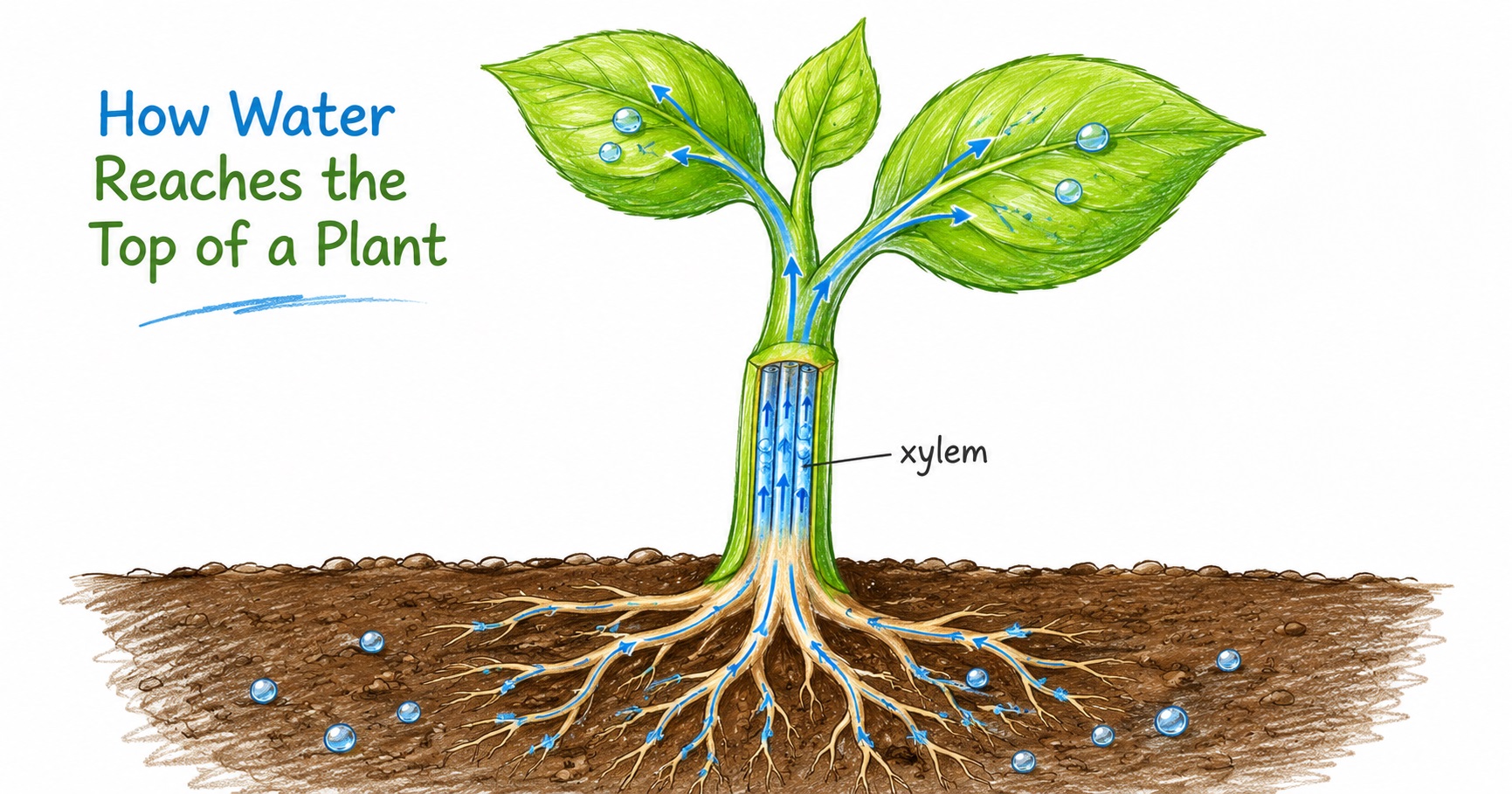
We see plants growing tall and turning into the trees. However in order for the plants to grow, one of the essential requirements is water.
But have you ever wondered how water travels from the ground all the way up to the leaves at the top of a tall plant or a tree? Plants don’t have pumps like we do in our homes, but they still manage to pull water upwards. The secret lies in a special process called capillary action!
What is Capillary Action?
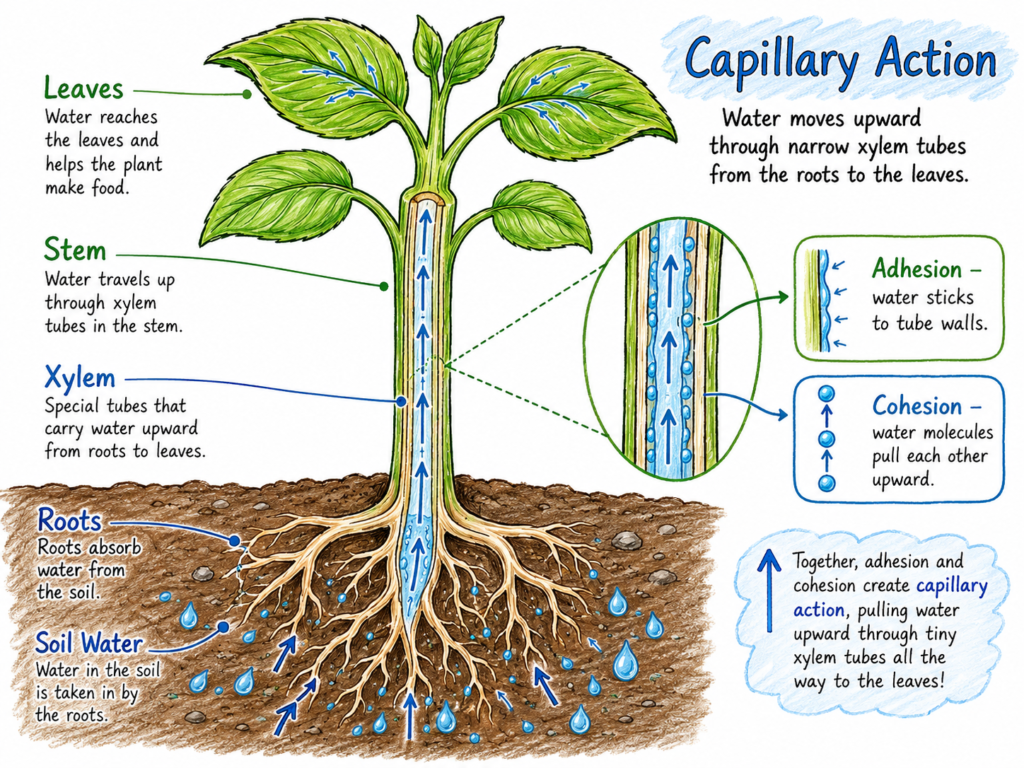
Capillary action is the ability of liquid (in our case water) to move through very tiny spaces or narrow tubes—even going upward against the pull of gravity! This might sound like magic, but it happens because of two special properties of water:
Cohesion
This means that water molecules like to stick to each other, like tiny magnets pulling one another along. This happens due to intermolecular forces attracts molecules.
Adhesion
This means that water molecules also stick to the walls of other surfaces, especially the inside of thin tubes.
When the end of this tube touches water (like in the soil), the water sticks to the inside walls of the tube (adhesion). This “grabs” the water upward a tiny bit.
As the water molecules stick together (cohesion), they pull their neighbors up with them—like holding hands and climbing a rope. As more water enters the bottom of the tube, it keeps pushing the chain of water upward. This continuous movement allows the water to climb higher and higher, drop by drop.
Even though gravity tries to pull the water down, these forces—cohesion and adhesion—are strong enough in very tiny tubes to pull water upward. This is what allows plants to get water from their roots all the way to their leaves, even at the top of tall trees!
How Does Capillary Action Help Plants?
Inside a plant, there are tiny tube-like structures called xylem. These tubes run from the roots all the way to the leaves.
Here’s how water gets to the top:
- Roots absorb water from the soil.
- Water enters the xylem tubes.
- Capillary action pulls the water up through the xylem.
- Water reaches the leaves, where it helps the plant make food using sunlight (a process called photosynthesis).
This amazing process allows even tall trees to get the water they need—from root to leaf!
Other Cool Uses of Capillary Action
Capillary action isn’t just useful in plants! We use it in many ways, such as:
- Paper towels and tissues: They soak up liquids using tiny fibers.
- Ink pens: Ink flows to the tip using capillary action.
- Sponges: Water moves into small holes through capillary action.
- Soil irrigation: Water spreads through dry soil using this process.