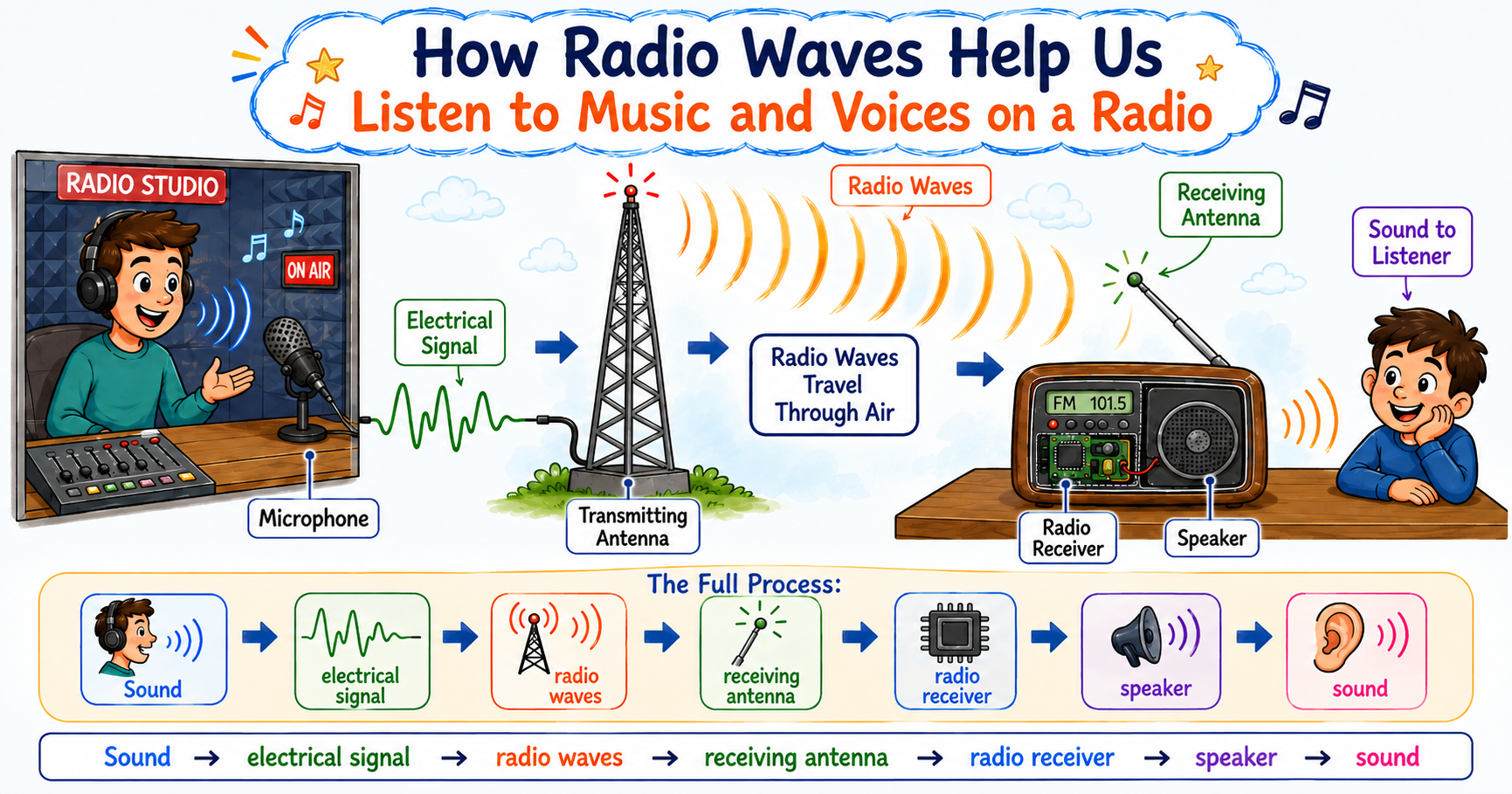
Have you ever turned on a radio and wondered how music, news, or someone’s voice can suddenly come out of the speaker?
There may be no wire connecting your radio to the broadcasting station, yet a song recorded many kilometers away can reach you almost instantly. The secret is radio waves.
Radio waves in radio communication act as invisible carriers that transport information through the air. A radio station converts voices and music into electrical signals, uses those signals to modify radio waves, and broadcasts the waves from an antenna. Your radio receives those radio waves and converts the information back into sound.
The journey looks like this:
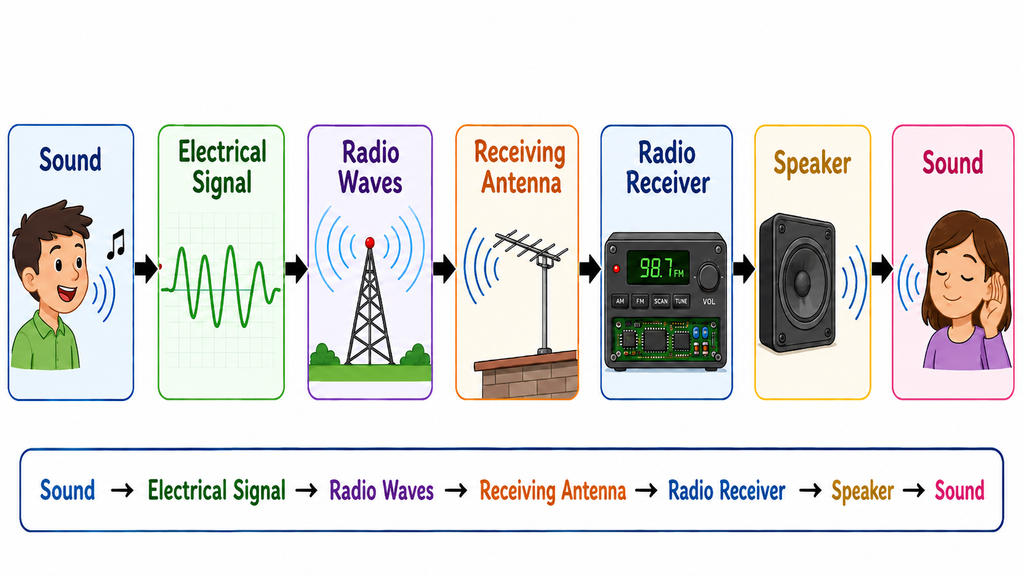
Let’s explore how each step works.
What Are Radio Waves?
Radio waves are a type of electromagnetic wave.
They belong to the electromagnetic spectrum, which also includes:
- Microwaves
- Infrared radiation
- Visible light
- Ultraviolet radiation
- X-rays
- Gamma rays
For more details about different types of electromagnetic waves, please refer to Electromagnetic Spectrum Explorer
Radio waves have much longer wavelengths than visible light, but both are forms of electromagnetic radiation.
One important feature of radio waves is that they can travel through space without needing air, water, or another material to carry them. Such waves are self-propogating waves which does not any medium to travel through. That makes radio waves extremely useful for wireless communication.
Radio broadcasting, television, mobile phones, Wi-Fi, Bluetooth, GPS, and satellite communication all rely on electromagnetic waves to transfer information.
What Do Radio Waves Do in a Radio?
It is easy to imagine that a radio station somehow sends sound waves directly through the air to your radio.
That is not what happens. Ordinary sound waves cannot travel hundreds of kilometers efficiently from a broadcasting station to your home. Instead, a radio station places information representing the sound onto radio waves.
The radio waves act like carriers.
Your radio’s antenna detects these waves, and electronic circuits inside the radio extract the information they contain. The radio then recreates the original sound. So when you listen to music on a radio, the music itself did not travel through the air from the station as sound.
Information about the music traveled as radio waves.
Step 1: Sound Enters a Microphone
Imagine a presenter speaking into a microphone at a radio station. The person’s vocal cords cause the surrounding air to vibrate. These vibrations are sound waves.
Inside the microphone, the sound waves are converted into a changing electrical signal. Different sounds create different electrical patterns. A loud sound creates larger changes in the electrical signal, while a quiet sound produces smaller changes.
Music produces even more complex patterns representing different notes, instruments, rhythms, and voices. This electrical signal contains the information that eventually needs to reach your radio.
Step 2: The Radio Station Creates a Carrier Wave
A broadcasting station generates a rapidly oscillating electromagnetic signal called a carrier wave.
The carrier wave has a particular frequency.
For example, an FM radio station might broadcast at:
100 MHz
where MHz means megahertz.
One megahertz equals one million cycles per second. Therefore, a carrier frequency of 100 MHz oscillates about:
100,000,000 times every second.
The carrier wave does not automatically contain music or speech. The station must first place the audio information onto it. This process is called modulation.
Step 3: Sound Information Is Added to the Radio Wave
Radio stations modify, or modulate, carrier waves so that they can carry information.
Two famous methods are:
AM — Amplitude Modulation
FM — Frequency Modulation
These methods explain why we commonly hear the terms AM radio and FM radio.
How AM Radio Waves Carry Sound
AM stands for Amplitude Modulation. Amplitude describes the strength of a wave.
In AM broadcasting, the amplitude of the carrier wave changes according to the original sound signal. Imagine the carrier wave becoming stronger and weaker in a pattern that matches the music or voice. The radio receiver detects these amplitude changes and uses them to reconstruct the original audio signal.
So in AM radio:
Sound information changes the amplitude of the radio wave.
How FM Radio Waves Carry Sound
FM stands for Frequency Modulation. Frequency describes how many wave cycles occur each second.
In FM broadcasting, the frequency of the carrier wave changes slightly according to the sound signal.
For example, a station centered around 100 MHz does not remain at exactly one frequency every instant. The transmitted frequency moves slightly above and below its assigned center frequency. These tiny changes contain the sound information.
So in FM radio:
Sound information changes the frequency of the radio wave.
FM signals are generally less affected by certain types of electrical noise than AM signals, which is one reason FM broadcasting is widely used for music.
Step 4: The Radio Transmitter Sends Radio Waves
Once the sound information has been added to the carrier wave, the signal is amplified. It is then sent to a large transmitting antenna.
Alternating electrical currents flow through the antenna. These changing currents produce changing electric and magnetic fields.
The fields spread outward from the antenna as electromagnetic waves. Those electromagnetic waves are the radio waves carrying the broadcast. They travel through the surrounding environment at approximately the speed of light.
That is nearly:
300,000 kilometers per second.
Because radio waves travel so quickly, a broadcast can reach listeners across a region almost immediately.
Radio Waves Are Around Us All the Time
At this moment, many different radio waves may be passing through the space around you.
They may come from:
- AM radio stations
- FM radio stations
- Television transmitters
- Mobile phone towers
- Wi-Fi routers
- Bluetooth devices
- Satellites
- Aircraft communication systems
- Emergency communication systems
You cannot normally see or hear these radio waves.
Your ears only respond to sound waves in a certain range of frequencies.
A radio receiver, however, is specifically designed to detect electromagnetic radio signals.
Step 5: The Radio Antenna Receives the Radio Waves
The first part of your radio that interacts with the broadcast is usually the antenna. When radio waves pass across a conducting antenna, their changing electromagnetic fields push and pull on electrons inside the conductor.
This creates a tiny changing electrical signal in the antenna. That signal contains information from the radio waves reaching the receiver.
However, there is a challenge. The antenna may be receiving signals from many radio stations at the same time.
How does your radio know which station you want?
Step 6: The Tuner Selects One Radio Frequency
Suppose you tune an FM radio to 98.5 MHz
You are essentially telling the receiver to select the radio signal around 98.5 MHz and reject most of the others. The radio uses electronic filtering and tuning circuits to isolate the desired frequency.
Older radios commonly used resonant circuits containing components such as:
- Capacitors
- Inductors
Modern radios may use integrated circuits, frequency synthesizers, and digital signal processing.
Although the technology has changed, the goal remains the same:
Select one station from the many radio waves reaching the antenna.
Why Do Radio Stations Use Different Frequencies?
Different stations are assigned different frequencies so their broadcasts can be separated. Imagine three FM stations transmitting at:
- 94.2 MHz
- 99.5 MHz
- 105.4 MHz
Their radio waves may all reach your antenna.
When you select 99.5 MHz, the receiver concentrates on that frequency range while reducing signals from the others.
This allows many radio stations to broadcast in the same city without every program playing through your speaker at once.
Step 7: The Radio Extracts the Music or Voice
After selecting the correct radio signal, the receiver must recover the original sound information. Remember that the audio has been encoded into changes in the radio carrier wave. The process of recovering this information is called demodulation.
A circuit known as a demodulator or detector performs this job. For AM radio, the receiver detects variations in amplitude.
For FM radio, the receiver detects variations in frequency. The resulting electrical signal now resembles the original audio signal that came from the microphone.
Step 8: The Audio Signal Is Amplified
The recovered audio signal is usually too weak to move a loudspeaker effectively. Therefore, it passes through an audio amplifier. The amplifier increases the strength of the electrical signal while preserving the information in it.
Your radio’s volume control adjusts how strongly this audio signal drives the speaker. A stronger signal causes larger speaker movements and therefore louder sound.
Step 9: The Speaker Converts Electricity Back Into Sound
The final step happens inside the radio’s speaker.
A typical loudspeaker contains:
- A coil of wire
- A permanent magnet
- A cone or diaphragm
The amplified electrical audio signal flows through the coil. The changing current produces a changing magnetic field.
This magnetic field interacts with the permanent magnet, causing the speaker cone to move back and forth. The moving cone pushes and pulls the surrounding air. This creates new sound waves.
Those sound waves reach your ears. Your brain interprets them as the presenter’s voice, a guitar, a drumbeat, or an entire orchestra.
The Complete Journey of Radio Waves and Sound
The full radio broadcasting process can be summarized like this:
1. A person speaks or music is played.
2. A microphone converts the sound into an electrical signal.
3. The station generates a high-frequency radio carrier wave.
4. The sound information modulates the carrier wave.
5. A transmitting antenna broadcasts the radio waves.
6. The radio waves travel through space.
7. Your radio antenna receives the waves.
8. The tuner selects the desired station frequency.
9. The receiver demodulates the signal.
10. An amplifier strengthens the audio signal.
11. The speaker converts the electrical signal back into sound.
So the radio wave acts as the middle part of a communication chain connecting the broad
Why Can’t We Hear Radio Waves Directly?
Humans cannot directly hear radio waves because our ears are designed to detect mechanical vibrations in air.
Radio waves are electromagnetic radiation.
Even though a radio carrier might have a frequency such as 100 MHz, that does not mean your ear could hear a 100 MHz sound.
The term frequency is used for both sound waves and radio waves, but they are different kinds of waves.
Your radio therefore acts as a translator. It detects electromagnetic signals and converts their encoded information into audible sound.
Why Does Moving a Radio Antenna Improve Reception?
You may have noticed that extending, rotating, or moving an antenna can make a weak station sound clearer.
Several factors influence how strongly an antenna receives radio waves.
These include:
- Antenna length
- Antenna orientation
- Distance from the transmitter
- Buildings
- Hills and mountains
- Electrical interference
- Reflections from nearby objects
Radio waves can reflect, bend, diffract, and interfere with one another. Moving a radio a small distance may therefore change the strength of the received signal.
This is why an antenna sometimes works well in one position but poorly in another.
What Causes Static on a Radio?
Crackling, buzzing, or hissing on a radio usually comes from unwanted electrical signals or electromagnetic interference.
Possible sources include:
- Lightning
- Electrical motors
- Power equipment
- Electronic devices
- Weak broadcast signals
- Other transmitters
If the desired radio signal is much stronger than the interference, reception is usually clear.
If the station’s signal is weak, background noise becomes more noticeable.
AM radio is particularly sensitive to some forms of amplitude-based electrical interference because AM broadcasts carry information through changes in signal amplitude.
How Far Can Radio Waves Travel?
Radio waves can travel very different distances depending on their frequency and environment.
Their range can be affected by:
- Transmitter power
- Radio frequency
- Antenna height
- Antenna design
- Mountains
- Buildings
- Earth’s surface
- Atmospheric conditions
Some radio signals mainly travel along relatively direct paths.
Others can bend around obstacles or interact with layers of Earth’s atmosphere.
Certain lower-frequency radio signals can sometimes travel hundreds or even thousands of kilometers.
This ability made radio one of the earliest practical forms of long-distance wireless communication.
Are AM and FM the Only Ways to Use Radio Waves?
AM and FM are famous because they are widely associated with traditional broadcasting, but modern wireless technology uses many more sophisticated techniques.
Radio waves also carry:
- Digital radio
- Mobile phone calls
- Television signals
- Wi-Fi data
- Bluetooth data
- Satellite signals
- GPS information
Instead of simply changing amplitude or frequency in the way traditional AM and FM systems do, modern systems can use complex combinations of amplitude, frequency, phase, timing, and digital coding.
The basic principle, however, remains the same that is information is encoded into electromagnetic radio waves, transmitted, received, and decoded.
How Does Digital Radio Use Radio Waves?
Digital radio also relies on radio waves, but the sound is first converted into digital information.
A computer represents the audio using numbers. The transmitter encodes those digital data onto a radio-frequency signal.
The receiver then:
- Receives the radio waves.
- Selects the correct channel.
- Extracts the digital information.
- Decodes the audio.
- Converts it into an electrical audio signal.
- Sends the signal to a speaker.
Digital systems can also use techniques that help reduce errors and improve the efficient use of the radio spectrum.
Are Radio Waves the Same Waves Used by Wi-Fi?
Yes. Wi-Fi also uses radio-frequency electromagnetic waves.
The main differences involve the frequencies used and the way information is encoded.
A traditional FM radio station may use frequencies around tens or hundreds of megahertz.
Wi-Fi commonly operates at frequencies measured in gigahertz.
Mobile phones, Bluetooth devices, satellites, and other wireless technologies also use particular sections of the radio-frequency spectrum.
This means the basic science you learn from ordinary radio broadcasting helps explain many modern wireless technologies.
A Simple Analogy for Radio Waves
Imagine sending a message using a delivery truck.
The truck is not the message itself.
It simply carries the message from one place to another.
A radio carrier wave works in a somewhat similar way.
The carrier wave is the delivery system, while the pattern placed onto the wave contains the information.
At the receiving end, the radio removes the information from the carrier and turns it back into sound.
The analogy is not perfect, because a radio wave is continuously modulated rather than carrying a physical package, but it provides a useful way to understand the idea.
Frequently Asked Questions About Radio Waves in Radio
Does a radio receive sound waves from the radio station?
No. A radio receives electromagnetic radio waves. These waves carry encoded information representing the original sound. The radio converts that information back into sound waves using its speaker.
What is the role of radio waves in radio communication?
Radio waves carry information wirelessly from a transmitting antenna to a receiving antenna. The information may represent music, speech, digital data, or many other types of communication.
How does an antenna receive radio waves?
The changing electromagnetic field of an incoming radio wave causes electrons inside a conducting antenna to move, producing a small electrical signal.
How does a radio choose one station?
The receiver uses tuning and filtering circuits to select the frequency associated with the chosen station while reducing signals at other frequencies.
What is the difference between AM and FM radio waves?
AM carries sound information by changing the amplitude of a carrier wave, while FM carries information primarily by changing its frequency.
Can humans hear radio waves?
No. Human ears detect mechanical sound waves, not electromagnetic radio waves. A radio receiver must convert the encoded radio signal into sound first.
Do radios create radio waves?
A broadcast radio receiver mainly receives radio waves. Radio transmitters, such as those at broadcasting stations, generate and transmit them.
Final Thoughts
Radio waves make it possible for music and voices to travel wirelessly across cities, countries, and sometimes much greater distances.
But a radio station does not actually send ordinary sound directly to your radio.
Instead, the station converts sound into electrical information and uses that information to modulate a high-frequency radio wave.
The transmitting antenna sends the radio waves through space.
Your radio antenna receives them. The tuner selects the station you want.
The receiver extracts the encoded information. The amplifier strengthens the resulting audio signal.
Finally, the speaker turns that electrical signal back into sound waves that your ears can hear.
So the next time you switch on an AM or FM radio, remember that invisible radio waves are traveling through the space around you carrying information.
Your radio is essentially a tiny decoding machine that catches one of those electromagnetic signals and transforms it back into music and voices.