
Imagine trying to count every oxygen molecule inside a balloon. You could not see the molecules, and there would be far too many to count one by one. Chemists solve this problem by using a special counting unit called the mole.
A mole lets scientists connect the invisible world of atoms and molecules with amounts they can measure in a laboratory. But how many particles are in a mole, and how much space does one mole of gas actually occupy? Let us find out.
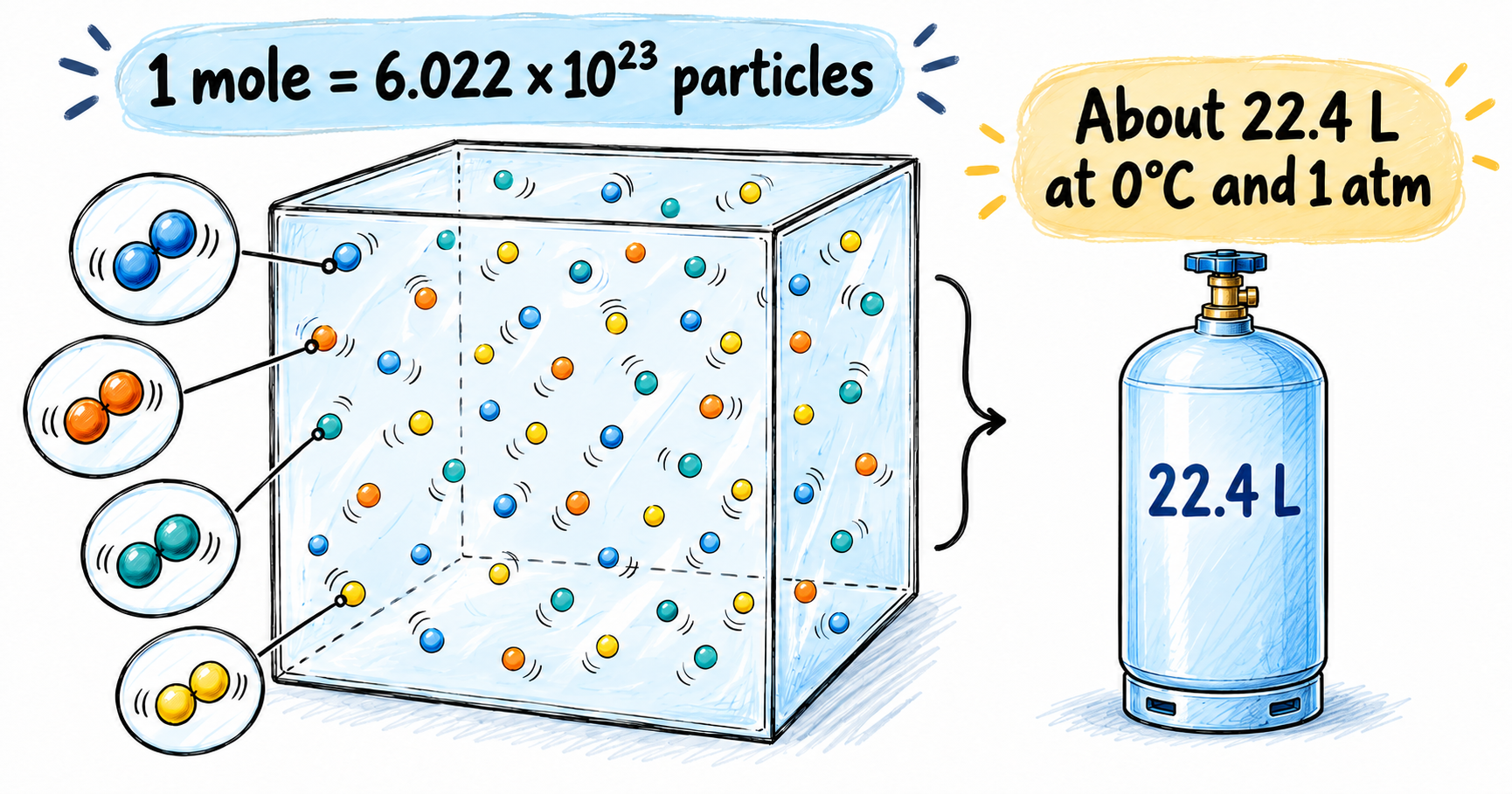
Short Answer: One mole contains 6.022 × 10²³ particles. At 0°C and a pressure of 1 atmosphere, one mole of an ideal gas occupies about 22.4 litres. Change the temperature or pressure, however, and its volume changes too.
What Is a Mole?
A mole is a counting unit. We already use special words for counting groups of objects. A pair means 2, and a dozen means 12. In the same way, a mole means:
This enormous value is called Avogadro’s number. Written in full, it is approximately:
602,200,000,000,000,000,000,000
The word particles is important because a mole can count different kinds of tiny objects:
- One mole of helium contains 6.022 × 10²³ helium atoms.
- One mole of oxygen gas contains 6.022 × 10²³ oxygen molecules.
- One mole of sodium ions contains 6.022 × 10²³ sodium ions.
Just as a dozen can describe eggs, pencils, or oranges, a mole can describe atoms, molecules, or ions.
Why Do Chemists Need Such a Huge Number?
Atoms and molecules are unbelievably small. Even a tiny amount of matter contains an enormous number of them. It would be impossible to count those particles individually, so chemists measure a larger group—the mole.
The mole acts as a bridge between two worlds:
- the microscopic world of atoms and molecules
- the everyday world of grams, litres, bottles, and laboratory containers
Think of it this way: A shopkeeper may count eggs by the dozen. A chemist counts atoms and molecules by the mole.
So, How Big Is 1 Mole of Gas?
The volume of a gas depends on its temperature and pressure. Therefore, one mole of gas does not always have the same volume. To compare gases fairly, scientists specify the conditions.
At 0°C and a pressure of 1 atmosphere: 1 mole of an ideal gas ≈ 22.4 litres
That is approximately the volume of:
- eleven 2-litre drink bottles, or
- a cube measuring roughly 28 centimetres along each side.
At around 25°C and 1 atmosphere, the same mole occupies about 24.5 litres. The particles have not increased in number. They simply move faster and spread farther apart at the higher temperature.
Do Different Gases Occupy the Same Volume?
Under the same temperature and pressure, one mole of different ideal gases occupies the same volume. This means one mole of helium, nitrogen, oxygen, and carbon dioxide each occupies about 22.4 litres at 0°C and 1 atmosphere.
However, they do not have the same mass. Their particles are made from different atoms, so some molecules are heavier than others.
| Gas | Particles in 1 mole | Approx. mass | Volume at 0°C, 1 atm |
| Hydrogen (H₂) | 6.022 × 10²³ molecules | 2 g | 22.4 L |
| Helium (He) | 6.022 × 10²³ atoms | 4 g | 22.4 L |
| Nitrogen (N₂) | 6.022 × 10²³ molecules | 28 g | 22.4 L |
| Oxygen (O₂) | 6.022 × 10²³ molecules | 32 g | 22.4 L |
| Carbon dioxide (CO₂) | 6.022 × 10²³ molecules | 44 g | 22.4 L |
The key idea: equal numbers of gas particles can occupy equal volumes while having different masses.
Why Are Gas Volumes So Similar?
Gas particles are usually very far apart compared with their own size. Most of a gas container is empty space between rapidly moving particles. Under the same temperature and pressure, the spacing between particles is broadly similar, so equal numbers of ideal-gas particles occupy equal volumes.
This idea is known as Avogadro’s law: equal volumes of gases at the same temperature and pressure contain equal numbers of particles.
How Temperature Changes Gas Volume
When a gas is heated, its particles gain kinetic energy and move faster. If the gas can expand, the particles spread into a larger volume.
- Higher temperature → faster particles → larger volume, if pressure stays constant
- Lower temperature → slower particles → smaller volume, if pressure stays constant
How Pressure Changes Gas Volume
Pressure tells us how strongly gas particles push against the walls of their container. Increasing the external pressure can squeeze the particles closer together.
- Higher pressure → particles pushed closer → smaller volume, if temperature stays constant
- Lower pressure → particles spread out → larger volume, if temperature stays constant
The Ideal Gas Law
Scientists connect the amount, pressure, volume, and temperature of a gas with the ideal gas law:
PV = nRT
- P = pressure
- V = volume
- n = number of moles
- R = gas constant
- T = temperature measured on the Kelvin scale
Real gases can differ slightly from this simple model, especially at very high pressures or very low temperatures. Under ordinary conditions, however, the ideal gas law is an excellent starting point.
Worked Example 1: Finding the Volume
Question: What volume will 2 moles of an ideal gas occupy at 0°C and 1 atmosphere?
At these conditions, 1 mole occupies approximately 22.4 L.
2 × 22.4 L = 44.8 L
Answer: Two moles occupy approximately 44.8 litres.
Worked Example 2: Finding the Number of Moles
Question: A gas occupies 11.2 litres at 0°C and 1 atmosphere. Approximately how many moles does it contain?
11.2 L ÷ 22.4 L per mole = 0.5 mole
Answer: The container holds approximately half a mole of gas.
The Big Idea
A mole is chemistry’s way of counting extremely small particles. One mole always contains 6.022 × 10²³ particles, whether those particles are helium atoms, oxygen molecules, or something else.
For gases, the space occupied by those particles depends on temperature and pressure. At 0°C and 1 atmosphere, one mole of an ideal gas occupies about 22.4 litres. Raise the temperature or lower the pressure, and it takes up more space. Change the kind of gas, and its mass may change—but the number of particles in one mole remains the same.
That is the power of the mole: it turns an unimaginably large number of invisible particles into something scientists can measure and understand.
Frequently Asked Questions
Is one mole always 22.4 litres?
No. The 22.4-litre value applies approximately to an ideal gas at 0°C and 1 atmosphere. At other temperatures or pressures, the volume changes.
Is a mole a measure of mass?
No. A mole measures the amount of substance. Its mass depends on which atoms or molecules are being counted.
How many molecules are in one mole of oxygen gas?
One mole of oxygen gas contains approximately 6.022 × 10²³ O₂ molecules.
Why is the mole useful? It lets chemists relate numbers of microscopic particles to measurable quantities such as mass and gas volume.