
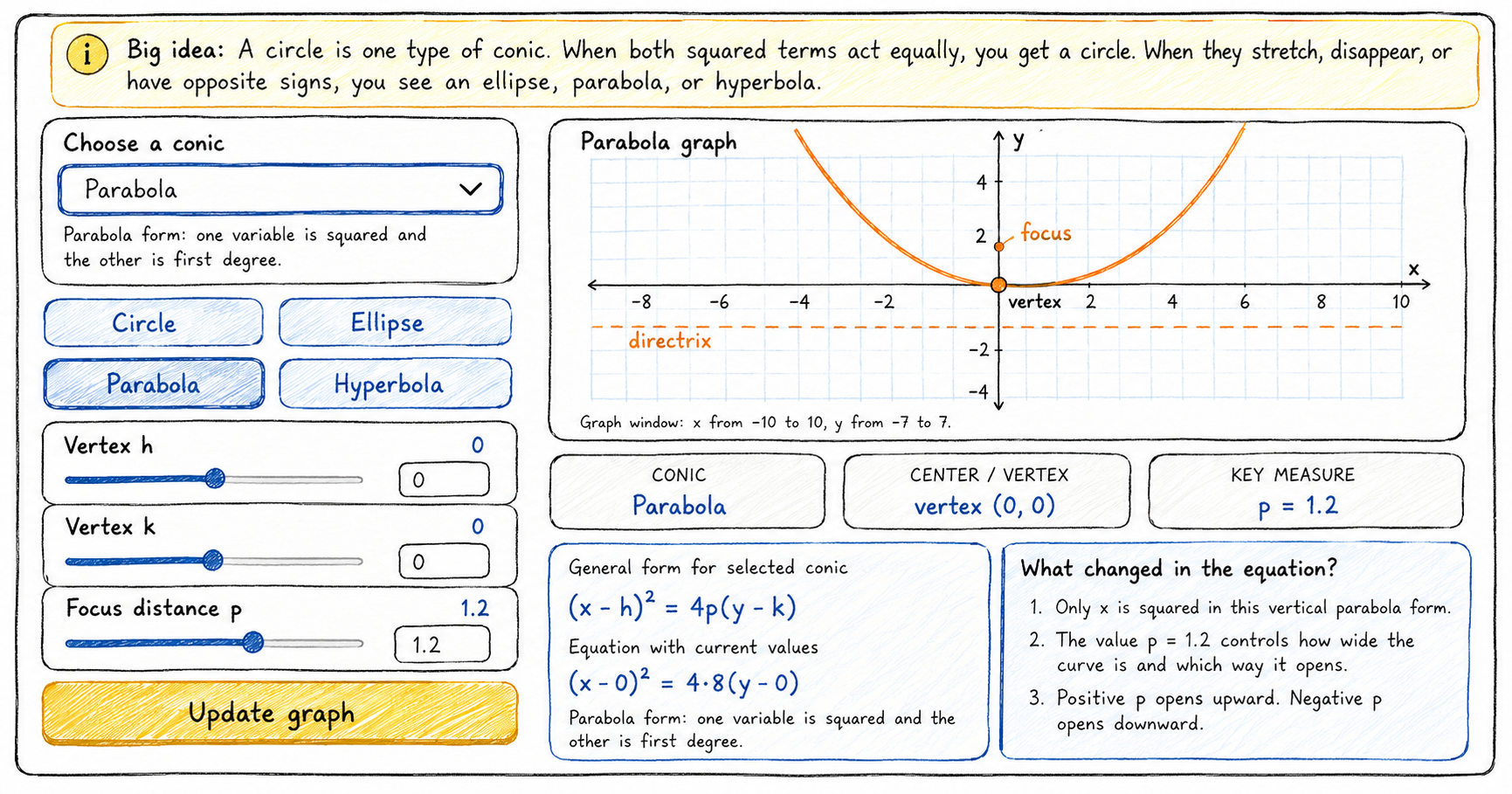
Use this interactive conic section tool to explore circle equations, then compare them with an ellipse, parabola, and hyperbola. Move the sliders to see how the general equation and graph change together.
How to use the circle equations and conic section explorer
Start with a circle
Choose Circle to see how center and radius control the standard circle equation.
Try each conic preset
Switch to ellipse, parabola, and hyperbola to compare the equation patterns.
Move one slider
Change one parameter at a time and watch the graph, equation, and explanation update.
Read the rule
The “What changed?” box explains why that equation makes that shape.
How circle equations connect to conic sections
A circle is one conic section. In the standard forms shown here, changing how the squared x and y terms appear creates an ellipse, parabola, or hyperbola. This does not mean every circle literally becomes every other curve; it means these shapes belong to one related equation family.
Equation patterns included
Circle equations
(x – h)2 + (y – k)2 = r2Both squared terms are positive and balanced.
Ellipse
(x – h)2/a2 + (y – k)2/b2 = 1Both squared terms are positive, but stretched differently.
Parabola
(x – h)2 = 4p(y – k)Only one variable is squared in this standard vertical form.
Hyperbola
(x – h)2/a2 – (y – k)2/b2 = 1The squared terms have opposite signs.
Circle equation example
For the equation (x – 2)2 + (y + 1)2 = 9, the center is (2, -1) and the radius is 3. The graph is a circle because both squared terms are positive, have the same weight, and add together.
Ideas for practice
- Keep h and k fixed, then compare a circle with an ellipse.
- Make the ellipse values a and b equal. Notice that it becomes circle-shaped.
- Change p in the parabola and describe how the curve gets wider or narrower.
- Look at the hyperbola asymptotes and explain why the branches never cross them.
Frequently asked questions
What is the standard equation of a circle?
The standard circle equation is (x – h)2 + (y – k)2 = r2, where (h, k) is the center and r is the radius.
How is an ellipse different from a circle?
A circle has the same radius in every direction. An ellipse has different horizontal and vertical radii.
Why is a parabola different from an ellipse?
In the standard parabola form shown here, only one variable is squared. In an ellipse, both x and y are squared and added.
How do I recognize a hyperbola?
A hyperbola has squared terms with opposite signs, so its graph opens into two separate branches.