

Have you ever wondered how a mirror shows your exact face every morning? Mirrors seem magical, but they actually work through fascinating science involving materials and light behavior. Let’s explore how mirrors form images, what they are made of, and the optical principles that make reflections possible.
The Science of Reflection
When light hits any surface, it can do three things:
- Absorb into the surface
- Transmit through the surface which is known as refraction
- reflect it back commonly known as reflection
Mirrors are designed to reflect nearly all the light that falls on them.
This happens because the metallic coating has free electrons that bounce the incoming light waves back in the same direction — creating a clear reflection.
The image in a mirror forms according to two fundamental laws of reflection:
1. The angle of incidence equals the angle of reflection.
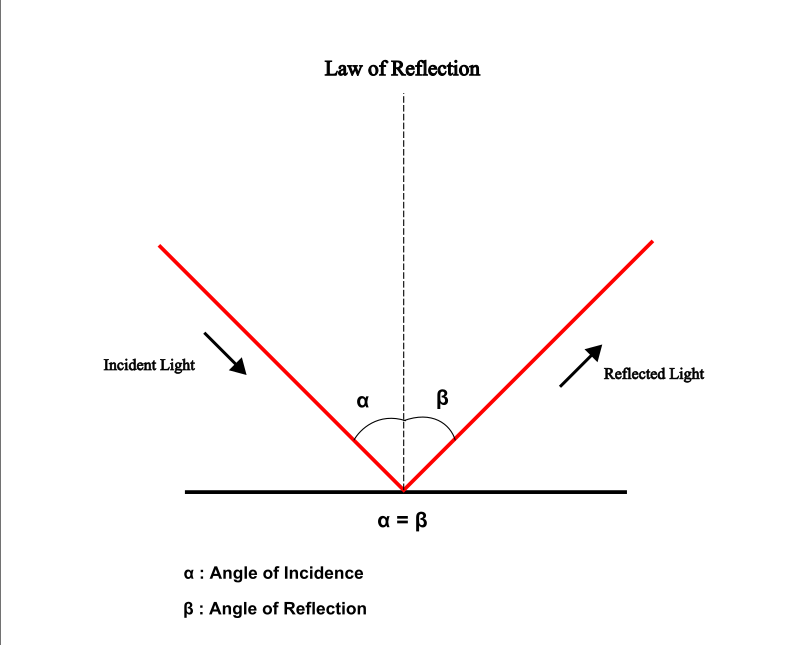
2. The incident ray, the reflected ray, and the normal (a line perpendicular to the mirror’s surface) all lie in the same plane.
How Does an Image Form in a Plane Mirror?
When light rays from your face hit the mirror:
- They reflect back in the same direction according to the laws of reflection.
- Your eyes see these reflected rays as if they are coming from behind the mirror.
- The brain interprets this as an image located behind the mirror surface.
This is called a virtual image — it cannot be projected on a screen because the light rays do not actually meet behind the mirror.
However, it looks identical to the object, except that left and right are reversed.
Simple Experiment
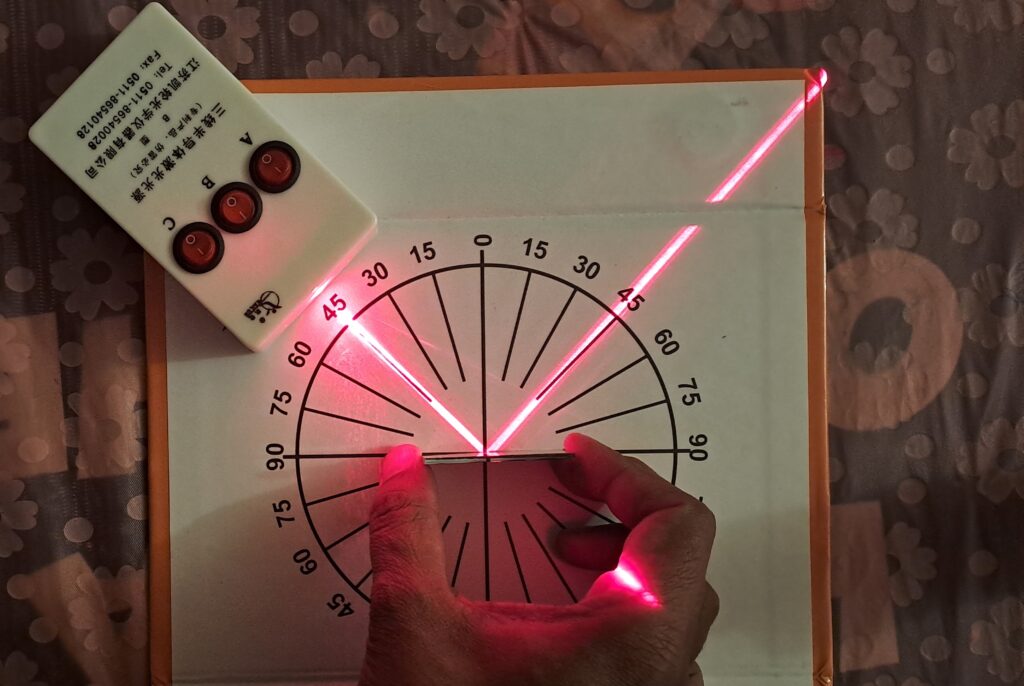
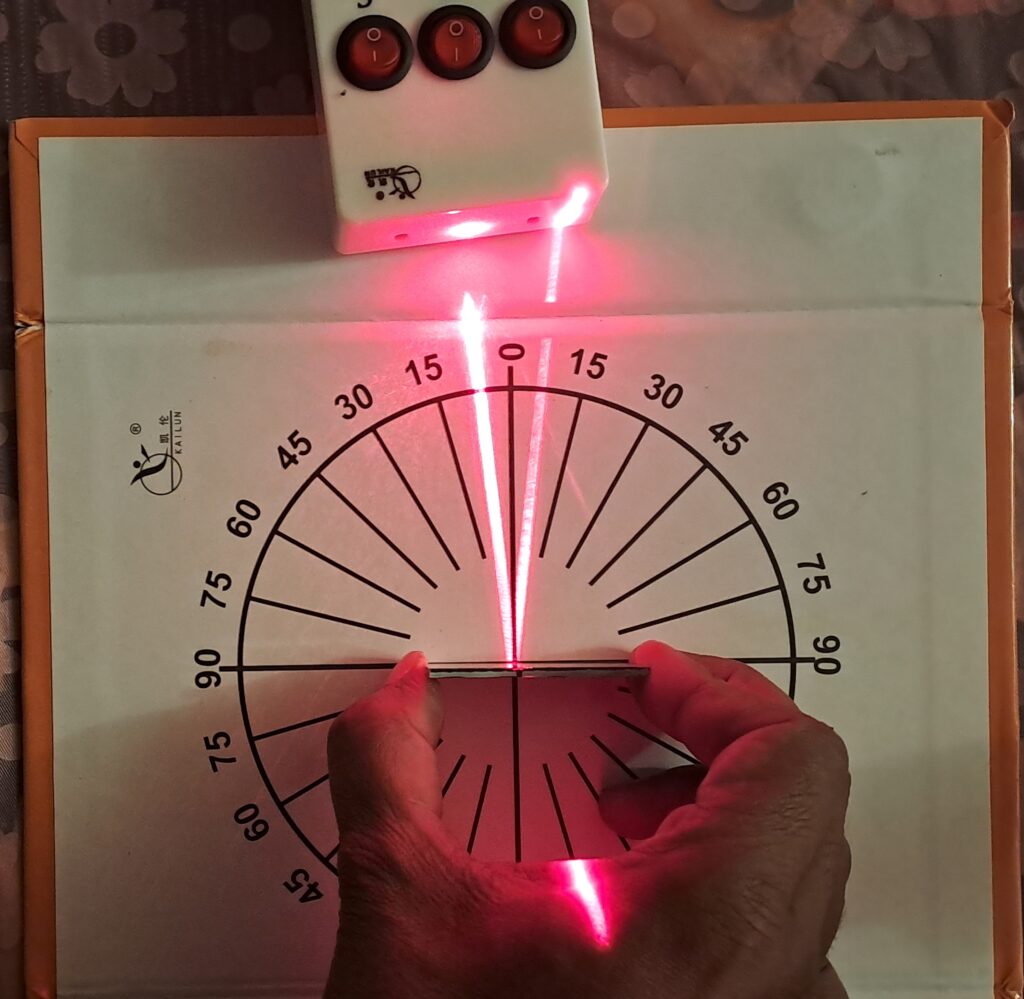
Lets try to understand the reflection from mirror using this simple experiment. In this experiment, laser beam is incident on the mirror first at 45 degrees. According to the law of reflection, the reflected beam after reflecting from the mirror will be reflected at 45 degrees.
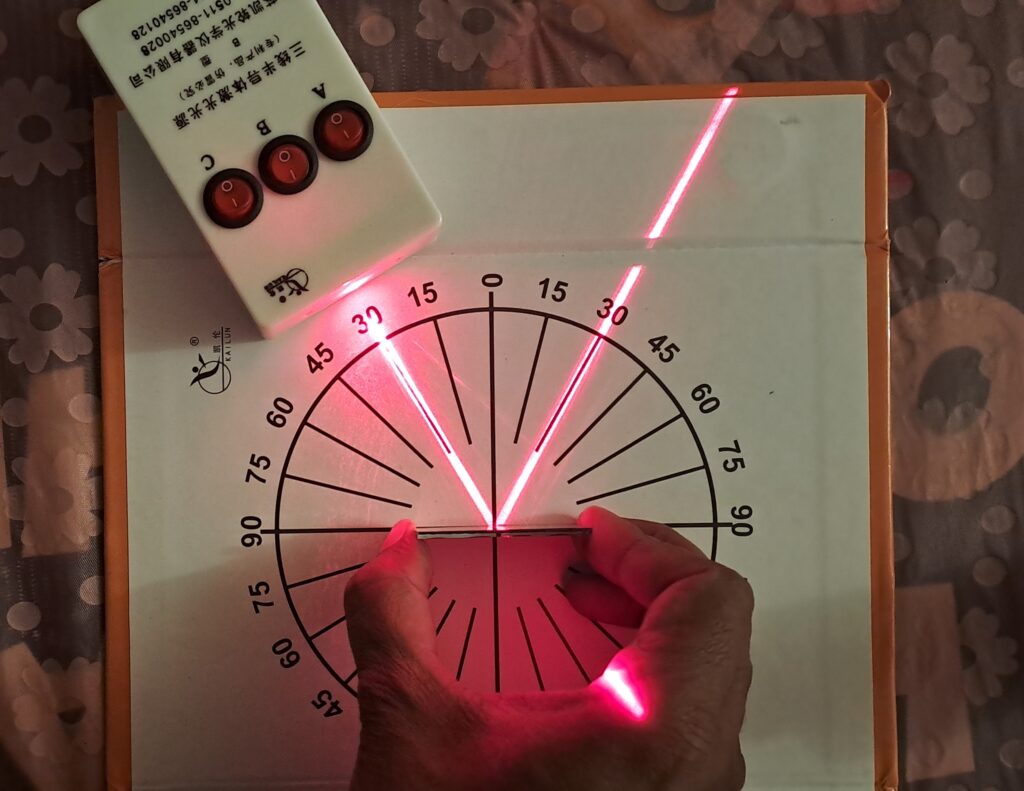
Now to lets try to reduce the angle of incidence to 30 degrees. Accordingly the angle of incidence will also be 30 degrees.
As we shorten the angle of reflection further, the angle of incidence will also becoming shorter by the same degree.
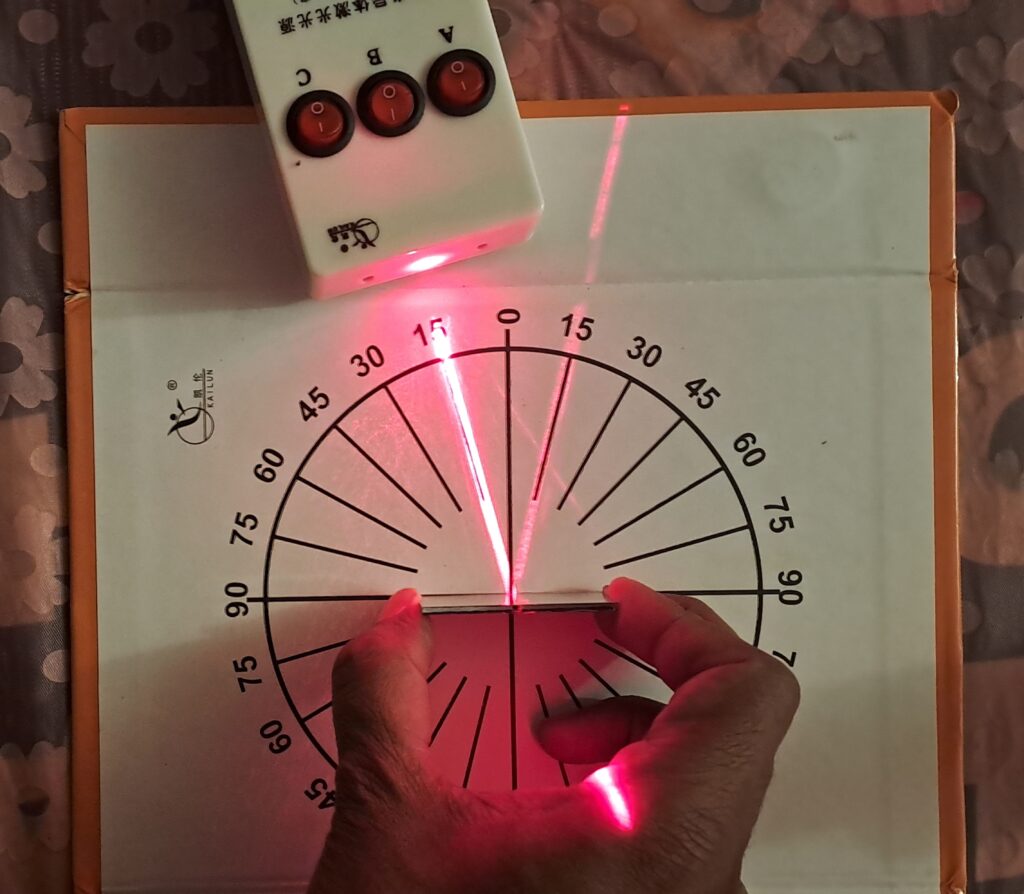
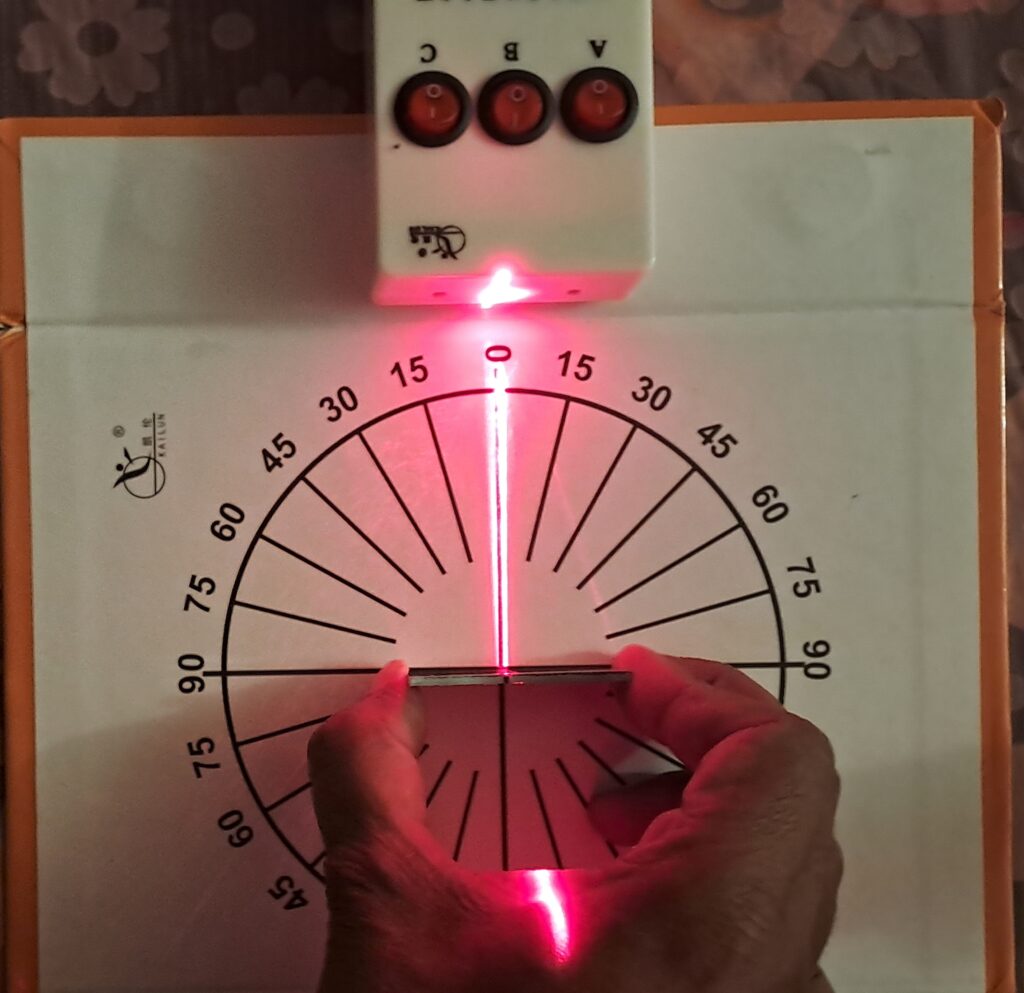
Now let’s see what happens if we made the angle of incidence to become 0 degree. You might have guess that the angle of reflection will be become 0 degree. What this means is that reflected light beam will be reflected back in the same direction. That’s how plane mirror reflect the beam back to us. When we stand in front of the mirror, the light beam from our body hit upon the mirror and then reflected back to us in accordance with the Law of . That’s how we see our reflection in the plane mirror.
What Is a Mirror Made Of?
A mirror is more than just a shiny surface. It is carefully engineered using several layers:
Glass Sheet
The front layer of a mirror is usually flat, smooth glass. The glass itself is transparent and mainly acts as a protective layer.
Reflective Coating
Behind the glass lies a thin layer of metallic coating, usually aluminum or silver.
This layer is the real part that reflects light. Silver was used in old mirrors (hence “silvered glass”), but modern mirrors often use aluminum because it resists oxidation better.
Protective Backing
To prevent the metal from tarnishing, mirrors are coated with a protective paint at the back. This keeps the reflective layer safe from scratches and moisture.