
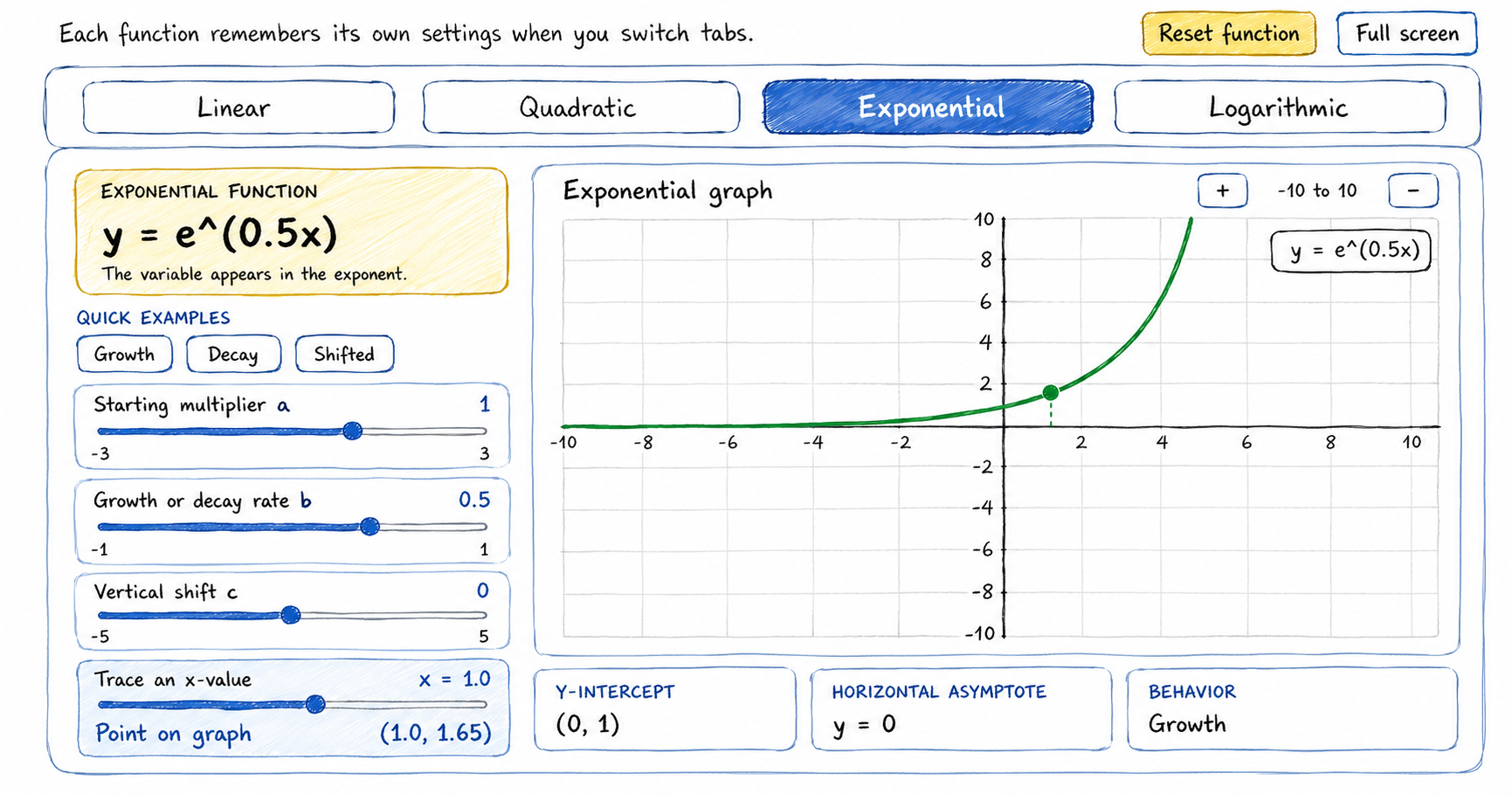
Use this interactive math functions graph tool to explore linear, quadratic, exponential, and logarithmic functions by changing coefficients and observing each graph.
How to use the interactive math functions graph tool
Select a function family, adjust its coefficients, and compare the equation with the graph and calculated features.
Choose a function
Select Linear, Quadratic, Exponential, or Logarithmic. Each tab remembers its own settings.
Adjust the coefficients
Move the sliders or load a quick example. The equation and graph update immediately.
Trace a point
Choose an x-value to locate a point and calculate its corresponding y-value.
Read the graph features
Study the intercepts, vertex, roots, asymptotes, domain, or growth behavior shown beneath the graph.
Four types of mathematical functions
Linear functions
y = mx + cA linear function has a constant rate of change and forms a straight line. The coefficient m is the slope, and c is the y-intercept.
Quadratic functions
y = ax2 + bx + cA quadratic function forms a parabola. The sign of a determines whether it opens upward or downward.
Exponential functions
y = aebx + cAn exponential function models repeated growth or decay. Its horizontal asymptote is y = c.
Logarithmic functions
y = a ln(x – h) + cA logarithmic function has the domain x > h and a vertical asymptote at x = h.
Worked graph examples
Linear: For y = 2x + 1, the slope is 2 and the graph crosses the y-axis at (0, 1).
Quadratic: For y = x2 – 4x + 3, the vertex is (2, -1), and the real roots are x = 1 and x = 3.
Exponential: For y = 2e-0.5x, the function decays, crosses the y-axis at (0, 2), and approaches y = 0.
Logarithmic: For y = ln(x – 2), the domain is x > 2, the vertical asymptote is x = 2, and the x-intercept is x = 3.
How coefficients transform a graph
Vertical scale and reflection
A leading multiplier changes vertical stretch. A negative multiplier can reflect a graph across the x-axis.
Vertical movement
Adding a constant c shifts a graph upward or downward. For exponential functions, it also moves the horizontal asymptote.
Horizontal movement
In ln(x – h), the value h moves the logarithmic graph and its vertical asymptote horizontally.
Rate and direction
The slope m controls a linear rate. The value b controls exponential growth or decay and contributes to a quadratic graph’s position.
Ideas for function graph practice
- Set the linear slope to zero. Explain why the resulting graph is horizontal.
- Compare quadratic functions with positive and negative values of a.
- Adjust b in an exponential function from positive to negative and describe the change.
- Move h in a logarithmic function and track the vertical asymptote.
- Predict a y-value before moving the trace slider, then verify it on the graph and value table.
Frequently asked questions
What is a mathematical function?
A function assigns exactly one output value to each allowed input value. The graph displays the ordered pairs that satisfy its equation.
What does an undefined value mean?
It means the selected x-value is outside the function’s real-number domain. For example, ln(x – h) is undefined when x is less than or equal to h.
Why does a quadratic function form a parabola?
The squared input causes the rate of change to vary, creating a curved graph with a vertex rather than a straight line.
What is an asymptote?
An asymptote is a line that a graph approaches. Exponential functions in this tool have a horizontal asymptote, while logarithmic functions have a vertical asymptote.
Why can the graph extend beyond the visible grid?
Some functions grow quickly. Use the zoom buttons to change the displayed coordinate range and inspect more or less of the graph.
Use this interactive math functions graph tool to explore linear, quadratic, exponential, and logarithmic functions by changing coefficients and observing each graph.
How to use the interactive math functions graph tool
Select a function family, adjust its coefficients, and compare the equation with the graph and calculated features.
Choose a function
Select Linear, Quadratic, Exponential, or Logarithmic. Each tab remembers its own settings.
Adjust the coefficients
Move the sliders or load a quick example. The equation and graph update immediately.
Trace a point
Choose an x-value to locate a point and calculate its corresponding y-value.
Read the graph features
Study the intercepts, vertex, roots, asymptotes, domain, or growth behavior shown beneath the graph.
Four types of mathematical functions
Linear functions
y = mx + cA linear function has a constant rate of change and forms a straight line. The coefficient m is the slope, and c is the y-intercept.
Quadratic functions
y = ax2 + bx + cA quadratic function forms a parabola. The sign of a determines whether it opens upward or downward.
Exponential functions
y = aebx + cAn exponential function models repeated growth or decay. Its horizontal asymptote is y = c.
Logarithmic functions
y = a ln(x – h) + cA logarithmic function has the domain x > h and a vertical asymptote at x = h.
Worked graph examples
Linear: For y = 2x + 1, the slope is 2 and the graph crosses the y-axis at (0, 1).
Quadratic: For y = x2 – 4x + 3, the vertex is (2, -1), and the real roots are x = 1 and x = 3.
Exponential: For y = 2e-0.5x, the function decays, crosses the y-axis at (0, 2), and approaches y = 0.
Logarithmic: For y = ln(x – 2), the domain is x > 2, the vertical asymptote is x = 2, and the x-intercept is x = 3.
How coefficients transform a graph
Vertical scale and reflection
A leading multiplier changes vertical stretch. A negative multiplier can reflect a graph across the x-axis.
Vertical movement
Adding a constant c shifts a graph upward or downward. For exponential functions, it also moves the horizontal asymptote.
Horizontal movement
In ln(x – h), the value h moves the logarithmic graph and its vertical asymptote horizontally.
Rate and direction
The slope m controls a linear rate. The value b controls exponential growth or decay and contributes to a quadratic graph’s position.
Ideas for function graph practice
- Set the linear slope to zero. Explain why the resulting graph is horizontal.
- Compare quadratic functions with positive and negative values of a.
- Adjust b in an exponential function from positive to negative and describe the change.
- Move h in a logarithmic function and track the vertical asymptote.
- Predict a y-value before moving the trace slider, then verify it on the graph and value table.
Frequently asked questions
What is a mathematical function?
A function assigns exactly one output value to each allowed input value. The graph displays the ordered pairs that satisfy its equation.
What does an undefined value mean?
It means the selected x-value is outside the function’s real-number domain. For example, ln(x – h) is undefined when x is less than or equal to h.
Why does a quadratic function form a parabola?
The squared input causes the rate of change to vary, creating a curved graph with a vertex rather than a straight line.
What is an asymptote?
An asymptote is a line that a graph approaches. Exponential functions in this tool have a horizontal asymptote, while logarithmic functions have a vertical asymptote.
Why can the graph extend beyond the visible grid?
Some functions grow quickly. Use the zoom buttons to change the displayed coordinate range and inspect more or less of the graph.


A really good blog and me back again.
wish you best and best