

A magnifying glass looks like a very simple object: just a curved piece of transparent glass or plastic held inside a frame. Yet when you place it over tiny writing, an insect, a leaf, or a small electronic component, the object suddenly appears much larger.
But the magnifying glass does not actually make the object grow. Instead, it changes the way light travels into your eyes, making your brain see a larger image of the object.
The science behind this effect comes from an important property of light called refraction and from the special shape of the lens inside a magnifying glass.
Let us explore how it works.
What Is a Magnifying Glass?
A magnifying glass is a simple optical instrument containing a convex lens. For more details regarding optical lens, please refer to Optical Lenses: Different Types, Uses, and Practical Applications
A convex lens is:
- thicker in the middle
- thinner around the edges
- curved outward on both sides, or sometimes on one side only
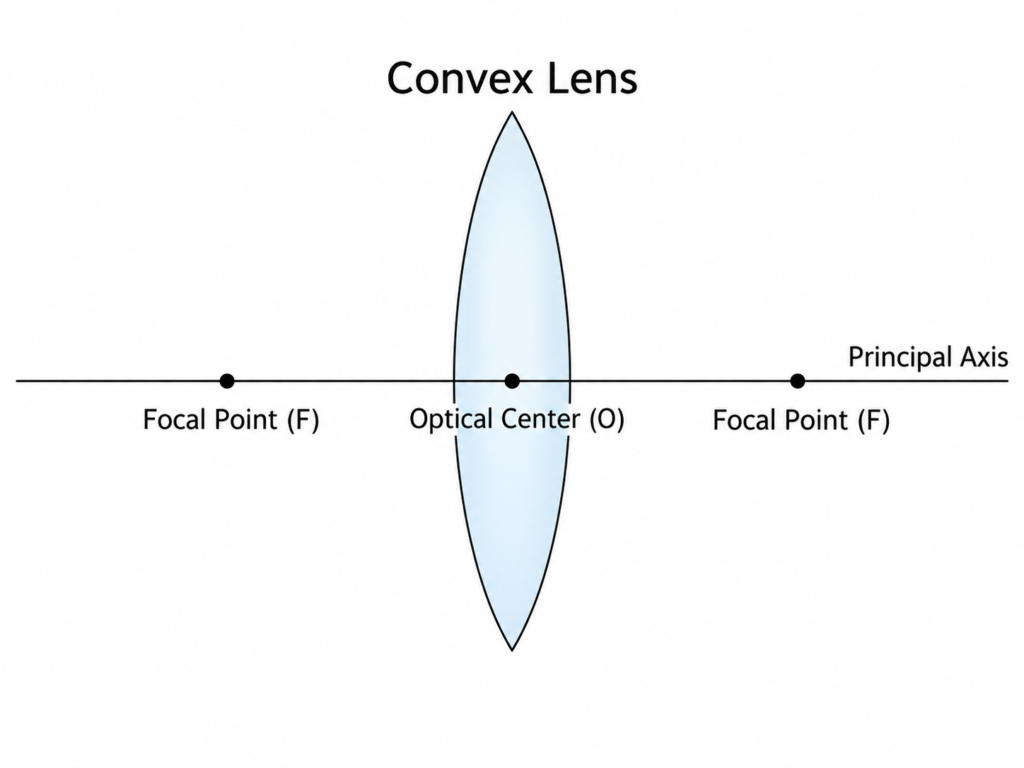
Its curved shape allows the lens to bend light rays in a controlled way.
This bending of light is what creates the magnifying effect.
Why Does Light Bend in a Lens?
Light normally travels in straight lines when it moves through the same material.
However, when light passes from one material into another, such as from:
air → glass → air
its speed changes slightly.
This change in speed causes the light ray to change direction.
The bending of light as it passes from one material to another is called refraction.
Because a magnifying glass has curved surfaces, different light rays enter the lens at different angles. As a result, the rays are bent by different amounts.
The lens uses this refraction to redirect light and create an image.
What Does a Convex Lens Do to Light?
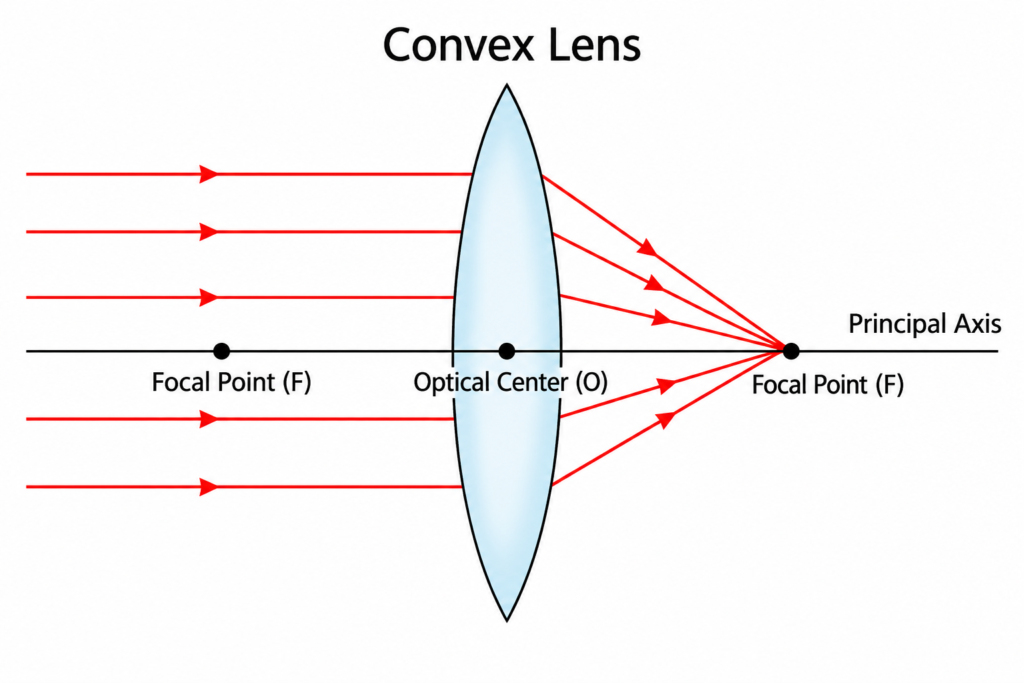
Imagine several parallel rays of light entering a convex lens.
As they pass through the lens, they bend inward and move toward one another.
If the rays are allowed to continue, they eventually meet at a point called the focal point.
The distance between the center of the lens and this point is called the focal length.
So a convex lens is often called a converging lens because it can bring parallel light rays together.
However, a magnifying glass works slightly differently when an object is placed very close to the lens.
Where Must the Object Be Placed?
This is the key to how a magnifying glass works.
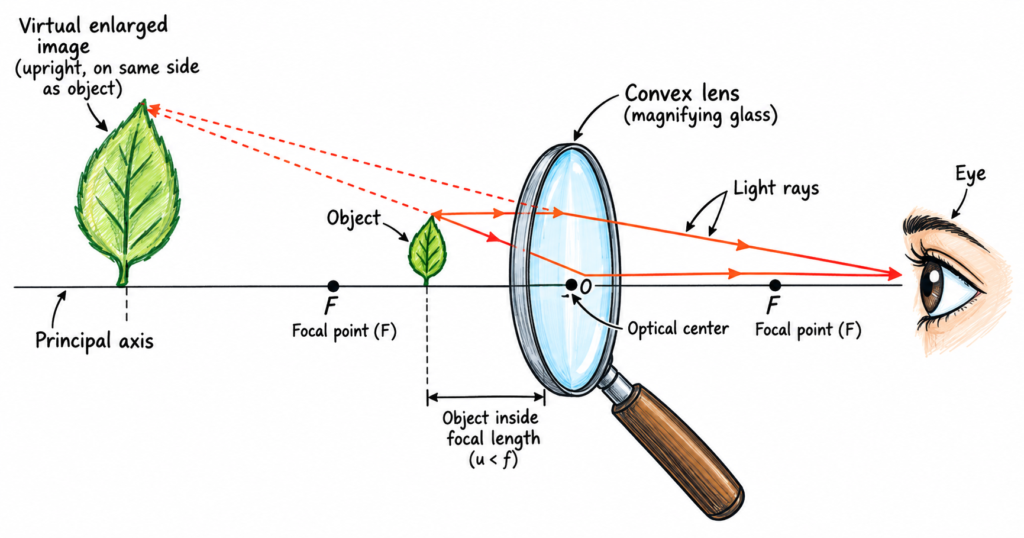
To use a convex lens as a magnifying glass, the object must be placed closer to the lens than the focal point.
In other words:
Object distance < Focal length
When the object is placed in this position, the light rays leaving the object pass through the convex lens and are refracted. The rays leaving the lens spread apart rather than actually meeting on the other side. Your eyes receive these rays and naturally assume that light has traveled in straight lines. Your brain therefore traces the rays backward. The rays appear to come from a larger object located behind the actual object. This produces what is called a virtual image.
What Is a Virtual Image?
A virtual image is an image formed when light rays only appear to come from a particular location.
The rays do not physically meet there.
When you look through a magnifying glass, the image you see is usually:
- virtual
- upright
- larger than the original object
This is the familiar magnified image seen when reading fine print or examining a small object.
Why Does the Image Look Bigger?
Your brain judges the apparent size of an object partly from the angle that the object occupies in your field of view. This angle is called the angular size. A small object held far away occupies only a small angle in your vision.
If you move the object closer to your eye, it appears larger because it occupies a larger angle. But your eye cannot focus comfortably on objects that are extremely close. A magnifying glass solves this problem.
It bends the light from a nearby object so that your eye can focus on it while the object appears to occupy a larger angle.
Therefore, the object appears bigger. The lens has not physically enlarged the object. It has increased its apparent angular size.
A Simple Example
Imagine trying to read a tiny printed letter. Without a magnifying glass, you might move the paper closer to your eye.
As the paper moves closer, the letter appears larger. Eventually, however, the paper becomes too close for your eye to focus clearly. Now place a magnifying glass between your eye and the letter.
If the letter is inside the focal length of the lens, the magnifying glass bends the light so that your eye can still focus on it. At the same time, the letter appears to subtend a larger angle. The result is a clear, enlarged image.
Why Does Moving the Magnifying Glass Change the Image?
You may have noticed that the image changes dramatically when you move a magnifying glass closer to or farther away from an object.
This happens because the image formed by a convex lens depends strongly on the object’s position relative to the focal point.
Object Inside the Focal Length
When the object is closer to the lens than the focal point:
- the image is virtual
- the image is upright
- the image is enlarged
This is how a magnifying glass is normally used.
Object at the Focal Point
If the object is placed approximately at the focal point, the light rays leaving the lens become almost parallel.
The image appears extremely far away.
Object Beyond the Focal Point
If the object is moved beyond the focal point, something interesting happens.
The light rays actually meet on the opposite side of the lens. The lens then produces a real image.
Depending on the object’s distance, this real image may be enlarged or reduced, but it will normally appear upside down. This is why an object may suddenly look inverted when you move a magnifying glass far enough away from it.
How Strong Is a Magnifying Glass?
Not all magnifying glasses enlarge objects by the same amount. Their magnifying power depends largely on their focal length.
A lens with a shorter focal length usually provides stronger magnification. This is why powerful hand lenses often have:
- greater curvature
- shorter focal lengths
- smaller usable viewing areas
A typical handheld magnifying glass may provide a magnification of around 2× to 10×, depending on its design.
A 5× magnifying glass, for example, makes an object appear roughly five times larger in angular size than it would under a standard viewing condition.
What Is Happening to the Light Rays?
Suppose a tiny arrow is placed just in front of a convex lens and inside its focal length.
Light from the top of the arrow travels in many directions. Some of those rays enter the lens. The curved lens bends the rays as they pass through it. After leaving the lens, the rays spread toward your eye. Your brain assumes that these rays have traveled in straight lines and mentally extends them backward. Those backward extensions appear to meet behind the object.
Because they seem to meet farther apart than the actual rays originated, the virtual image appears larger than the real object. This ray behavior is the core reason a magnifying glass magnifies.
Does a Magnifying Glass Actually Add Detail?
A magnifying glass does not create information that was not already present in the light coming from the object.
Instead, it spreads the object’s visual details over a larger area of your retina. This can make details easier for your eyes to distinguish.
However, magnification has limits.
Eventually, imperfections in the lens, diffraction, and the object’s own available detail limit how much useful information can be seen.
This is why scientists use microscopes rather than extremely powerful single magnifying glasses when they need much greater magnification.
Why Are the Edges Sometimes Blurry?
Simple magnifying glasses are not perfect optical systems.
Light rays traveling through different parts of the lens may not all focus in exactly the same way.
This can create optical imperfections called aberrations.
For example:
Spherical Aberration
Rays passing near the edge of a simple curved lens may focus differently from rays passing near the center. This can cause blurry areas.
Chromatic Aberration
Different colors of light refract by slightly different amounts.
As a result, you may sometimes notice colored fringes around the edges of objects.
More advanced optical instruments use several lenses together to reduce these effects.
Why Can a Magnifying Glass Focus Sunlight?
You may have seen a magnifying glass concentrate sunlight into a tiny bright spot. This happens because sunlight reaching Earth is approximately made of parallel rays.
A convex lens bends these rays inward and brings them together near its focal point. When a large amount of sunlight is concentrated into a small area, that spot can become very hot.
This is another demonstration of the same optical property that makes a magnifying glass useful: its ability to refract and redirect light.
Safety note: Never use a magnifying glass to look directly at the Sun. Concentrated sunlight can permanently damage the eyes.
Is a Magnifying Glass the Same as a Microscope?
A magnifying glass and a microscope both use lenses, but they are not the same.
A magnifying glass normally uses one main convex lens.
A compound microscope uses at least two important lens systems:
- an objective lens
- an eyepiece lens
The objective first forms an enlarged image of a tiny object.
The eyepiece then magnifies that image again.
This allows microscopes to achieve much greater magnification than ordinary magnifying glasses.
In a way, a magnifying glass is one of the simplest members of a much larger family of optical instruments.
Where Are Magnifying Lenses Used?
The principle of magnification appears in many everyday and scientific devices, including:
- reading magnifiers
- microscopes
- telescopes
- binoculars
- cameras
- projectors
- smartphone camera systems
- inspection equipment
Although these instruments can contain many lenses, they all rely on the same fundamental idea: control the path of light using refraction.
Conclusion
A magnifying glass magnifies an object because its convex lens bends light by refraction, creating a larger upright virtual image when the object is placed inside the lens’s focal length.