
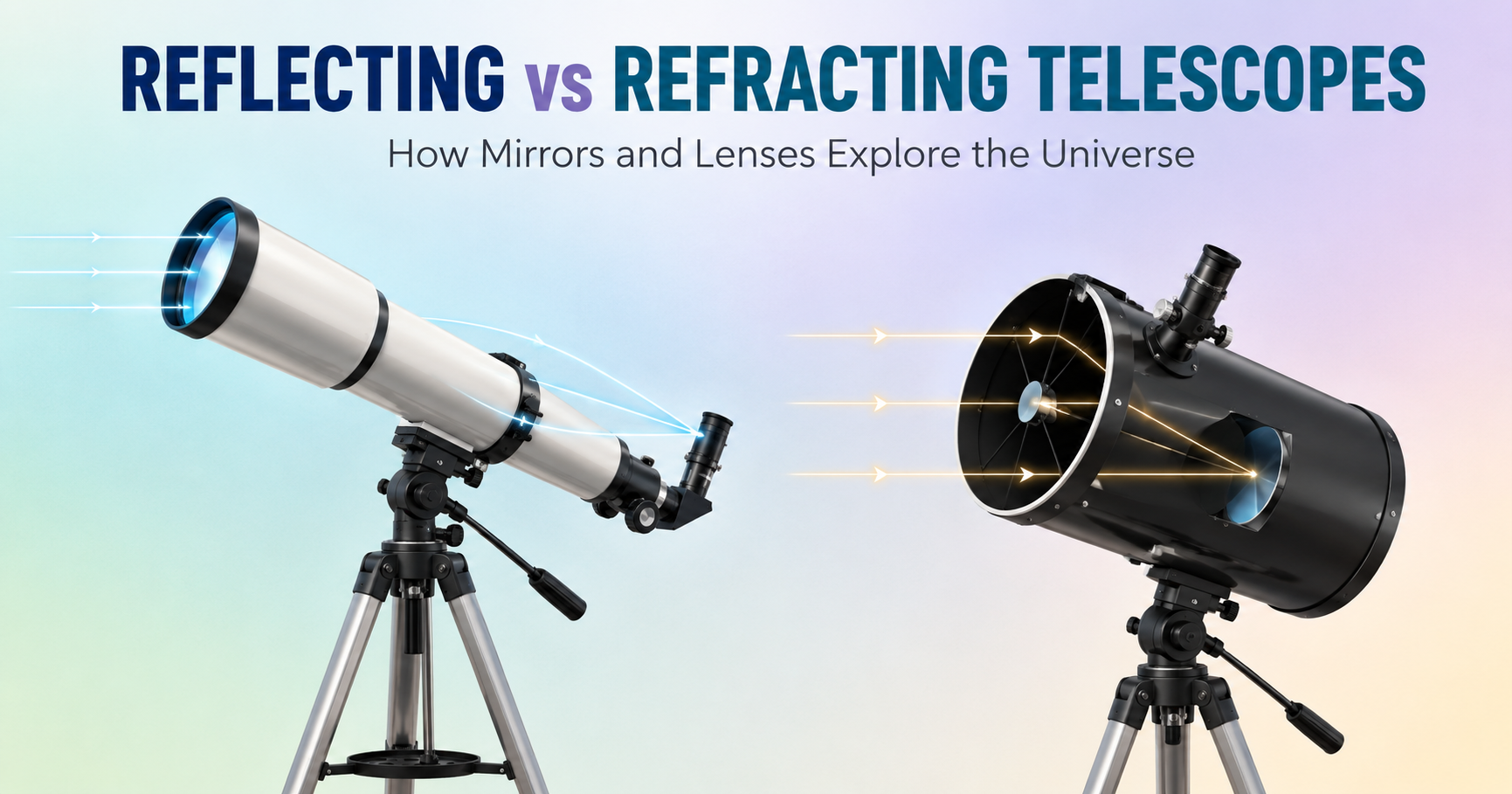
When you look at pictures of telescopes, you may notice that some have long tubes with lenses, while others have shorter tubes with mirrors. These two designs represent the two main types of telescopes: refracting telescopes and reflecting telescopes.
Both are designed to collect light from distant objects and make them appear larger and brighter, but they use different methods to achieve this goal.
How Telescopes Help Us See Distant Objects
Stars, planets, and galaxies are incredibly far away. Although they may appear bright in the night sky, only a small amount of their light reaches Earth.
A telescope gathers more light than the human eye can collect. The more light it gathers, the more details astronomers can observe.
The key difference between telescope types lies in how they focus that light.
What Is a Refracting Telescope?
A refracting telescope uses lenses to bend and focus light.
At the front of the telescope is a large lens called the objective lens. As light passes through this lens, it bends (or refracts) and comes together at a focal point. An eyepiece then magnifies the image for the observer.
How It Works?
When light enter through the objective lens, the lens bends the incoming light rays. The objective lens are convergent lens which converges light at a focal point For more details about convergent lens, please refer to Optical Lenses: Different Types, Uses, and Practical Applications. The eyepiece magnifies the image enabling user to see that magnified image.
Components of Refracting Telescope

Following are main the components of reflecting telescope:
1. Objective Lens
The objective lens is the large lens located at the front of the telescope.
It has following functions:
- Collects incoming light from distant objects.
- Bends (refracts) the light rays.
- Focuses the light to form an image inside the telescope.
The objective lens is the primary light-gathering component of a refractor.
2. Eyepiece
The eyepiece is positioned at the rear of the telescope.
- Magnifies the image formed by the objective lens.
- Allows the observer to view distant objects in greater detail.
It has following functions:
Changing the eyepiece changes the magnification.
3. Optical Tube
The optical tube connects the objective lens and eyepiece.
It has following functions:
- Maintains the correct distance between optical components.
- Prevents stray light from entering the system.
- Protects the lenses.
4. Focuser
The focuser is located near the eyepiece.
It has following functions:
- Adjusts the position of the eyepiece.
- Helps produce a clear and sharp image.
5. Diagonal Mirror or Prism (Optional)
Many modern refracting telescopes include a star diagonal, which contains either a mirror or prism.
It has following functions:
- Bends the light path by 90 degrees.
- Makes viewing more comfortable, especially when observing objects high in the sky.
6. Mount and Tripod
Like all telescopes, refractors require a stable support system.
It has following functions:
- Holds the telescope securely.
- Allows smooth movement and tracking of celestial objects.
- Reduces vibrations during observation.
Advantages of Refracting Telescopes
- Produce sharp, high-contrast images.
- Require little maintenance because the optical system is sealed.
- Excellent for observing the Moon and planets.
Disadvantages of Refracting Telescopes
- Large lenses are expensive to manufacture.
- Heavy lenses can sag under their own weight.
- Different colors of light bend by different amounts, causing color fringes around objects (chromatic aberration).
What Is a Reflecting Telescope?
A reflecting telescope uses mirrors instead of lenses.
A large curved mirror at the back of the telescope collects incoming light and reflects it toward a focal point. A smaller mirror redirects the light to an eyepiece or camera.
The most common type of reflecting telescope is Newton reflector which was invented by Sir Isaac Newton.
How It Works?
When light enter the telescope, a curved primary mirror reflects the light. The reflected converges toward a focal point. A secondary mirror redirects the light to the eyepiece.
Components of Reflecting Telescope

Following are main the components of reflecting telescope:
1. Primary Mirror
The primary mirror is the largest and most important optical component. It is a curved mirror having parabolic shape and located at the back of the telescope tube.
It has following functions:
- Collects incoming light from distant objects.
- Reflects and focuses the light toward a focal point.
- Determines the telescope’s light-gathering power.
The larger the primary mirror, the more light the telescope can collect and the fainter the objects it can observe.
2. Secondary Mirror
The secondary mirror is a smaller mirror positioned near the front of the telescope.
It has following functions:
- Intercepts the focused light from the primary mirror.
- Redirects the light toward the eyepiece or camera.
- Makes viewing more convenient by placing the eyepiece on the side or rear of the telescope.
3. Eyepiece
The eyepiece is the lens through which the observer looks.
It has following functions:
- Magnifies the image formed by the mirrors.
- Determines the telescope’s magnification when combined with the telescope’s focal length.
Different eyepieces can provide different levels of magnification.
4. Optical Tube
The optical tube is the main body of the telescope.
It has following functions:
- Holds the mirrors in proper alignment.
- Blocks unwanted stray light.
- Protects optical components from dust and damage.
5. Focuser
The focuser is a mechanical device attached near the eyepiece.
It has following functions:
- Moves the eyepiece slightly inward or outward.
- Allows the observer to obtain a sharp image.
6. Mount and Tripod
The mount supports the telescope and allows it to move smoothly.
It has following functions:
- Keeps the telescope stable.
- Allows accurate tracking of celestial objects.
- Enables movement in different directions.
Advantages of Reflecting Telescopes
- Mirrors can be made much larger than lenses.Less expensive for large apertures.
- No chromatic aberration because mirrors reflect all colors equally.
- Ideal for observing faint deep-sky objects such as galaxies and nebulae.
Disdvantages of Reflecting Telescopes
- Require occasional alignment of mirrors (collimation).
- Open tube designs may collect dust.
- Secondary mirrors slightly block incoming light.
Why Do Large Observatories Use Reflecting Telescopes?
Almost all modern research telescopes use mirrors rather than lenses.
Large lenses become extremely heavy and difficult to support without distortion. Mirrors, however, can be supported from behind, allowing them to be much larger.
For example, the famous Hubble Space Telescope and the James Webb Space Telescope both rely on mirrors to collect light from distant regions of the universe. To know more about James Webb Space Telescope, click here.
Which Telescope Is Better?
Neither design is universally better. The best choice depends on what you want to observe.
- If you enjoy viewing the Moon, planets, and bright objects, a refracting telescope can provide excellent image quality.
- If you want to observe faint galaxies, nebulae, and star clusters, a reflecting telescope usually offers more light-gathering power for the same cost.
This is why many beginner astronomers choose small reflectors, while professional observatories almost always use large reflecting telescopes.
Key Takeaway
A refracting telescope focuses light using lenses, while a reflecting telescope focuses light using mirrors. Refractors are known for sharp planetary views and low maintenance, whereas reflectors can be built much larger and are better suited for exploring distant galaxies and other deep-sky objects. Both designs have played an important role in helping us understand the universe.