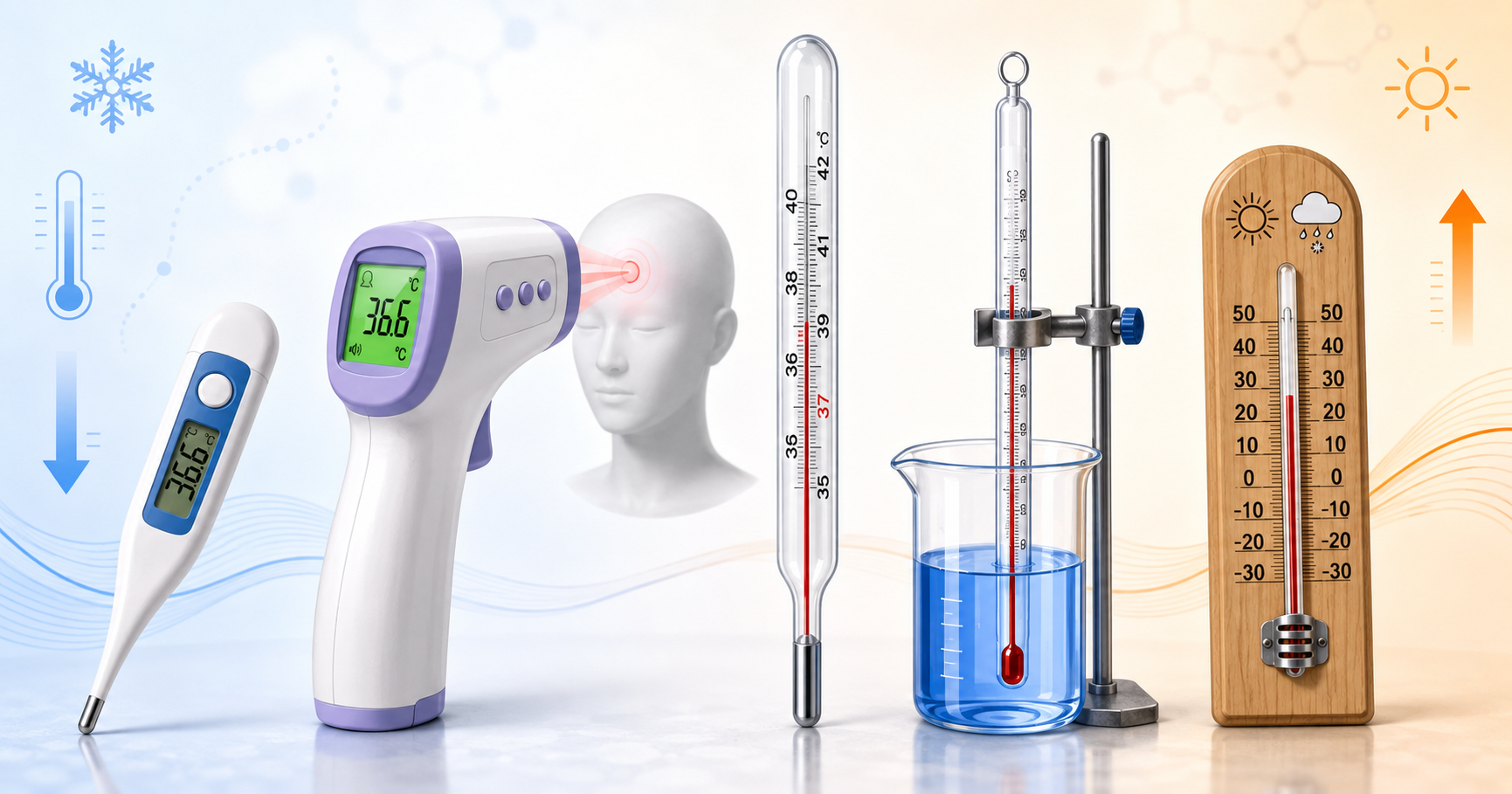
A thermometer is a simple but very useful tool. We use it to check body temperature, weather temperature, water temperature, food temperature, and even machine temperature. But have you ever wondered how a thermometer actually measures temperature?
A thermometer works by detecting how hot or cold something is. It does this by using materials that change when temperature changes. Some materials expand, some contract, some change electrical resistance, and some detect heat radiation. These changes help the thermometer show a temperature reading.
Let’s explore how a thermometer measures temperature in a simple and clear way.
What Is Temperature?
Before learning how a thermometer works, we first need to understand temperature.
Temperature tells us how hot or cold something is. Scientifically, it is related to how fast the tiny particles inside a substance are moving.
Everything around us is made of tiny particles called atoms and molecules. These particles are always moving.
When something is hot, its particles move faster.
When something is cold, its particles move slower.
So, temperature is a way of measuring the average motion energy of these tiny particles.
For example, in hot tea, the water molecules move quickly. In ice, the water molecules move much more slowly.
What Does a Thermometer Do?
A thermometer measures temperature and shows it as a number.
This number is usually shown in degrees Celsius, written as °C, or degrees Fahrenheit, written as °F. In science, temperature may also be measured in Kelvin, written as K.
For example:
Water freezes at 0°C.
Normal human body temperature is about 37°C.
Water boils at about 100°C at sea level.
The thermometer does not “see” temperature directly. Instead, it detects a physical change caused by temperature and converts that change into a readable number.
The Basic Idea Behind a Thermometer
Most thermometers work because materials respond to heat.
When a material is heated, its particles move faster and usually spread farther apart. This causes the material to expand.
When a material is cooled, its particles move slower and usually come closer together. This causes the material to contract.
This idea is called thermal expansion.
Older thermometers used this principle very clearly. A liquid inside a thin glass tube expanded when heated and moved upward. When cooled, the liquid contracted and moved downward.
The height of the liquid showed the temperature.
How a Liquid-in-Glass Thermometer Works
A traditional thermometer often has a small bulb at the bottom and a very thin glass tube above it. The bulb contains a liquid such as alcohol or mercury.
When the thermometer is placed in a warm place, heat enters the bulb. The liquid inside the bulb gets warmer and expands. Since the glass tube is very narrow, even a small expansion pushes the liquid upward.
When the thermometer is placed in a cold place, the liquid cools down and contracts. As it takes up less space, the level of liquid moves downward.
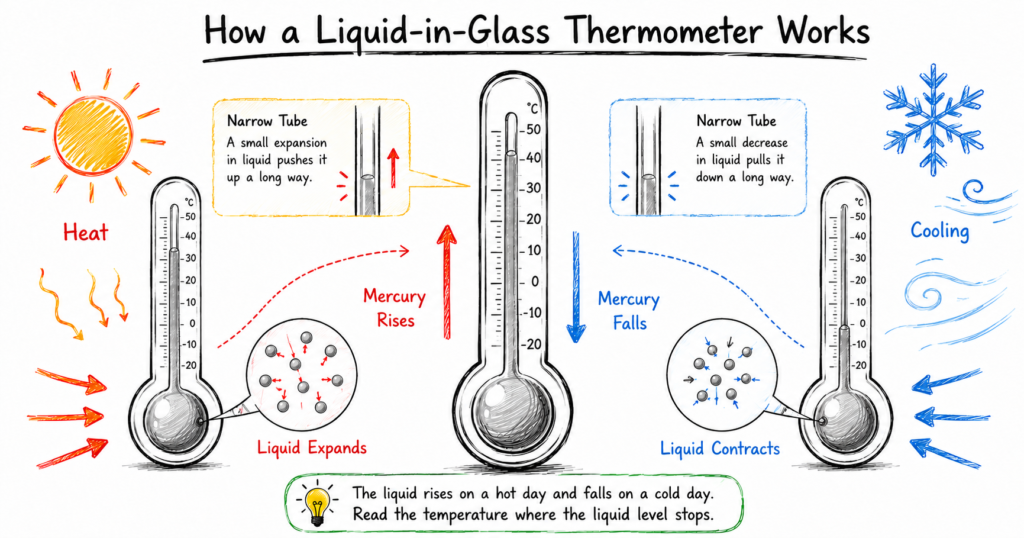
The glass tube has a temperature scale marked on it. By looking at where the liquid stops, we can read the temperature.
This is why the liquid rises on a hot day and falls on a cold day.
Why Is the Tube So Thin?
The tube in a liquid thermometer is very narrow for an important reason.
If the tube were wide, the liquid would not rise much when it expanded. The change would be difficult to see.
But in a very thin tube, even a tiny expansion makes the liquid move up noticeably. This makes the thermometer more sensitive and easier to read.
So, the narrow tube helps small temperature changes become visible.
Why Do Some Thermometers Use Colored Alcohol?
Many modern liquid thermometers use colored alcohol instead of mercury.
Alcohol is useful because it expands and contracts clearly with temperature changes. It can also be colored red, blue, or green, making it easy to see inside the glass tube.
Mercury was used in many older thermometers because it expands evenly and is shiny, so it is easy to read. However, mercury is toxic, which means it can be harmful if the thermometer breaks. Because of this, mercury thermometers are now less common in many homes and schools.
How Does a Digital Thermometer Work?
A digital thermometer does not use a rising liquid. Instead, it uses an electronic sensor.
Inside many digital thermometers, there is a tiny part called a thermistor. A thermistor is a special material whose electrical resistance changes when temperature changes.
Electrical resistance means how strongly a material resists the flow of electric current.
When the temperature changes, the thermistor’s resistance changes too. The thermometer’s tiny electronic circuit measures this change and converts it into a temperature reading.
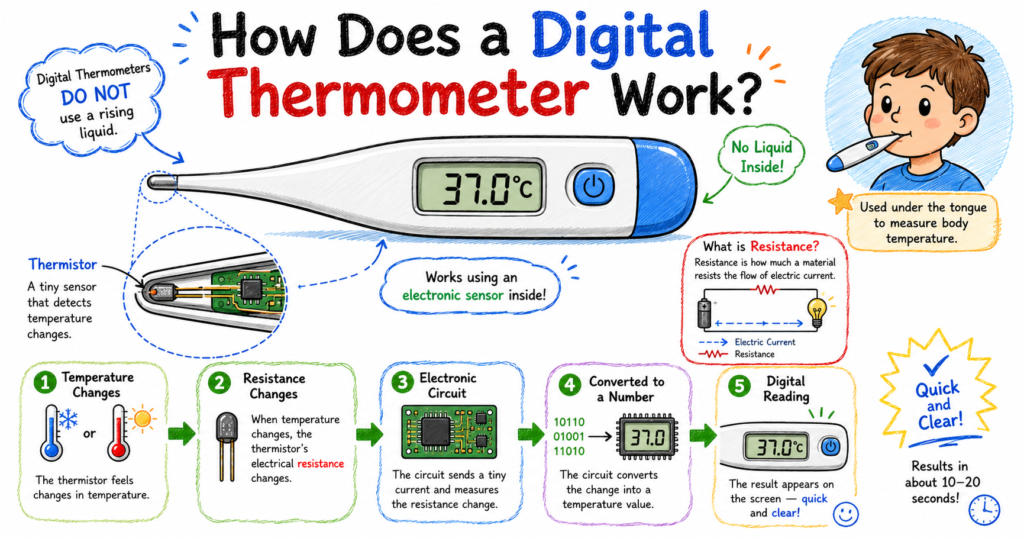
That reading appears on the digital screen.
This is why digital thermometers can show numbers quickly and clearly.
How Does an Infrared Thermometer Work?
An infrared thermometer can measure temperature without touching an object.
This type of thermometer detects infrared radiation. Infrared radiation is a kind of heat energy that warm objects give off.
Every object emits some infrared radiation. Hotter objects emit more of it.
An infrared thermometer has a sensor that detects this radiation. Then its electronics calculate the surface temperature of the object and show it on the display.
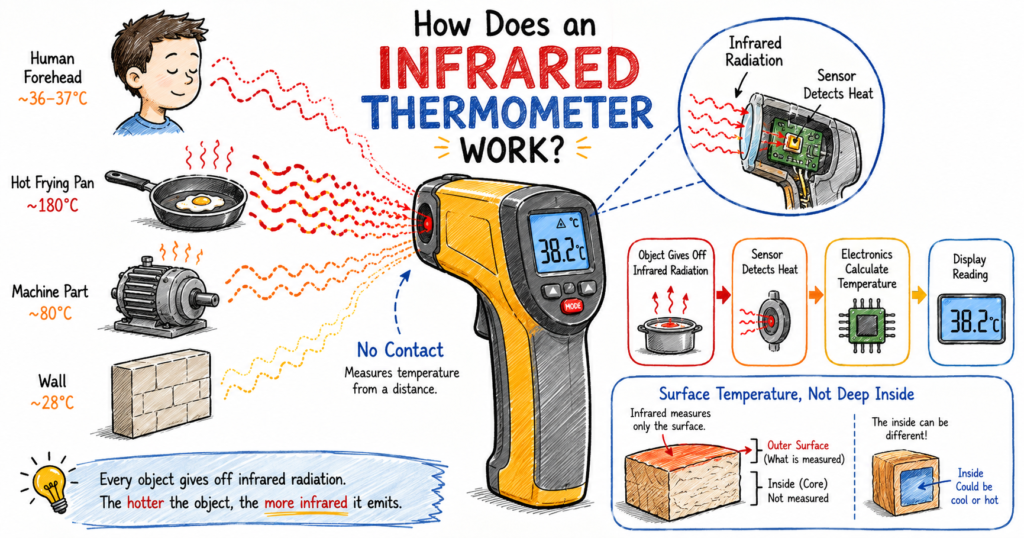
This is why an infrared thermometer can measure the temperature of a forehead, hot pan, machine part, or wall from a short distance.
However, infrared thermometers usually measure surface temperature, not the temperature deep inside an object.
Why Does a Thermometer Need Time to Show the Correct Reading?
A thermometer often needs a little time before it shows the correct temperature. This is because heat must transfer between the object and the thermometer.
For example, when you place a thermometer under your tongue, the thermometer is usually cooler than your body at first. Heat moves from your mouth into the thermometer. After a short time, the thermometer reaches the same temperature as that part of your body.
This is called thermal equilibrium.
Thermal equilibrium happens when two objects in contact reach the same temperature. Once this happens, the thermometer can give a more accurate reading.
Digital thermometers are designed to detect this change quickly, while older glass thermometers may take longer.
How Is a Thermometer Calibrated?
A thermometer needs a proper scale so that its readings are accurate. This process is called calibration.
Calibration means comparing the thermometer with known temperature points.
For example, scientists know that pure water freezes at 0°C and boils at 100°C at sea level. These points can be used to mark a temperature scale.
Once the thermometer is calibrated, it can show other temperatures correctly between or beyond these points.
Without calibration, a thermometer might still respond to heat, but the numbers shown might not be accurate.
Common Types of Thermometers
There are many types of thermometers, and each one is useful for a different purpose.
1. Clinical Thermometer
A clinical thermometer is used to measure body temperature. It can be digital, infrared, or liquid-based. Doctors and families use it to check for fever.
2. Weather Thermometer
A weather thermometer measures air temperature. It is often placed outdoors in a shaded area so sunlight does not directly heat it and give a false reading.
3. Kitchen Thermometer
A kitchen thermometer measures the temperature of food. It helps check if food is cooked properly and safely.
4. Laboratory Thermometer
A laboratory thermometer is used in science experiments. It can measure the temperature of liquids, gases, or other materials during experiments.
5. Infrared Thermometer
An infrared thermometer measures surface temperature without touching the object. It is useful when the object is too hot, too far, or unsafe to touch.
Why Temperature Measurement Matters
Temperature measurement is important in everyday life and science.
Doctors use thermometers to check if someone has a fever. Weather stations use them to report daily temperature. Scientists use thermometers during experiments. Engineers use them to monitor machines. Cooks use them to check food safety.
Without thermometers, it would be much harder to understand and control heat in our world.
Can a Thermometer Be Wrong?
Yes, a thermometer can give an incorrect reading if it is not used properly.
For example, a weather thermometer placed in direct sunlight may show a temperature higher than the actual air temperature. A body thermometer removed too early may not show the correct body temperature. An infrared thermometer may give a wrong reading if it is held too far away or pointed at a shiny surface.
To get better results, thermometers should be used according to their instructions.
Fun Fact About Temperature
Temperature is not the same as heat.
Temperature tells us how hot or cold something is. Heat is energy that moves from a warmer object to a cooler object.
For example, a cup of hot tea has a high temperature. A bathtub of warm water may have a lower temperature than the tea, but it contains much more total heat energy because it has much more water.
So, temperature and heat are related, but they are not exactly the same thing.
Conclusion
A thermometer measures temperature by detecting a change caused by heating or cooling. In a liquid thermometer, the liquid expands and rises when heated, then contracts and falls when cooled. In a digital thermometer, an electronic sensor changes its electrical resistance with temperature. In an infrared thermometer, a sensor detects heat radiation from an object’s surface.
The main idea is simple: temperature changes cause physical changes, and the thermometer converts those changes into numbers we can read.
So, the next time you use a thermometer, remember that it is not just showing a number. It is using science to translate tiny changes in matter or energy into a temperature reading we can understand.