Have you ever seen an image where people, animals, or machines appear in bright colors such as red, orange, yellow, blue, and purple—even in complete darkness?
That is called thermal imaging.
Thermal imaging allows us to “see” heat. Instead of detecting visible light like an ordinary camera, a thermal camera detects a type of electromagnetic radiation called infrared radiation. Because almost every object around us gives off infrared radiation, thermal cameras can reveal temperature differences that our eyes cannot see.
But how does a thermal camera turn invisible heat radiation into a colorful picture? Let’s find out.
What Is Thermal Imaging?
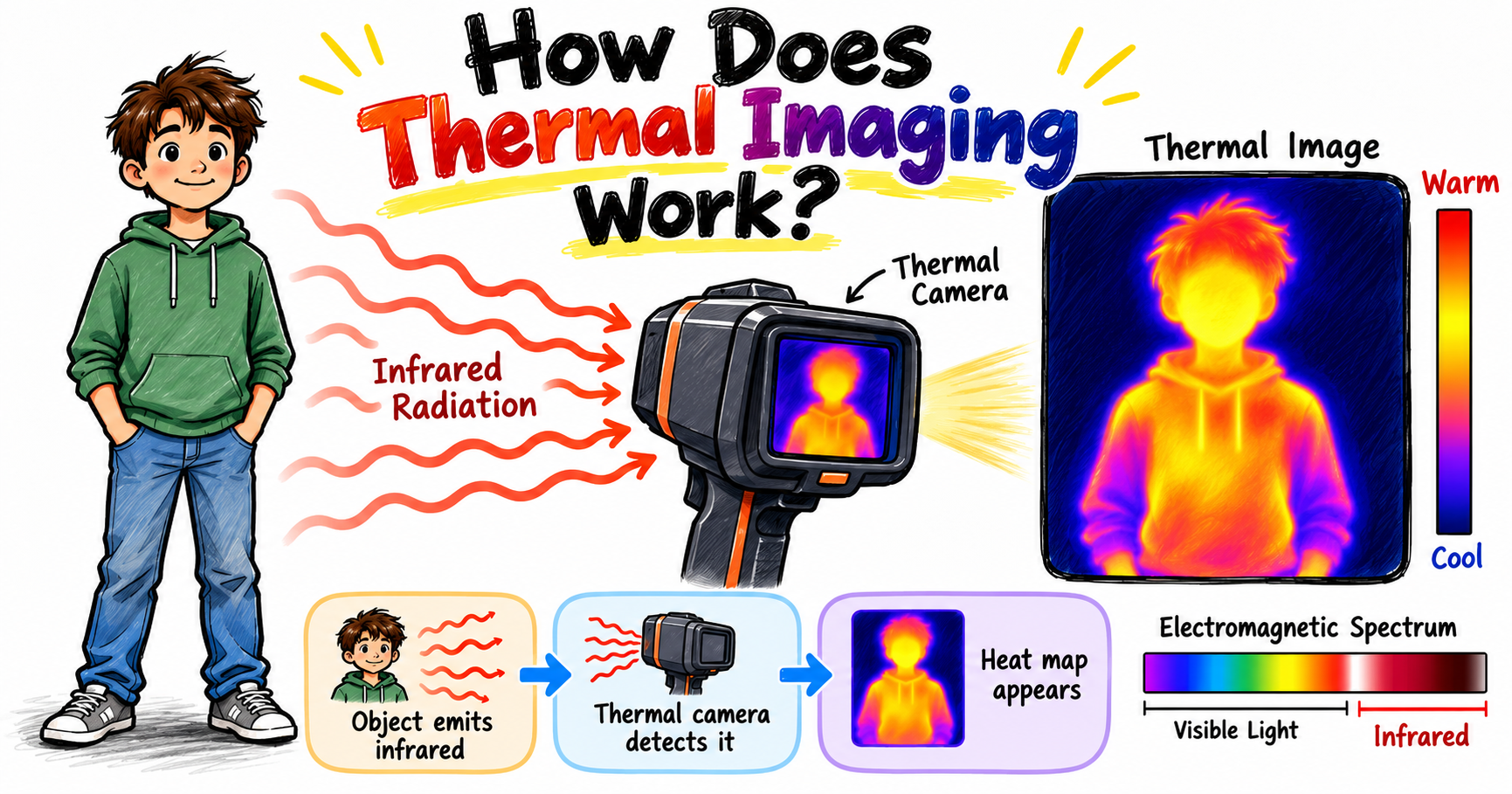
Thermal imaging is a technology that detects infrared radiation emitted by objects and converts it into an image showing differences in temperature.
A thermal camera does not photograph heat directly. Instead, it measures the infrared energy reaching its sensor from different parts of a scene. The camera then converts those measurements into an image called a thermogram.
Warmer and cooler areas can be displayed using different colors or shades.
For example:
- hotter areas may appear white, yellow, orange, or red
- cooler areas may appear blue, purple, or black
The exact colors depend on the color palette selected on the thermal camera.
Thermal Cameras Detect Infrared Radiation
To understand thermal imaging, we first need to understand infrared radiation.
Visible light is only a small part of the electromagnetic spectrum.
The electromagnetic spectrum includes:
- radio waves
- microwaves
- infrared radiation
- visible light
- ultraviolet radiation
- X-rays
- gamma rays
Infrared radiation lies just beyond the red end of visible light. For more details about electromagnetic spectrum, refer to Electromagnetic Spectrum Explorer
Human eyes cannot normally see infrared radiation, but we can often experience its effects as warmth.
All objects with a temperature above absolute zero emit electromagnetic radiation.
The amount and wavelength distribution of this radiation depend on the object’s temperature.
Many everyday objects at normal temperatures emit much of their detectable thermal radiation in the infrared region of the electromagnetic spectrum.
A thermal camera is designed to detect this infrared radiation.
Ordinary Cameras vs Thermal Cameras
An ordinary digital camera detects mostly visible light.
Light from a lamp, the Sun, or another source reflects from objects and enters the camera.
The camera’s sensor measures this reflected visible light and forms an image.
A thermal camera works differently. Instead of relying mainly on reflected visible light, it detects infrared radiation associated with the temperatures of the objects in the scene.
That means thermal cameras can often work even when there is very little visible light. For example, imagine standing outside on a completely dark night.
An ordinary camera may struggle to see a person without additional lighting.
A thermal camera may still detect the person’s body because the body emits infrared radiation.
How Does a Thermal Camera Work?
A thermal imaging camera works through several important steps.
1. Objects Emit Infrared Radiation
Everything around us emits thermal radiation.
A person, animal, building, car engine, tree, or cup of hot water all emit infrared radiation.
Generally, warmer objects emit more thermal radiation than cooler objects.
The spectrum of radiation they emit also changes with temperature.
A person’s skin, for example, usually emits much more infrared radiation than a cold wall.
2. Infrared Radiation Enters the Camera
The infrared radiation from the scene enters the thermal camera through a special lens.
Ordinary glass is not always suitable for thermal imaging because some types of glass block much of the infrared radiation used by thermal cameras.
Thermal cameras may therefore use special lens materials such as germanium, which transmit infrared wavelengths used for thermal imaging.
The lens focuses the infrared radiation onto the camera’s detector.
3. The Detector Measures Infrared Energy
Inside the camera is an infrared detector containing many tiny sensing elements called pixels.
Each pixel measures infrared radiation coming from a small part of the scene.
One common type of thermal detector is called a microbolometer.
A microbolometer absorbs infrared radiation.
When it absorbs radiation, its temperature changes slightly.
This tiny change affects one of the detector material’s electrical properties.
The camera’s electronics measure these changes.
In this way, thousands—or even millions—of detector pixels can measure the infrared energy coming from different parts of the scene.
4. The Camera Creates a Temperature Map
The camera’s processor converts the detector signals into numerical values.
Using calibration data and information about how infrared radiation behaves, the camera estimates the apparent temperatures of different parts of the scene.
These measurements form a two-dimensional temperature map.
This is the basic information behind a thermal image.
5. The Temperature Map Becomes an Image
Humans cannot see infrared radiation directly, so the camera converts the temperature information into something our eyes can understand.
Each temperature range is assigned a shade or color.
Instead, they represent temperature differences.
This type of artificial coloring is known as a false-color palette because the colors do not represent the actual visible colors of the objects.
Why Do Thermal Images Use Bright Colors?
Thermal radiation itself is not red, yellow, or blue. Those colors are added by the camera. They make temperature differences easier to see. A thermal camera may offer several display modes.
White Hot
Hotter objects appear white. Cooler objects appear darker.
Hotter objects appear black.
Black Hot
Cooler objects appear lighter.
Rainbow or Ironbow
Different temperatures are displayed using different colors. These colorful palettes can make small temperature differences easier to notice.
For scientific measurements, however, the actual temperature data is more important than the decorative color palette.
Can Thermal Cameras See in Complete Darkness?
Yes—thermal cameras can often work in complete visible darkness.
That is because they do not require ordinary visible light to illuminate the scene.
Objects themselves emit infrared radiation.
This makes thermal cameras extremely useful at night.
For example, they can help detect:
- people
- animals
- warm machinery
- overheating electrical equipment
- vehicles
even when visible lighting is poor.
However, thermal imaging should not be confused with ordinary night vision.
Thermal Imaging vs Night Vision
Thermal cameras and night-vision cameras are different technologies.
Night Vision
Traditional night vision amplifies small amounts of available visible or near-infrared light.
It usually produces an image that looks similar to an ordinary scene, often with a green tint.
If there is absolutely no light, some night-vision systems need an infrared illuminator.
Thermal Imaging
Thermal imaging detects infrared radiation associated with temperature.
It does not need visible light reflected from an object.
That is why a warm person may stand out clearly against a cooler background.
Why Do Humans Show Up Clearly on Thermal Cameras?
The human body is usually warmer than many surrounding objects.
Human skin is often around 30–35°C, although the exact surface temperature varies with conditions.
The body continuously emits infrared radiation.
If the surrounding air, walls, or vegetation are cooler, the difference in emitted infrared radiation makes a person easy to distinguish.
That is why thermal cameras are widely used in:
- search and rescue
- firefighting
- security
- wildlife observation
Can Thermal Cameras See Through Walls?
This is a common misconception.
Thermal cameras cannot normally see through walls.
A thermal camera detects infrared radiation coming from the surface that faces the camera.
If a warm pipe is behind a wall, the camera does not normally see the pipe directly.
However, the pipe might warm the wall.
The thermal camera may then detect the warmer area on the wall’s surface.
This can make it appear as though the camera can see through the wall, but it is actually detecting a surface temperature difference.
Can Thermal Cameras See Through Glass?
Usually, not in the way people expect.
Ordinary glass allows visible light to pass through, but it blocks much of the long-wave infrared radiation detected by many thermal cameras.
Therefore, when you point a thermal camera at a window, you may mainly see the thermal radiation from the surface of the glass itself rather than the object behind it.
The glass may even reflect infrared radiation from other warm objects nearby.
What Is a Microbolometer?
A microbolometer is one of the most common sensors used in modern uncooled thermal cameras.
It contains an array of extremely small heat-sensitive detector elements.
When infrared radiation hits one of these elements, its temperature changes slightly.
This changes its electrical resistance.
The camera measures the resistance changes across the detector array.
From this information, it builds a thermal image.
Because microbolometers can work without cryogenic cooling systems, they have made thermal cameras smaller, cheaper, and more practical.
They are now used in devices ranging from industrial inspection cameras to handheld thermal imagers.
How Accurate Are Thermal Cameras?
Thermal cameras can be very useful for estimating surface temperatures, but several factors affect their accuracy.
One important factor is called emissivity.
What Is Emissivity?
Different materials emit infrared radiation differently.
Emissivity describes how effectively a surface emits thermal radiation compared with an ideal emitter.
Materials such as:
- human skin
- painted surfaces
- wood
- fabric
often have relatively high emissivity.
Shiny metals may have much lower emissivity and can strongly reflect infrared radiation from their surroundings.
That means a shiny metal object can sometimes appear warmer or cooler than it actually is because the camera may detect reflected infrared radiation.
Professional thermal measurements therefore require correct camera settings and careful interpretation.
What Can Thermal Imaging Be Used For?
Thermal imaging has many scientific, industrial, medical, and everyday applications.
Firefighting
Firefighters use thermal cameras to locate:
- people in smoke-filled rooms
- hidden hot spots
- fire behind surfaces
- safer escape routes
Smoke can block visible light, but thermal radiation may still provide useful information.
Search and Rescue
Thermal cameras can help rescuers locate people at night or in difficult environments.
A warm human body may be easier to detect against cooler terrain.
Electrical Inspection
Electrical components can become unusually hot before they fail.
Thermal cameras can reveal overheating:
- wires
- electrical panels
- transformers
- motors
- circuit breakers
This allows engineers to find potential problems before serious damage occurs.
Building Inspections
Thermal cameras can reveal temperature differences caused by:
- poor insulation
- air leaks
- heat loss
- moisture problems
- heating system faults
For example, a poorly insulated section of a wall may appear warmer from outside during cold weather because more heat is escaping through it.
Mechanical Maintenance
Machines often generate heat when operating.
An overheated bearing, motor, pump, or mechanical joint may indicate friction or another problem.
Thermal imaging helps maintenance engineers identify these hot spots.
Wildlife Observation
Researchers can use thermal cameras to observe animals at night without shining bright visible lights on them.
Warm animals may stand out clearly against cooler vegetation.
Medicine
Specialized thermal imaging techniques can measure differences in skin temperature.
However, thermal imaging alone generally cannot diagnose most diseases. Medical interpretation requires suitable equipment, controlled conditions, and trained professionals.
Thermal Imaging and Heat Transfer
Thermal cameras are also useful for learning about heat transfer.
Heat can move through:
- conduction
- convection
- radiation
A thermal camera can make some of these processes easier to observe.
For example, imagine placing one end of a metal rod in hot water.
Over time, thermal imaging could show the warmer region spreading along the rod.
This provides a visual demonstration of heat being transferred through conduction.
Similarly, thermal images of buildings can reveal heat escaping through walls, roofs, doors, and windows.
Does a Thermal Camera Measure Heat Directly?
Not exactly. A thermal camera measures infrared radiation, not heat itself. Heat refers to energy transferred between systems because of a temperature difference.
The camera detects electromagnetic radiation emitted and reflected by surfaces and uses that information to estimate temperature. This distinction is important.
A thermal camera is therefore better described as an infrared radiation detector that can estimate surface temperature.
Why Do Hotter Objects Emit More Infrared Radiation?
Atoms and molecules inside matter are constantly moving. The warmer an object becomes, the greater the average microscopic energy of its particles. Matter therefore interacts with electromagnetic radiation in ways that depend strongly on temperature.
Hotter objects generally emit more thermal radiation. As temperature increases, the wavelength at which thermal radiation is strongest also shifts toward shorter wavelengths. Very hot objects eventually begin emitting enough visible light to glow.
For example:
- a warm human emits mainly infrared radiation
- hot metal may glow red
- even hotter metal may glow orange, yellow, or white
This connection between temperature and electromagnetic radiation is one of the fundamental principles behind thermal imaging.
A Simple Example
Imagine two cups sitting on a table. One contains hot tea. The other contains cold water.
To your eyes, the cups may look almost identical. A thermal camera sees something very different. The cup containing hot tea emits more infrared radiation from its warm surfaces.
The cup containing cold water emits less. The thermal camera detects this difference and displays the cups using different shades or colors.
The hot cup might appear yellow or white, while the cold cup appears blue or purple. The camera has turned invisible infrared information into a visible image.
The Thermal Imaging Process in One Line
The entire process can be summarized as:
Object emits infrared radiation → infrared lens focuses radiation → detector measures it → electronics process the signal → software estimates temperature → thermal image appears on the screen
Thermal Imaging and the Electromagnetic Spectrum
Thermal imaging is an excellent example of why the electromagnetic spectrum is so important.
Human vision detects only a tiny range of electromagnetic wavelengths. Technology allows us to detect radiation that lies outside this visible range. Thermal cameras extend our senses into the infrared part of the spectrum.
This allows us to discover information that would otherwise remain invisible.
Key Takeaways
- Thermal imaging allows us to visualize differences in temperature.
- Thermal cameras detect infrared radiation, not visible light.
- All everyday objects emit thermal radiation because their temperatures are above absolute zero.
- Warmer objects generally emit more thermal radiation.
- An infrared detector converts incoming radiation into electrical signals.
- A processor converts those signals into a thermal image called a thermogram.
- Thermal image colors are artificial and represent temperature ranges.
- Thermal cameras can often operate in complete visible darkness.
- They generally cannot see through walls.
- Ordinary glass often blocks the infrared wavelengths used by thermal cameras.
- Thermal imaging is widely used in engineering, firefighting, building inspections, wildlife research, security, and science.
Final Thought
Our eyes show us only a tiny part of the electromagnetic world around us.
Even in a completely dark room, objects are constantly emitting invisible infrared radiation.
A thermal camera detects that hidden radiation and translates it into an image we can see.
So when you look at a thermal image, you are not simply looking at a colorful photograph.
You are looking at an invisible world of infrared radiation—and discovering how temperature shapes the electromagnetic energy surrounding us.