Water can contain suspended materials such as soil, dust, tiny pieces of leaves, sediment, colouring, and other particles. A water filtration DIY kit provides a hands-on way to investigate how several filtering materials work together to separate some of these substances from water.
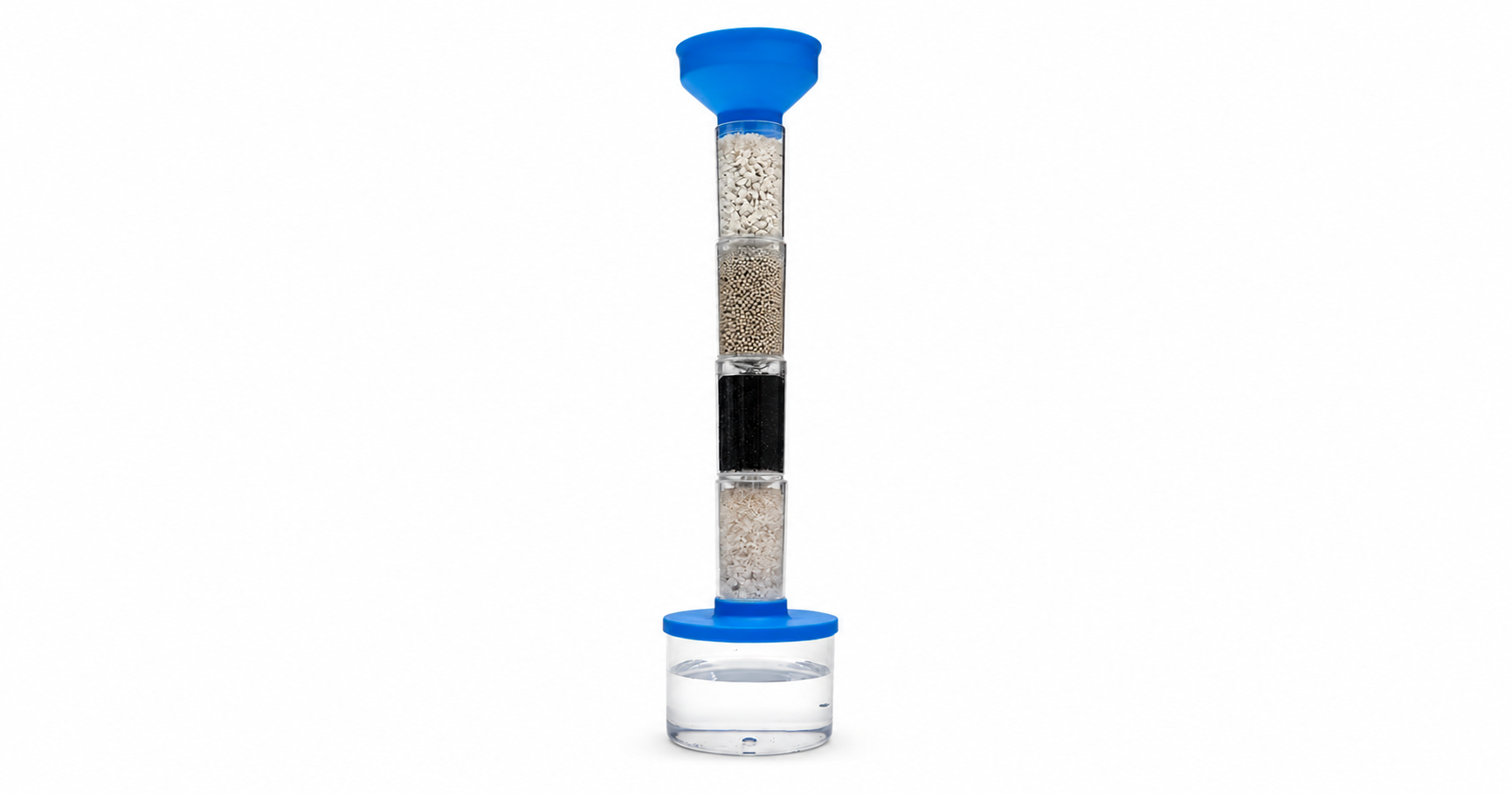
Instead of using a homemade bottle, the kit uses a transparent filtration tube, funnel, collection cup, filter papers, sponges, and packets of different filtering materials. Because the tube is transparent, children can observe the water as it passes through each layer and compare its appearance before and after filtration.
Affiliate disclosure: This article contain affiliate links. If you purchase a product through link given below, we may earn a small commission at no additional cost to you.
VIEW THE DIY WATER FILTRATION KIT
What Is Included in the DIY Water Filtration Kit?
The exact contents may vary slightly between sellers, so the product listing should be checked before ordering. Kits of this design commonly contain:
- A plastic funnel or hopper
- A transparent filtration tube
- A plastic collection cup
- Filter paper
- Small sponges
- Quartz sand
- Porcelain sand or another fine filtering medium
- Crushed granite or small stones
- Activated carbon
- Potash Alum
- An illustrated instruction guide
Comparable listings for this style of kit describe a clear filtration column containing layers such as crushed granite, porcelain sand, activated carbon and quartz sand, supported by filter paper and sponges.
What Does the Kit Demonstrate?
The kit demonstrates that filtration is often a multi-stage process. One material cannot efficiently capture every kind or size of particle. Instead, several materials are arranged in layers, with each layer performing a different function.

The experiment mainly demonstrates:
- Screening of larger particles
- Physical filtration of suspended sediment
- Adsorption by activated carbon
- Movement of water through porous materials
- The effect of particle size on filtration
- The importance of arranging filtering materials in stages
How Is the Filtration Column Arranged?
The kit uses a tall transparent tube that acts as a miniature filtration column. A funnel is attached at the top, while a collection cup is positioned beneath the outlet.
The layers are assembled inside the tube according to the kit’s instruction guide. A typical arrangement may include:
- Filter paper near the lower outlet
- A supporting sponge
- Fine filtering material
- Activated carbon
- Sand
- Crushed stone or granite
- Another sponge or filter-paper layer where instructed
The exact order should follow the manual supplied with the product because the quantities and materials can differ between kit versions.
Once assembled, the column creates a path through which the experimental water must travel before reaching the collection cup.
How Does Each Part of the Kit Work?
Funnel or Hopper
The funnel makes it easier to pour water into the narrow filtration tube. It also directs the flow toward the centre of the filter bed, reducing spills and helping the water spread across the upper layer.
Crushed Granite or Small Stones
The largest pieces of filtering material usually act as the first physical barrier.
The spaces between the stones are large enough for water to flow through, but some larger pieces of debris become trapped. This stage also helps distribute the water before it reaches the finer materials below.
Quartz Sand
Quartz sand contains much smaller spaces than the crushed-stone layer. As water moves between the grains, smaller suspended particles may become trapped.
Sand does not behave like a solid wall. It contains a network of tiny pathways called pores. Water can move through these pores, while particles that are too large or that collide with the grains may remain inside the filter bed.
Porcelain Sand or Fine Filter Medium
The finer material provides another stage of physical filtration. Its smaller spaces allow it to capture particles that passed through the coarser layers.
Using both coarse and fine materials creates gradual filtration rather than forcing all the water through one very dense layer.
Activated Carbon
Activated carbon works differently from sand and stone. It contains a large number of microscopic pores, giving it an extensive internal surface area.
As water passes through the carbon layer, certain substances may attach to its surface. This process is known as adsorption.
Adsorption should not be confused with absorption:
- In absorption, one substance enters the body of another material.
- In adsorption, substances collect mainly on the material’s surface.
Activated carbon may influence the appearance, colour or odour of the experimental water, depending on what has been mixed into it.
Sponges
The sponges help separate and support the filtering layers. They can also catch particles and prevent sand or carbon from moving freely through the tube.
Without supporting barriers, the smaller materials could mix together or escape through the outlet.
Filter Paper
Filter paper provides a fine physical barrier near the outlet or between layers. Its tiny openings allow water to pass while retaining some particles and pieces of the filtering media.
Collection Cup
The cup catches the water after it has travelled through the entire filtration column. This makes it possible to place the starting sample and filtered sample side by side for comparison.
Step-by-Step: How the Kit Filters Water
Step 1: Prepare the Filtration Tube
Place the filtration tube securely on its base or collection container. Insert the filter paper and sponge as shown in the instruction guide.
Make sure the outlet is covered properly so that loose filtering material does not fall directly into the cup.
Step 2: Add the Filtering Materials
Pour the supplied materials into the tube one layer at a time.
Keep the layers separate and reasonably level. Do not mix all the materials together because the purpose of the experiment is to observe how filtration occurs in stages.
Step 3: Prepare the Experimental Water
Prepare a muddy sample using clean water and a small amount of soil or another material recommended in the kit’s guide.
A useful classroom sample might contain:
- Fine soil
- Small paper pieces
- A little sand
- Tiny leaf fragments
- A small amount of food colouring, when permitted by the instructions
Avoid overloading the mixture. Extremely thick mud may block the filter before the experiment can be observed properly.
Step 4: Observe the Original Sample
Before filtration, place some of the mixture in a transparent glass or cup.
Observe and record:
- Its colour
- Its cloudiness
- The size of visible particles
- Whether particles float or settle
- Its general appearance
This becomes the control sample for comparison.
Step 5: Pour the Water into the Funnel
Add the experimental water slowly.
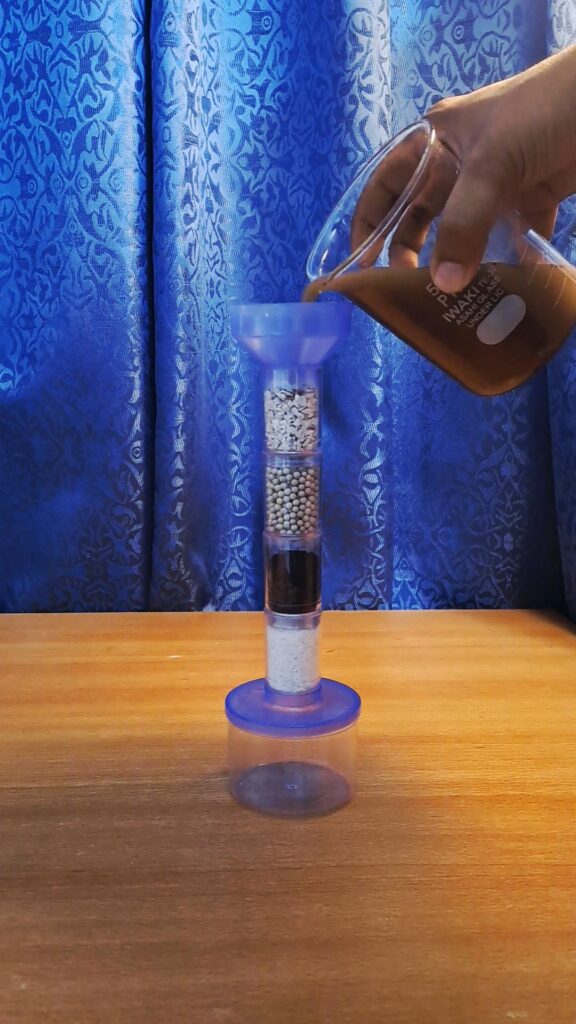
Pouring too quickly may disturb the layers, create channels through the filter or cause the funnel to overflow. A slow, controlled flow allows the water to contact more of the filtering material.
Step 6: Watch the Water Move Through the Layers
Because the filtration column is transparent, students can observe:
- Large particles becoming trapped near the upper layers
- Water slowing down in the fine sand
- Changes in appearance around the carbon layer
- Tiny air bubbles moving through the pores
- Filtered water collecting beneath the column
Step 7: Compare the Two Samples
Place the original sample beside the collected sample.
- Clarity
- Colour
- Amount of visible sediment
- Particle size
- Rate of settling

The comparison shows which visible changes were produced by the filtration column.
Why Does the Water Usually Look Clearer?
Cloudy water contains suspended particles. These particles scatter light as it passes through the water, making the water appear muddy or opaque.
During filtration, many suspended particles become trapped:
- Between pieces of crushed stone
- Inside the spaces between sand grains
- Around the sponge fibres
- On the filter paper
- Within the porous carbon bed
When fewer suspended particles remain, less light is scattered and the collected water may appear clearer.
Why Are Several Layers Used?
Each filtering material has spaces of a different size.
A layer of stones allows water to pass quickly but mainly affects larger particles. Fine sand can capture smaller particles, but it could become clogged rapidly if the largest debris reached it first.
The layered design therefore works progressively:
Larger particles → medium particles → finer particles → interaction with activated carbon → final physical barrier
This is similar to sorting objects through a series of sieves, beginning with large openings and ending with smaller ones.
What Is Adsorption?
Adsorption is one of the most important scientific ideas demonstrated by the activated-carbon layer.
Activated carbon has many microscopic pores. These pores provide a large surface on which certain molecules can collect.
A small piece of activated carbon can therefore have a much greater effective surface area than its outside dimensions suggest. This is why activated carbon is used in many filtration and purification applications.
In the kit, adsorption occurs alongside physical filtration. The sand mainly traps particles between grains, whereas activated carbon can interact with some substances at the molecular level.
Why Does the Water Flow Slowly?
Water must follow winding pathways around thousands of particles inside the filter column. This resistance slows its movement.
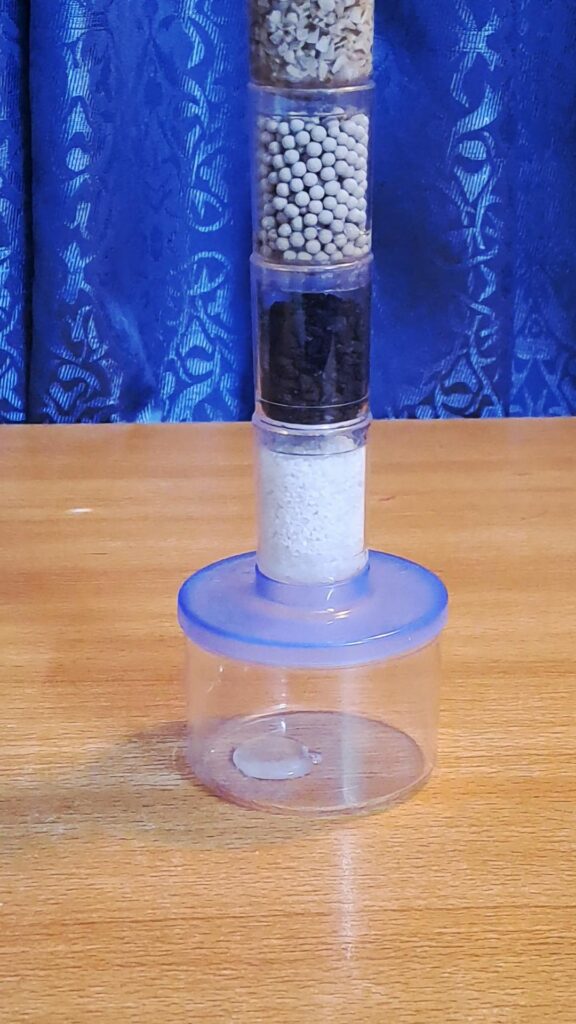
The flow rate depends on several factors:
Grain Size
Large grains create wider pathways and generally allow faster flow. Fine grains produce narrower pathways and slower flow.
Layer Thickness
A thicker layer creates a longer path. Water takes more time to travel through it.
Compaction
If the materials are packed too tightly, the pores may become restricted. If they are too loose, water may move through large channels without contacting enough of the filter.
Amount of Sediment
As particles accumulate inside the filter, some pores become blocked. The filtration rate may gradually decrease.
Pouring Speed
Adding water too quickly can place more pressure on the upper layers and may disturb the carefully arranged materials.