The astrolabe is one of the most remarkable scientific instruments from the ancient and medieval world. Before the invention of modern clocks, telescopes, satellites, and GPS systems, people used the astrolabe to study the sky, measure time, locate stars, and understand the movement of the Sun. It was not only a scientific tool but also a symbol of human curiosity, mathematical skill, and astronomical knowledge.
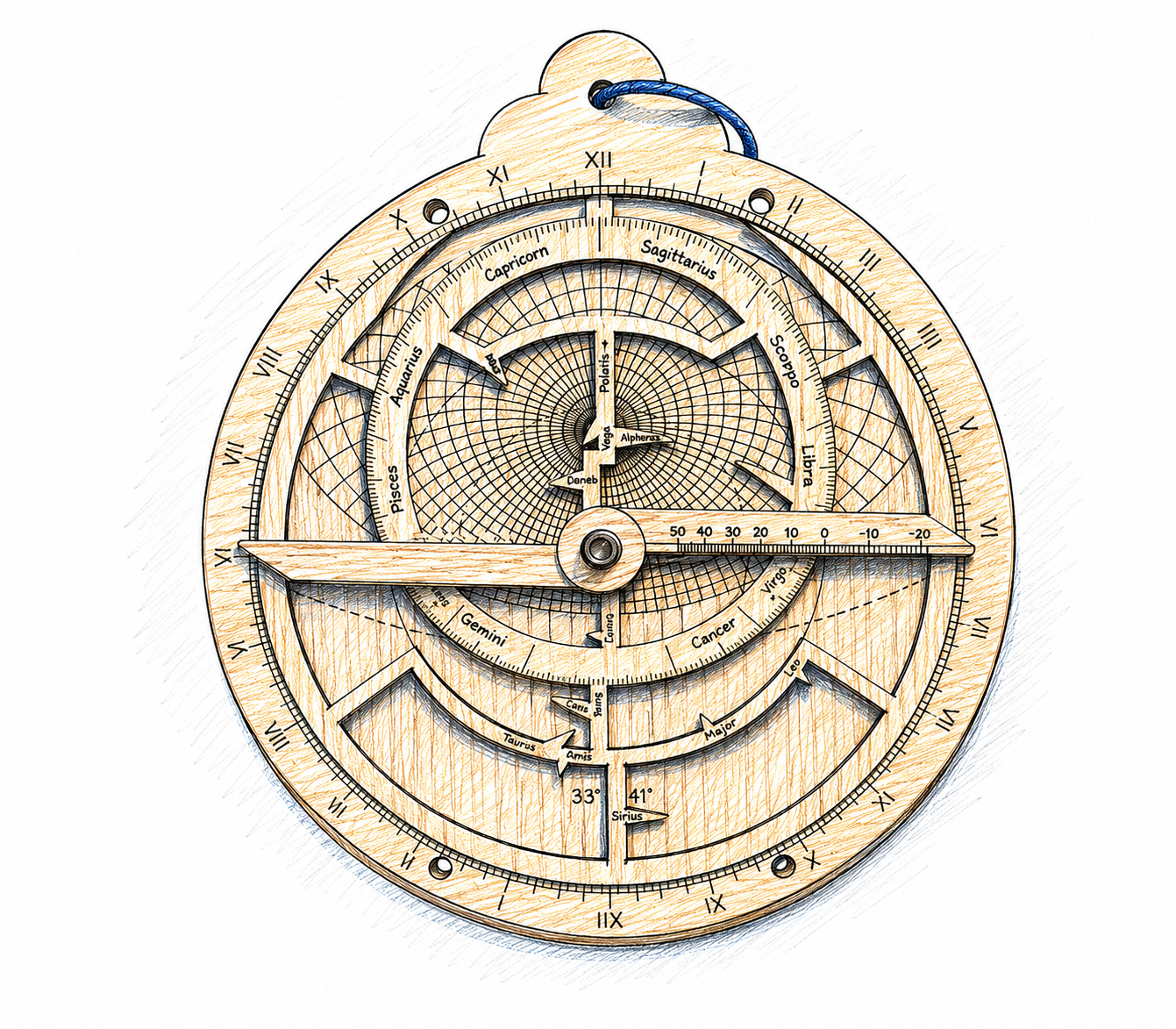
At first glance, an astrolabe looks like a flat circular disk covered with lines, scales, and rotating parts. These markings may appear complicated, but each part has a purpose. Together, they represent the sky on a flat surface and allow the user to make different astronomical observations and calculations.
The astrolabe was especially important because it connected science, mathematics, navigation, religion, and daily life. Astronomers used it to study celestial objects, travelers used it for direction, and scholars used it to teach astronomy and geometry.
What is an Astrolabe?
An astrolabe is a flat, circular astronomical instrument used to represent the sky. It shows the positions of the Sun, stars, horizon, and other important sky lines on a two-dimensional surface. In simple words, it is like a small model of the sky that can be held in the hand.
The word “astrolabe” comes from Greek roots meaning “star taker” or “star finder.” This name suits the instrument because one of its major purposes was to help users locate stars and understand their positions.
An astrolabe usually contains different circular scales and rotating parts. These parts help the user read information related to time, direction, altitude, and celestial movement. Unlike modern digital devices, the astrolabe works mechanically and visually. It depends on careful observation and correct reading of its scales.
The astrolabe was designed for practical use. It could be used outdoors to observe the Sun or stars, but it could also be used indoors as a teaching tool for astronomy.
A Brief History of the Astrolabe
The astrolabe has a very long history. Its origins go back more than 2,000 years. Early ideas behind the astrolabe are linked with ancient Greek astronomy. Scholars such as Hipparchus and Claudius Ptolemy contributed to the mathematical and astronomical knowledge that later influenced the design of the astrolabe.
The instrument became especially advanced during the Islamic Golden Age. Muslim scientists, astronomers, and mathematicians improved the astrolabe and made it more accurate and useful. Scholars such as Al-Battani and Al-Sufi helped expand astronomical knowledge and supported the development of instruments used for timekeeping, navigation, and religious purposes.
During this period, the astrolabe became widely used in the Islamic world. It was valuable for determining time, studying the sky, and calculating prayer-related times. Later, through cultural and scientific exchanges, especially in regions such as Al-Andalus, the astrolabe spread into medieval Europe. There, it became an important tool for astronomers, sailors, teachers, and scholars.
For many centuries, the astrolabe remained one of the most important scientific instruments. Eventually, it was replaced by newer instruments such as the telescope, mechanical clock, sextant, and modern navigation tools. However, its importance in the history of science remains very strong.
Main Functions of an Astrolabe
The astrolabe was a multi-purpose instrument. It could perform several important tasks that were useful in astronomy, navigation, timekeeping, and education.
The astrolabe was a multi-purpose instrument. It could perform several important tasks that were useful in astronomy, navigation, timekeeping, and education.
1. Measuring Time
One of the most common uses of the astrolabe was measuring time. By observing the position of the Sun during the day or certain stars at night, users could estimate the time.
This was very useful in an age when accurate clocks were not common. The astrolabe helped people connect the movement of celestial objects with the passage of time.
2. Observing the Sun and Stars
The astrolabe helped users observe the positions of the Sun and bright stars. It allowed astronomers to understand where celestial objects appeared in the sky at different times of the day or year.
This made it useful for learning about the daily and seasonal movement of the sky.
3. Locating Stars
Another important function of the astrolabe was locating stars. Since the instrument included star pointers or markings for bright stars, users could identify where a star should appear in the sky.
This function was useful for astronomers, travelers, and students learning about constellations and celestial navigation.
4. Estimating Sunrise and Sunset
The astrolabe could also be used to estimate sunrise and sunset times. This was helpful for planning daily activities, understanding the length of the day, and studying seasonal changes.
Because sunrise and sunset times change throughout the year, the astrolabe helped users see how the Sun’s path changes with the seasons.
5. Understanding Direction and Altitude
The astrolabe could measure altitude, which means the angle of an object above the horizon. This made it useful for observing the height of the Sun, stars, or even nearby objects.
It also helped users understand direction in the sky, such as north, south, east, and west.
6. Navigation
In earlier times, navigation depended heavily on the Sun, stars, and horizon. The astrolabe helped travelers and sailors estimate their position and direction.
Although later navigation instruments became more accurate, the astrolabe played an important role in the development of navigation.
7. Educational Use
The astrolabe was also a powerful teaching tool. It helped students understand astronomy, geometry, angles, time, and the movement of celestial objects.
Even today, the astrolabe is useful for education because it shows how ancient scientists used observation and mathematics to study the universe.
Important Parts of an Astrolabe
Although this article is not focused on the detailed working of the astrolabe, it is helpful to know its main parts.
The mater is the main body or base of the astrolabe. It holds the other parts in place.
The plate, also called the tympan, represents the sky for a specific latitude. This is important because the sky appears different from different places on Earth.
The rete is a rotating star map. It usually shows bright stars and the Sun’s yearly path.
The rule is a straight rotating pointer used to read scales on the front of the astrolabe.
The alhidade is a sighting bar on the back of the astrolabe. It is used to measure the altitude of the Sun, stars, or objects.
The limb is the raised outer rim of the astrolabe. It often contains degree or hour markings.
These parts worked together to make the astrolabe a compact but powerful scientific instrument.
Astrolabe in the Islamic Golden Age
The astrolabe became especially important in the Islamic Golden Age. During this period, scholars made major advances in astronomy, mathematics, geography, and instrument-making.
Muslim astronomers used the astrolabe for observing the sky, measuring time, and solving astronomical problems. It was also useful for determining prayer-related times, since Islamic prayers are connected with the position of the Sun and twilight.
The astrolabe was not only a scientific object but also a beautifully crafted instrument. Many historical astrolabes were made with great artistic skill, featuring engraved scales, decorative patterns, and precise markings.
This combination of science and art makes the astrolabe one of the most impressive instruments of medieval civilization.
Why Astrolabes Were Designed for Specific Locations
One interesting feature of the astrolabe is that many of its plates were designed for specific latitudes. Latitude means how far north or south a place is from the equator.
The reason for this is simple: the sky does not look exactly the same from every place on Earth. A star that appears high in the sky in one city may appear lower in another. Some stars may be visible from one latitude but not from another.
Because of this, an astrolabe made for one location works best near that latitude. For example, the manual notes that its astrolabe is designed for the latitude of Islamabad, so using it far from that location may cause slight errors.
Useful Astrolabe Resources
For readers who want to explore astrolabes further, there are several useful online resources and marketplaces.
One helpful website is The Astrolabe Project. It contains resources related to astrolabe construction, astrolabe design, and an Astrolabe Generator that can help learners create printable astrolabe parts for different uses. The site also includes articles on constructing astrolabes, including desktop and hand-held models.
Readers who want to buy a physical astrolabe can also search on Etsy, where different sellers offer decorative, brass, wooden, and educational astrolabe-style instruments. Some examples include handcrafted brass astrolabes, Islamic astrolabe designs, and wooden astrolabe kits. Availability, price, and quality can vary, so buyers should carefully check product descriptions, photos, reviews, size, and whether the instrument is decorative or actually usable for learning.
For educational purposes, it is better to choose an astrolabe that clearly mentions its learning use, latitude compatibility, and whether it includes instructions. Some decorative astrolabes may look beautiful but they may not be practical enough for real sky observations.