
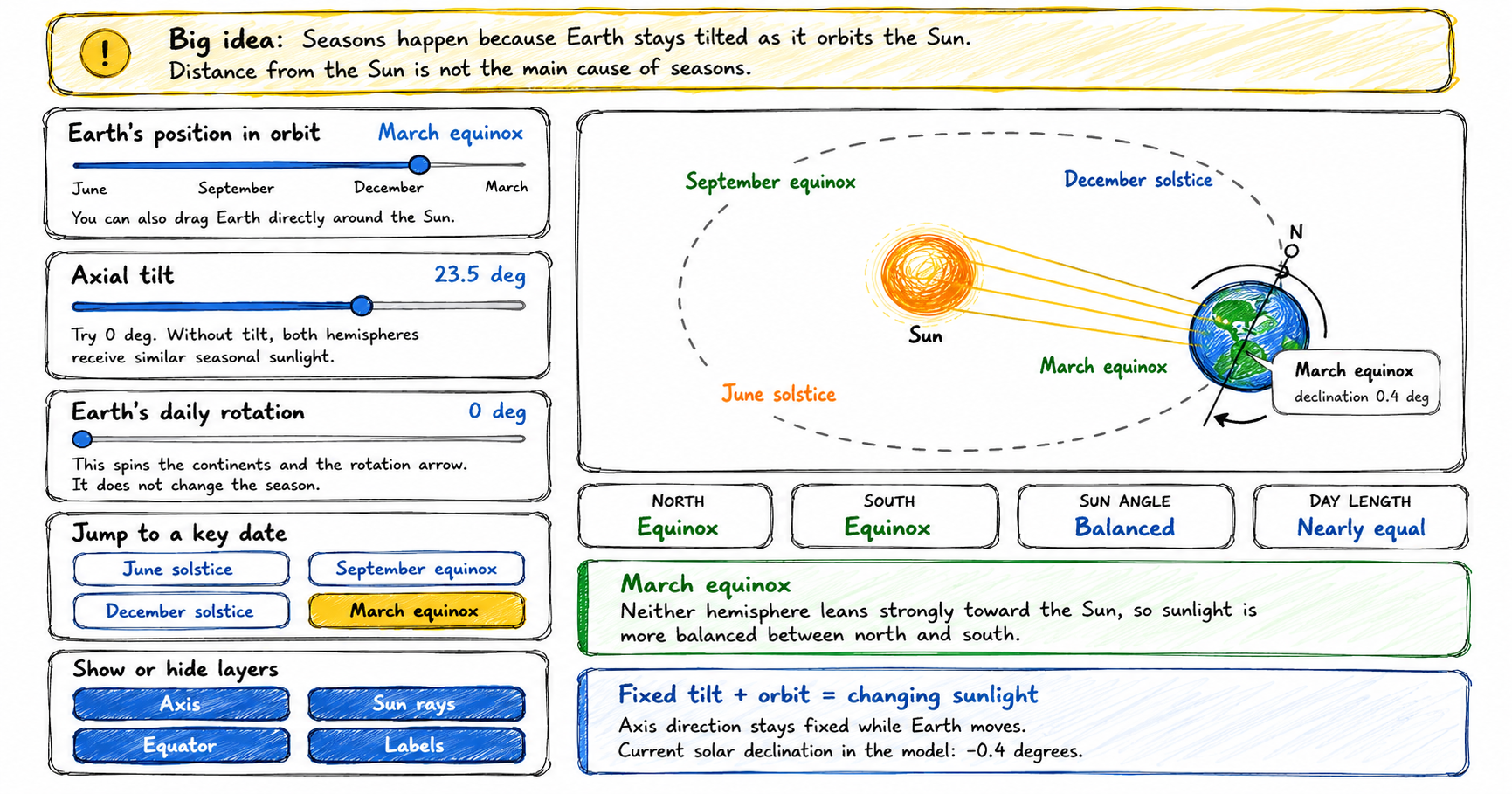
Use this interactive seasons simulator to learn why seasons change. Drag Earth around the Sun, adjust the axial tilt, spin the globe, and compare solstices, equinoxes, sunlight angle, and day length.
How to use the interactive seasons simulator
Drag Earth
Move Earth around the Sun or use the orbit slider. Watch the axis stay pointed in the same direction.
Change the tilt
Try 23.5 degrees, then try 0 degrees. The difference shows why tilt is essential for seasons.
Use key dates
Jump to June solstice, September equinox, December solstice, and March equinox.
Spin the globe
The daily rotation changes day and night on the globe, but it does not change the season.
Why do seasons change?
Seasons change because Earth is tilted on its axis while it orbits the Sun. The axis stays pointed in nearly the same direction in space. During part of the year, the Northern Hemisphere leans toward the Sun and receives more direct sunlight and longer days. About six months later, it leans away and receives lower-angle sunlight and shorter days.
Summer
A hemisphere has summer when it leans toward the Sun. Sunlight is more direct and daylight lasts longer.
Winter
A hemisphere has winter when it leans away from the Sun. Sunlight is less direct and daylight is shorter.
Equinox
Near an equinox, neither hemisphere leans strongly toward the Sun, so day and night are more balanced.
Not distance
Earth’s distance from the Sun changes slightly, but that is not the main reason for opposite seasons in the two hemispheres.
About the model
The simulator is not drawn to scale. The Sun, Earth, orbit, and light rays are arranged to make the season pattern easy to see. The important idea is the fixed tilted axis and how each hemisphere faces the Sun during the year.
Frequently asked questions
Why is summer in one hemisphere when it is winter in the other?
When one hemisphere leans toward the Sun, the other hemisphere leans away. That is why the seasons are opposite.
Does Earth’s daily rotation cause seasons?
No. Daily rotation causes day and night. Seasons come from axial tilt plus Earth’s yearly orbit.
What happens if axial tilt is set to zero?
The hemispheres receive much more similar sunlight through the year, so strong seasonal differences disappear in this simplified model.
Why do solstices and equinoxes matter?
Solstices mark the strongest tilt toward or away from the Sun. Equinoxes mark times when the hemispheres are more evenly lit.