Have you ever looked at the Moon and noticed that its shape seems to change from one night to another? Sometimes the Moon appears as a bright circle, while at other times it looks like a thin curved line. On some nights, it may not be visible at all.
These changing appearances are called the phases of the Moon.
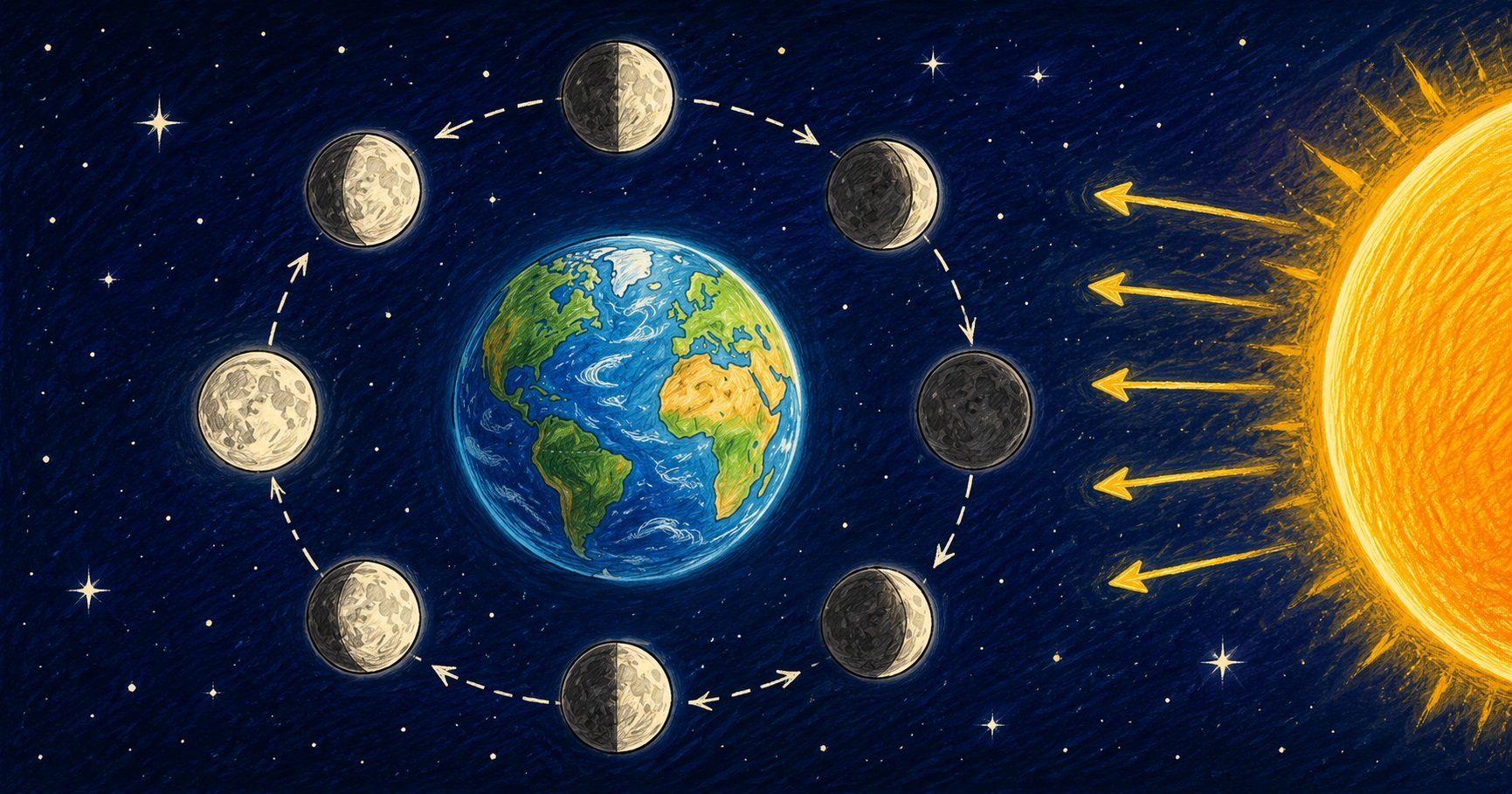
The Moon does not actually change its shape. It is always a round object in space. The phases happen because the Moon moves around Earth, and we see different portions of its sunlit side during its journey.
The Moon Does Not Produce Its Own Light
The Moon may look bright in the night sky, but it does not make its own light. Instead, it reflects light from the Sun.
At any moment, the Sun illuminates half of the Moon, just as it illuminates half of Earth. However, the amount of the illuminated half that we can see from Earth changes as the Moon travels around us.
This changing view creates the Moon’s phases.
The Moon Orbits Earth
The Moon revolves, or orbits, around Earth. It takes approximately 29.5 days to complete one full cycle of phases.
As the Moon moves around Earth, its position relative to Earth and the Sun changes. From our viewpoint, we see different amounts of the Moon’s illuminated surface.
For example, when the Moon is positioned between Earth and the Sun, the illuminated side faces away from us. When Earth is between the Sun and the Moon, the illuminated side faces us more directly.
The Main Phases of the Moon
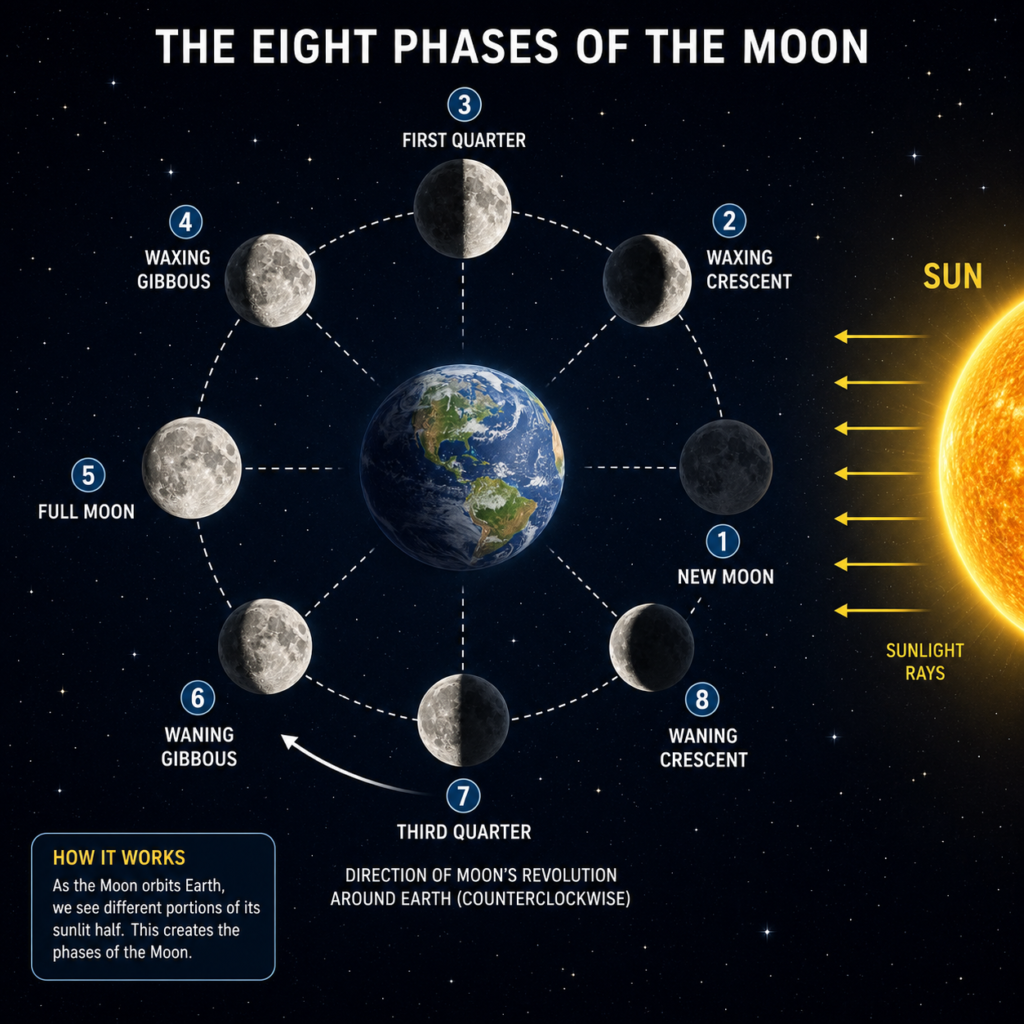
The Moon passes through eight commonly recognized phases during each lunar cycle.
1. New Moon
During the new moon phase, the Moon is located approximately between Earth and the Sun.
The side of the Moon illuminated by the Sun faces away from Earth. The side facing us is mostly dark, so the Moon is usually difficult or impossible to see.
The new moon marks the beginning of a new lunar cycle.
2. Waxing Crescent
After the new moon, a small curved section of the Moon becomes visible.
This thin illuminated section is called a crescent. The word waxing means that the visible illuminated part is increasing.
Each evening, more of the Moon appears to be lit.
3. First Quarter
During the first quarter phase, half of the Moon’s visible surface appears illuminated.
Although it is called a quarter moon, we see half of the Moon’s visible face. The name refers to the fact that the Moon has completed approximately one-quarter of its orbit around Earth.
4. Waxing Gibbous
After the first quarter, more than half of the Moon appears illuminated.
This phase is called waxing gibbous. The word gibbous means that the Moon appears larger than a semicircle but is not yet completely full.
The illuminated portion continues to grow each night.
5. Full Moon
During a full moon, Earth is positioned approximately between the Sun and the Moon.
The side of the Moon facing Earth is almost completely illuminated by sunlight. As a result, the Moon appears as a bright, round circle in the sky.
A full moon usually rises around sunset and remains visible for much of the night.
6. Waning Gibbous
After the full moon, the illuminated portion begins to decrease.
This phase is called waning gibbous. The word waning means that the visible illuminated part is becoming smaller.
More than half of the Moon is still visible, but the bright section decreases each night.
7. Third Quarter
During the third quarter phase, half of the Moon’s visible surface appears illuminated again.
The Moon has now completed approximately three-quarters of its orbit around Earth.
Depending on where you live, the illuminated half may appear on the opposite side from the first quarter Moon.
8. Waning Crescent
The final phase before the next new moon is the waning crescent.
Only a thin curved portion of the Moon remains visible. This crescent becomes smaller each day until the Moon reaches the new moon phase again.
The entire cycle then repeats.
What Do Waxing and Waning Mean?
Two useful words help describe the Moon’s phases.
Waxing means the illuminated part of the Moon is increasing.
Waning means the illuminated part is decreasing.
After the new moon, the Moon waxes until it becomes full. After the full moon, it wanes until it becomes new again.
A simple sequence is:
New Moon → Waxing Moon → Full Moon → Waning Moon → New Moon
Why Do We Sometimes See Half of the Moon?
The Moon is a sphere, so the Sun always illuminates one-half of it.
However, when the Moon is at a right angle to the line between Earth and the Sun, we see approximately half of its illuminated side and half of its dark side.
This creates the first quarter and third quarter phases.
The Moon has not been cut in half, and no shadow is covering it. We are simply viewing the illuminated half from a particular angle.
Are Moon Phases Caused by Earth’s Shadow?
A common misunderstanding is that Earth’s shadow causes the phases of the Moon. This is not correct.
Moon phases are caused by the changing positions of the Sun, Earth and Moon.
Earth’s shadow falls on the Moon only during a lunar eclipse. A lunar eclipse does not occur every month because the Moon’s orbit is slightly tilted compared with Earth’s orbit around the Sun.
Therefore, normal Moon phases are not eclipses.
Why Do Moon Phases Repeat?
The Moon continuously orbits Earth. After completing one orbit, it returns to approximately the same position relative to Earth and the Sun.
This causes the same sequence of phases to repeat every 29.5 days.
The repeating pattern is called the lunar cycle or synodic month.
Because a calendar month is slightly longer than a lunar cycle, two full moons can occasionally occur within the same calendar month. The second full moon is sometimes called a blue moon.
Does Everyone See the Same Moon Phase?
People in different parts of the world see the same general Moon phase on the same date.
However, the Moon may appear tilted or rotated differently depending on the observer’s location. People in the Northern Hemisphere and Southern Hemisphere may see the illuminated portion on opposite-looking sides.
The phase itself remains the same because everyone is observing the same Moon, Sun and Earth arrangement.
Why Can We Sometimes See the Moon During the Day?
The Moon is not only visible at night. It can often be seen during the daytime.
As the Moon orbits Earth, it rises and sets at different times. During many phases, the Moon is above the horizon while the Sun is also in the sky.
The Moon is bright enough to be visible during daylight, especially when the sky is clear and the Moon is far enough from the Sun’s position in the sky.
Interesting Facts About Moon Phases
- The Moon takes about 29.5 days to complete one full cycle of phases.
- Half of the Moon is always illuminated by the Sun.
- We usually see the same side of the Moon because it rotates once during each orbit around Earth.
- The Moon rises approximately 50 minutes later each day.
- Moon phases have been used to create calendars for thousands of years.
- Some religious and cultural calendars are still based on lunar cycles.
- A solar eclipse can only occur near a new moon.
- A lunar eclipse can only occur near a full moon.
Conclusion
The Moon has phases because it orbits Earth while reflecting light from the Sun. As the positions of the Sun, Earth and Moon change, we see different amounts of the Moon’s illuminated half.
The Moon itself does not change shape, and Earth’s shadow does not normally cause the phases. Instead, the phases are the result of our changing viewing angle.
From the nearly invisible new moon to the bright full moon and back again, the Moon follows a beautiful and predictable cycle in the sky.