
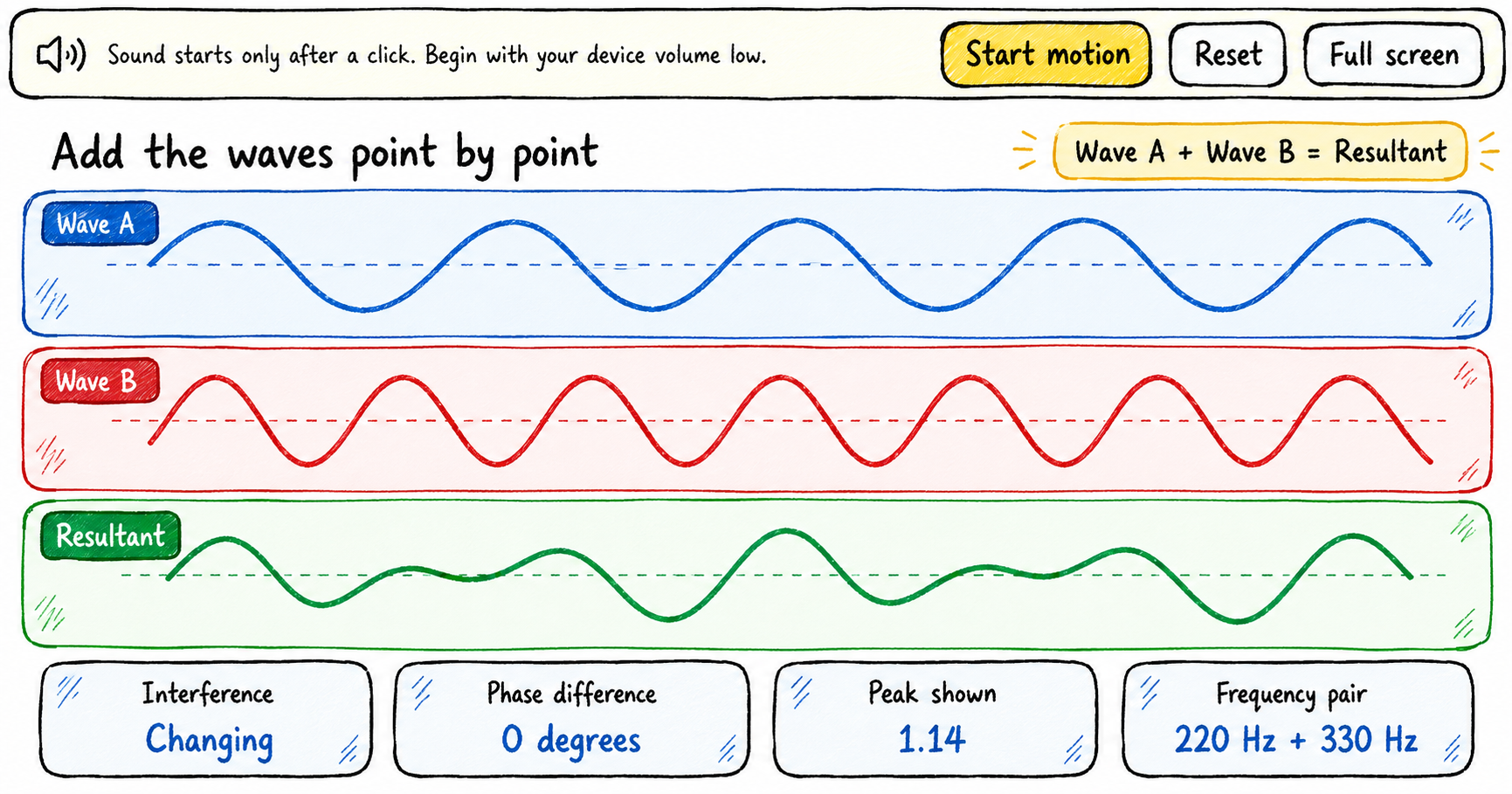
Explore the superposition of waves by changing the frequency, amplitude, and phase of two waves, then observing how their displacements combine to form a resultant wave.
How to use the superposition of waves tool
The explorer displays Wave A, Wave B, and their resultant in three aligned graphs. Begin with a quick experiment or build your own pair.
Choose an experiment
Try Constructive, Destructive, Partial, or Different frequencies to load a useful starting pattern.
Adjust each wave
Move the frequency, amplitude, and phase sliders for Wave A and Wave B.
Compare the graphs
At each horizontal position, add the displacement of the blue wave to the displacement of the red wave and compare it with the green resultant.
Listen carefully
Hear either wave alone or both together. Start with your device volume low and stop the sound when finished.
What is the superposition of waves?
When waves overlap, the displacement at each point is found by adding the individual displacements at that same point and time. A positive displacement and another positive displacement add upward. A positive displacement and a negative displacement partly or completely cancel.
Constructive and destructive interference
Constructive interference
When matching crests and troughs line up, their displacements reinforce one another and the resultant amplitude becomes larger.
Destructive interference
When a crest lines up with an equal trough, their opposite displacements cancel and the resultant can become zero.
Partial interference
With a phase difference between 0 and 180 degrees, reinforcement and cancellation are incomplete.
Changing interference
Waves with different frequencies continually change their alignment, producing a resultant pattern that changes over time.
Worked amplitude example
Set both waves to the same frequency and an amplitude of 0.60.
At a phase difference of 0 degrees, they reinforce: 0.60 + 0.60 = 1.20 maximum amplitude.
At a phase difference of 180 degrees, one displacement is the opposite of the other: 0.60 + (-0.60) = 0. The equal waves cancel completely.
What the controls change
Frequency
Frequency controls how many oscillations occur each second. In the graph window, a higher frequency shows more closely spaced cycles.
Amplitude
Amplitude controls the maximum displacement from the center line. Larger amplitudes make taller crests and deeper troughs.
Phase
Phase shifts a wave through its cycle. For equal frequencies, phase difference strongly affects reinforcement and cancellation.
Peak shown
This readout reports the largest absolute displacement currently sampled in the displayed resultant wave.
Ideas for wave superposition practice
- Use equal frequencies and amplitudes. Compare phase differences of 0, 90, and 180 degrees.
- Set one amplitude to zero and confirm that the resultant matches the remaining wave.
- Keep both phases fixed and change only one frequency. Observe how the resultant pattern changes.
- Create two unequal amplitudes at 180 degrees and predict the remaining amplitude.
- Pause the motion and choose one horizontal position. Estimate Wave A plus Wave B there, then check the resultant graph.
Frequently asked questions
What is the principle of superposition of waves?
It states that when waves overlap, the resultant displacement equals the algebraic sum of the displacement produced by each wave at that point.
Do waves disappear after destructive interference?
No. While they overlap, their displacements may cancel. The individual waves continue after passing through one another in a linear medium.
When does complete cancellation occur?
Complete cancellation occurs when two waves have equal amplitudes, the same frequency, and opposite displacements, corresponding to a 180-degree phase difference in this tool.
Why does the interference readout say changing?
When the two frequencies differ, their relative alignment does not stay fixed. The tool therefore labels the interference as changing.
Can the resultant amplitude be larger than either wave?
Yes. Constructive interference can produce a resultant amplitude as large as the sum of the two individual amplitudes.