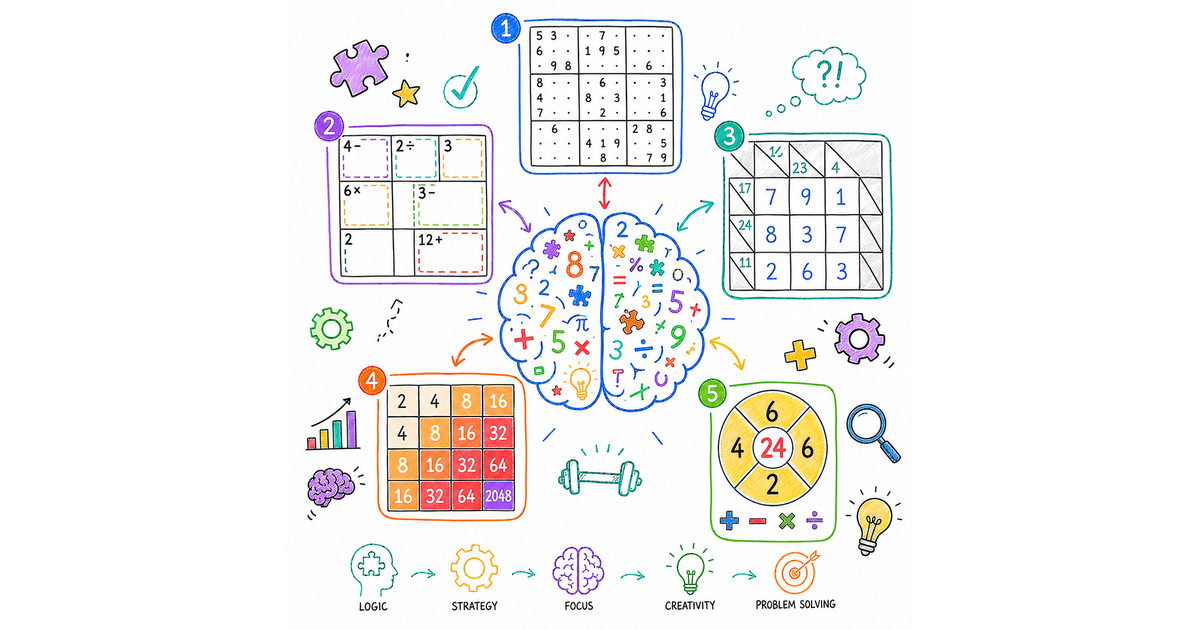
For decades, popular culture treated mathematics as a rigid discipline confined to school blackboards. However, the global rise of logic puzzles and mobile applications has shifted that perception entirely. Today, millions of people engage with complex mathematical logic daily without even realizing it. They do it simply because it is fun.
Whether you want to improve your mental arithmetic, sharpen your deductive reasoning, or just find an engaging alternative to mindless scrolling, these five fun math games offer the perfect cognitive workout.
1. Sudoku
Sudoku is one of the world’s most popular logic games. Although it uses numbers, you do not need to do any math calculations.
Although Sudoku is strongly associated with Japan, its roots trace back to an 18th-century puzzle concept created by Swiss mathematician Leonhard Euler. Euler’s “Latin Squares” used symbols arranged so that no symbol repeated within a row or column.
The puzzle gained worldwide popularity after being introduced to Japan in 1984, where it was given the name “Sudoku,” meaning “single number.”
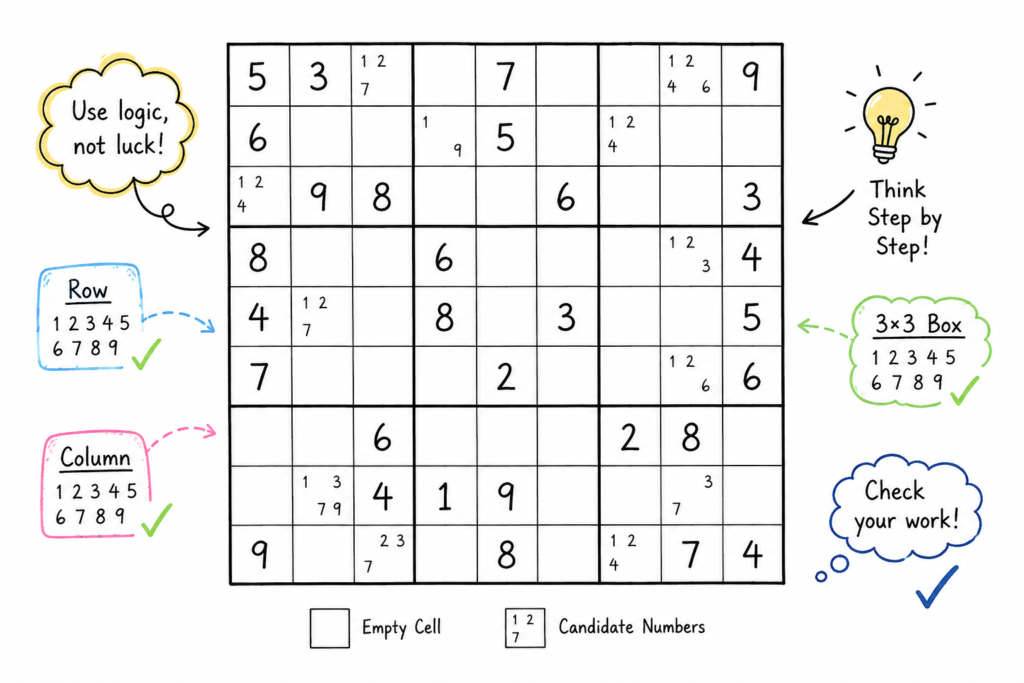
The Blueprint: A 9 x 9 grid broken down into nine smaller 3 x 3 sub-grids.
The Objective: Fill the entire board with digits from 1 to 9.
The Constraints: Every single number must appear exactly once in each horizontal row, vertical column, and designated 3×3 sub-grid.
Sudoku improves logical reasoning, concentration and pattern recognition. Players learn how to eliminate impossible choices and gradually uncover the correct solution. By forcing your brain to cross-reference multiple constraints simultaneously, Sudoku strengthens working memory and enhances scanning patterns.
Play here: sudoku.com
2. KenKen
If you love the structural grid layout of Sudoku but wish you could mix in some active mathematical equations, KenKen (also known as Calcudoku) is the answer. Invented by a Japanese math teacher to help his students practice arithmetic painlessly, this game layers operational math on top of grid alignment.
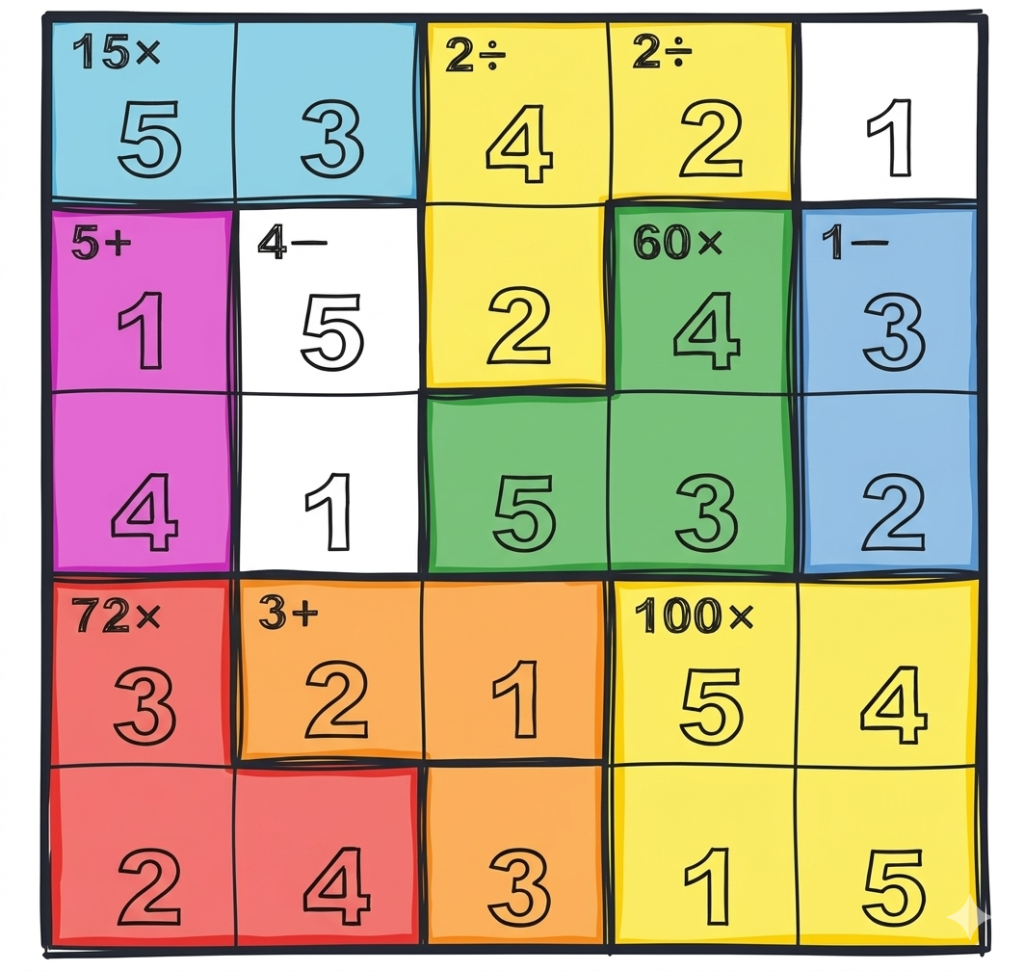
The Blueprint: Grids ranging from a simple 3 x 3 up to a challenging 9 x 9, divided into heavily outlined clusters called “cages.”
The Objective: Fill the grid with numbers (e.g., 1 to 4 for a 4 x 4 puzzle) so that no number repeats in any row or column.
The Constraints: Each cage features a tiny target number and a mathematical operator (+, -, x, ÷). The numbers inside that cage must calculate to the target value using that exact operation. For example, a cage marked 7+ spanning three cells could be filled with a 1, 2, and 4.
Play here: kenkenpuzzle.com
3. Kakuro
Often referred to as “Cross Sums,” Kakuro looks exactly like a traditional crossword puzzle, but it completely replaces vocabulary clues with arithmetic equations.
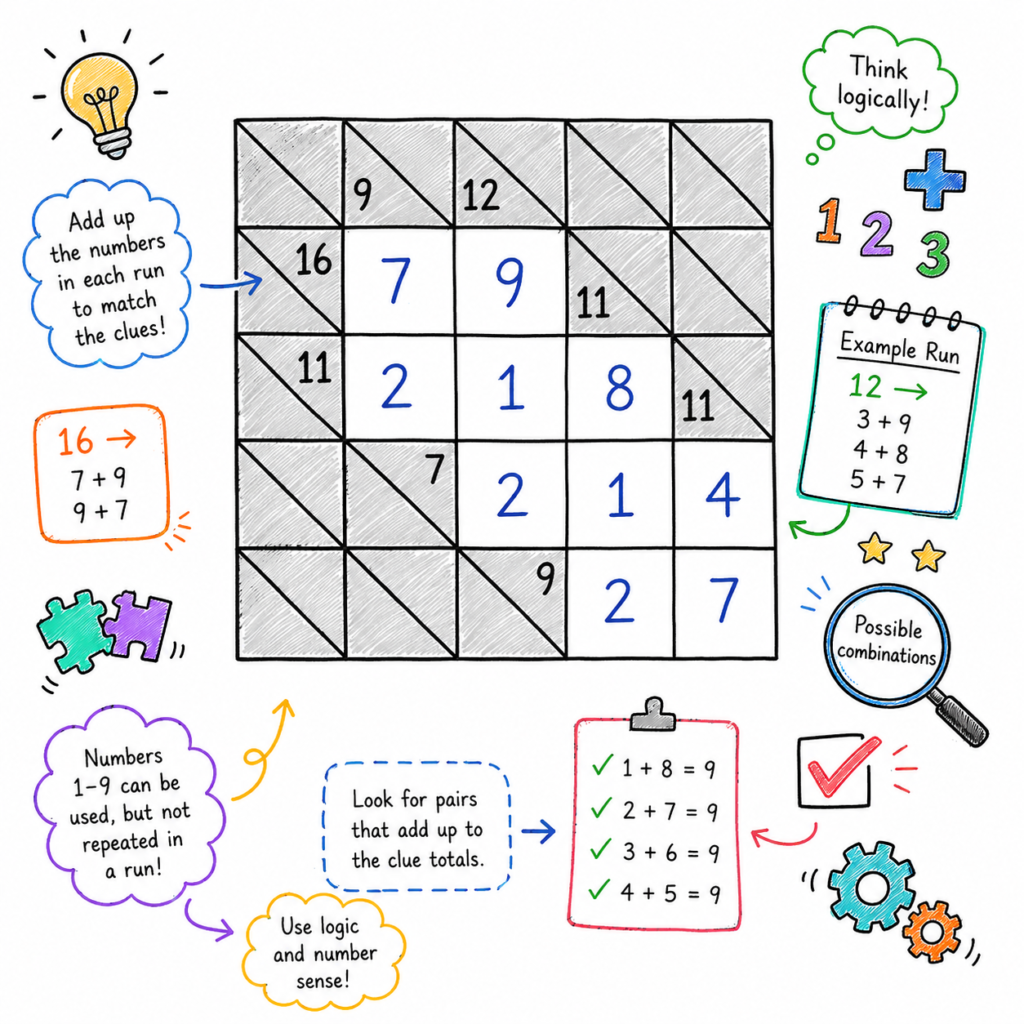
The Blueprint: An asymmetrical grid of white cells (to be filled) and black split cells containing numeric clues.
The Objective: Fill continuous runs of horizontal or vertical white cells with digits from 1 to 9.
The Constraints: The numbers in any consecutive run must add up exactly to the clue listed at the start of that run. Most importantly, you cannot repeat a digit within the same sum segment.
Kakuro forces players to learn the unique factorizations of numbers. For example, if you see a clue of 16 across two cells, the only possible digit combinations are 9 + 7 or 7 + 9 (since 8 + 8 breaks the rule against repeating digits). It builds an intuitive, lightning-fast understanding of number partitions.
Play here: kakuroconquest.com
4. 2048
Swapping paper for screens, 2048 took the world by storm as a viral mobile gaming hit n 2014. It serves as a beautiful, kinetic representation of geometric progressions and powers of 2.
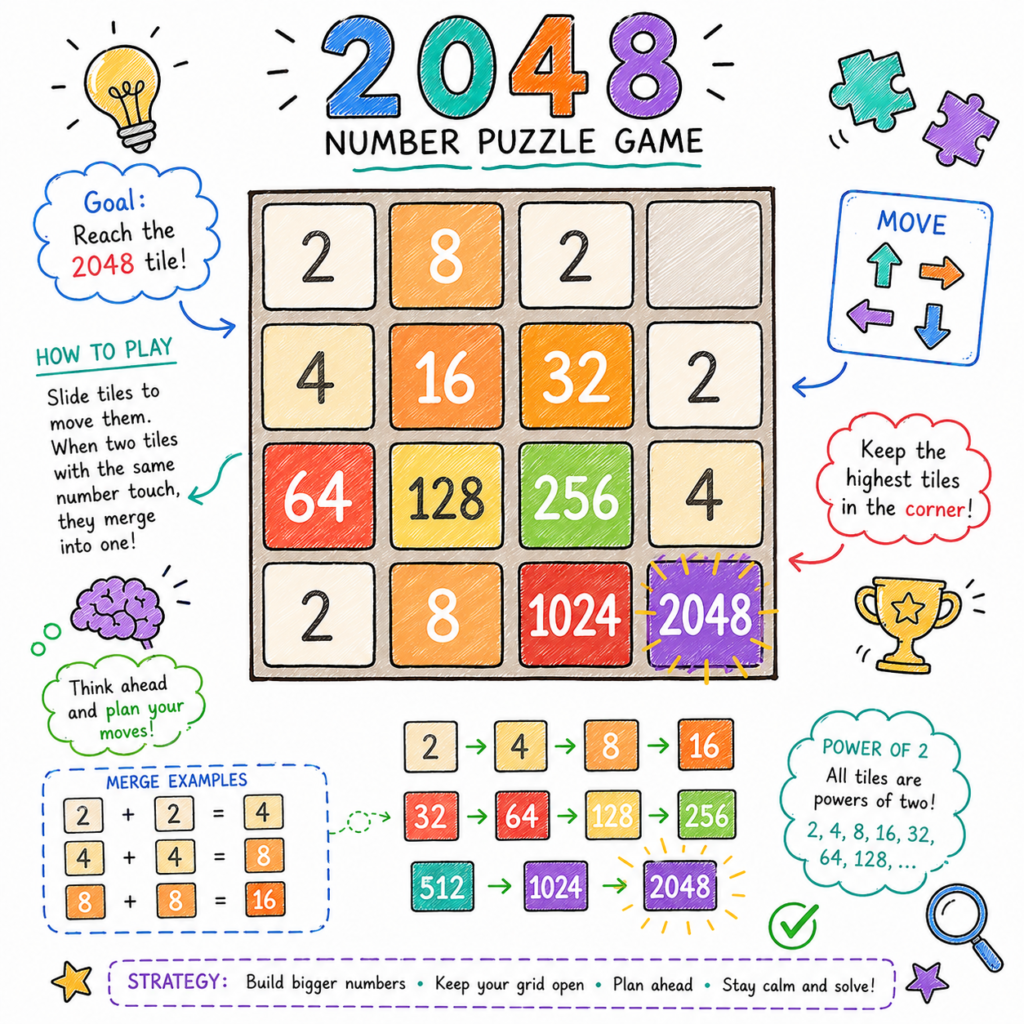
The Blueprint: A simple 4 x 4 square grid interface.
The Objective: Slide numbered tiles across the board to combine them until you forge the elusive 2048 tile.
The Constraints: Every time you swipe in a direction (up, down, left, right), all tiles slide as far as they can. If two tiles of the same value collide, they seamlessly merge into one tile carrying their combined sum (2 + 2 = 4, 4 + 4 = 8, and so on). Meanwhile, a random new 2 or 4 tile spawns in an empty spot with every single move.
2048 helps player understand powers of two, planning ahead and strategic thinking. Success requires careful decision-making and efficient use of space.
Play here: 2048.org
5. The 24 Game
Originally a popular school card game, the 24 Game skips the grids and forces players to get creative with basic math.
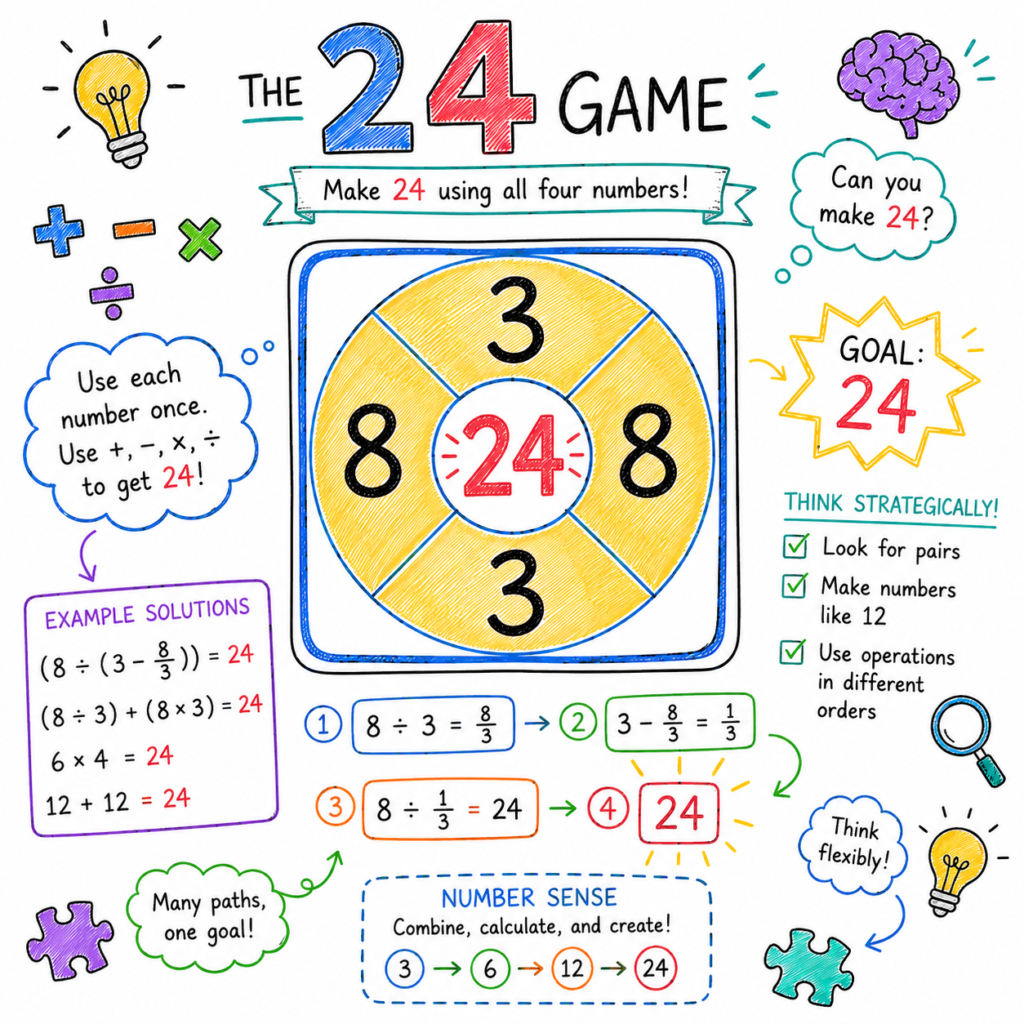
The Rules of 24:
You are presented with four numbers (for example: 1, 3, 4, and 6). Using addition, subtraction, multiplication, and division, you must manipulate these numbers to reach a final total of exactly 24.
- You must use all four numbers.
- You can use each number exactly once.
- You can use any combination of operators, along with parentheses, to structure your equation.
For the numbers listed above, the solution requires a clever utilization of fraction multiplication:
6 ÷ (1 – (3 ÷ 4)) = 24
The 24 Game breaks the rigid, linear mindset of basic mathematics. Instead of working forward from a problem to an answer, it forces your brain to reverse-engineer formulas, drastically improving mental math speed and flexibility with the order of operations (PEMDAS).
Play here: coolmathgames.com
Final Thoughts
Those fun maths games are more than just entertainment. They help build important skills such as reasoning, concentration, pattern recognition, and problem-solving. Whether you enjoy the pure logic of Sudoku, the arithmetic challenge of KenKen, or the strategic thinking of 2048, these games offer a fun way to exercise your brain.