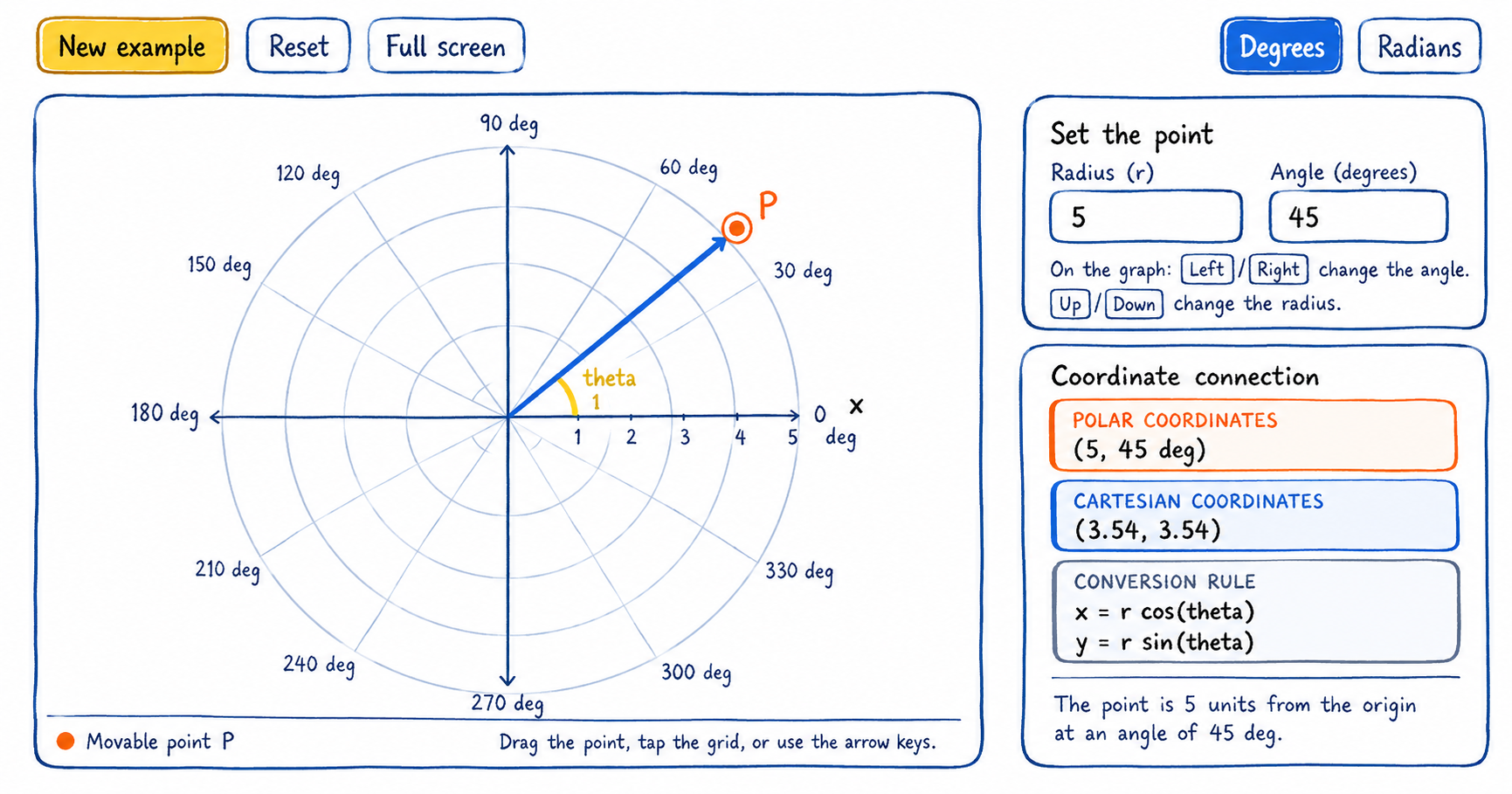
Explore polar coordinates by moving a point around a circular grid. See how radius and angle describe its position, connect polar coordinates to x- and y-coordinates, and practice conversions with worked steps.
How to use the polar coordinate interactive tool
The activity combines a movable point with a coordinate converter. Start on the graph, then use the converter to check your understanding.
Move point P
Drag the orange point, tap anywhere on the grid, or enter a radius and angle directly.
Compare coordinate systems
Watch the polar coordinate pair and Cartesian coordinate pair update together.
Switch angle units
Choose degrees or radians. The graph labels, point value, and converter all use the selected unit.
Practice conversions
Convert in either direction and follow the formulas shown in the worked solution.
What are polar coordinates?
A polar coordinate pair is written as (r, theta). Instead of moving horizontally and vertically from the origin, polar coordinates describe how far to travel and which direction to face.
Radius (r)
The radius is the straight-line distance from the origin to the point. A larger radius places the point farther from the center.
Angle (theta)
The angle is measured from the positive x-axis. Positive angles turn counterclockwise around the origin.
Polar to Cartesian
Use x = r cos(theta) and y = r sin(theta) to calculate rectangular coordinates.
Cartesian to polar
Use the distance formula for r and the quadrant-aware atan2 function to determine the angle.
Worked polar coordinate example
Suppose a point has polar coordinates (5, 53.13 degrees).
Calculate x using x = 5 cos(53.13 degrees), which is approximately 3. Calculate y using y = 5 sin(53.13 degrees), which is approximately 4.
Therefore, the polar point (5, 53.13 degrees) represents the Cartesian point (3, 4).
Ideas for practice
- Keep the angle fixed and change only the radius. Describe how the point moves.
- Keep the radius fixed and rotate through 0, 90, 180, and 270 degrees.
- Find polar coordinates for points in each of the four Cartesian quadrants.
- Switch to radians and locate pi/2, pi, 3pi/2, and 2pi.
- Convert (3, 4) to polar coordinates, then convert the answer back to Cartesian coordinates.
Frequently asked questions
What does the radius mean in polar coordinates?
The radius tells you how far the point is from the origin. It plays the same role as the length of a line drawn from the center to the point.
Where does a polar angle begin?
A standard polar angle begins on the positive x-axis. Positive angles are measured counterclockwise.
Are 0 degrees and 360 degrees the same direction?
Yes. A full turn returns to the starting direction, so angles that differ by 360 degrees, or by 2pi radians, are coterminal.
What is the angle at the origin?
At the origin the radius is zero. Every angle reaches the same point, so there is no single unique angle.
Why use atan2 instead of ordinary inverse tangent?
Atan2 uses the signs of both x and y to identify the correct quadrant and also handles points on the vertical axis.