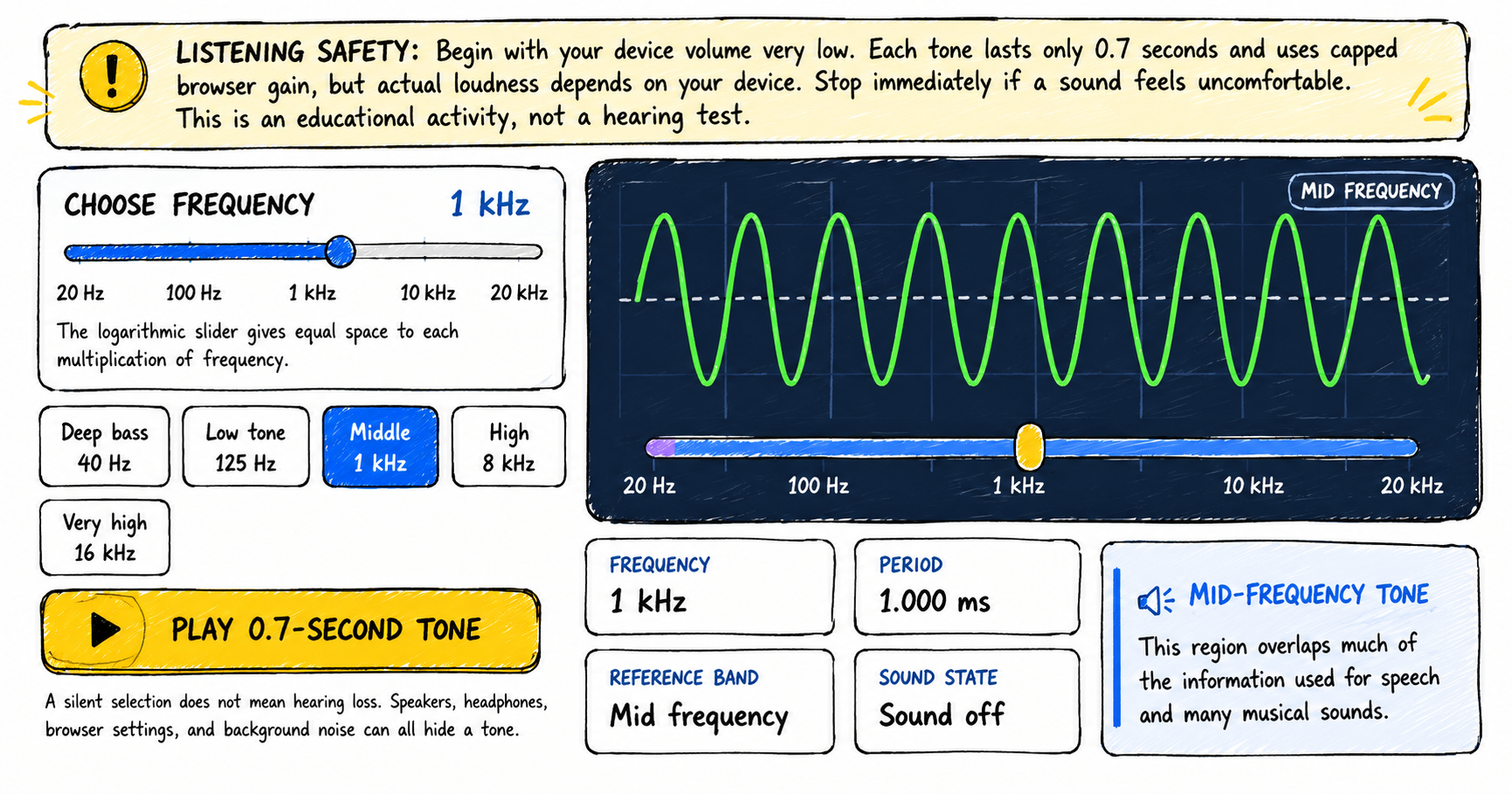
Explore the human hearing range from low bass to very high frequencies, compare pitch and period, and optionally record observations from short quiet tone bursts.
How to use the human hearing range explorer
Lower your volume
Set your device volume very low before playing a tone. Stop immediately if any sound feels uncomfortable.
Choose a frequency
Move the logarithmic slider or choose a preset. The visual display and period update without starting sound.
Play a short tone
Press the play button deliberately. Each sine tone fades in and out and stops automatically after 0.7 seconds.
Try the guided tour
Explore nine frequencies and record whether you noticed each one. Treat the results as observations, not a hearing diagnosis.
What is the human hearing range?
The commonly quoted human hearing range is approximately 20 Hz to 20,000 Hz for a young person with healthy hearing. It is a broad reference, not a range that every person can hear. Sensitivity varies with frequency, age, noise exposure, health, and individual differences.
Low frequencies
Frequencies below roughly 250 Hz include deep bass, low musical fundamentals, and rumbles. Small speakers may not reproduce the lowest part accurately.
Middle frequencies
The middle part of the range contains substantial information used in speech and many everyday sounds.
High frequencies
Higher frequencies contribute brightness and detail. Sensitivity at the upper end commonly differs between people and may change with age.
Beyond the reference range
Sound below 20 Hz is called infrasound, while sound above 20 kHz is ultrasound. These boundaries are conventional rather than perfectly sharp.
Frequency, pitch, and period
Frequency
Frequency is the number of cycles completed each second and is measured in hertz. A 1,000 Hz tone completes 1,000 cycles per second.
Pitch
Pitch is the perception connected mainly with frequency. A higher-frequency tone is generally heard as higher in pitch.
Period
Period = 1 / frequencyA 1,000 Hz tone has a period of 0.001 seconds, or 1 millisecond.
Octaves
Doubling frequency raises a tone by one octave. The jump from 125 to 250 Hz is the same octave ratio as 8,000 to 16,000 Hz.
Why this is not an online hearing test
The browser controls the electronic signal, but it cannot know the sound pressure level reaching your ears. Headphones, speakers, device volume, frequency response, fit, room noise, and distortion all affect the result. A missing tone may be a device limitation rather than a hearing limitation. A clinical hearing assessment uses calibrated equipment and controlled levels.
Safe listening guidance
Keep volume low and listening brief. The World Health Organization recommends keeping personal-device volume below 60% of maximum and limiting exposure to loud sounds. This explorer further limits each tone to a short burst and caps its browser gain, but it cannot measure the final decibel level from your equipment.
Frequently asked questions
Why can I see a tone but not hear it?
The selected frequency may be outside your device’s useful output range, masked by background noise, or below your hearing sensitivity at that listening level.
Why do high tones become harder to notice?
Upper-frequency sensitivity differs among individuals and commonly changes with age and noise exposure. Equipment performance also falls off at high frequencies.
Does a higher frequency mean a louder sound?
No. Frequency mainly controls pitch. Loudness depends on sound level and human sensitivity, which is not equal at every frequency.
Why is the slider logarithmic?
Pitch relationships depend on frequency ratios. A logarithmic scale gives equal visual spacing to equal ratios, such as each doubling of frequency.
What should I do if I am concerned about my hearing?
Stop using this activity and consult a qualified hearing health professional. Persistent tinnitus, difficulty understanding speech, or difficulty hearing high-pitched sounds should not be evaluated with an uncalibrated webpage.