Understanding Waves Superposition with this Interactive Tool

The picture showing red and blue wave superimposed onto each other whereas green wave is the resultant wave as result of superposition of red and blue wave.

Explore the superposition of waves by changing the frequency, amplitude, and phase of two waves, then observing how their displacements combine to form a resultant wave. How to use the superposition of waves tool The explorer displays Wave A, Wave B, and their resultant in three aligned graphs. Begin with a quick experiment or build … Read more

How Do Noise Cancelling Headphones Work? The Science Behind the Silence

The picture of Noise Cancelling Headphones against white background.

In a world filled with constant noise—traffic, office chatter, and everyday hustle—noise-cancelling headphones have become one of the most popular gadgets for work, travel, and relaxation. But how do these magical devices block out unwanted sounds? The answer lies in clever engineering and fascinating physics. Before we delve straight into the answer, lets first look … Read more

Why some objects sink while others float in water?

Float and Sink

Whether something is going to sink or float in water depends on the density of the object in water and the density of the water. Density is a measure of how much mass  is packed into a certain unit of volume. In short density is mass per unit of volume. The condition of sink and … Read more

Galton Board: Understanding Probability in a Fun and Visual Way

Picture of a Galton Board.

Have you ever seen tiny balls falling through a triangle of pegs and collecting in bins at the bottom, forming a perfect bell-shaped curve? That fascinating device is called a Galton Board — also known as a Quincunx or Bean Machine. Invented by Sir Francis Galton in the 19th century, this clever machine offers a … Read more

Exploring Permutations and Combinations: A Simple Visual Guide for Students

Scribble-style educational infographic explaining permutations with three objects, A, B, and C, showing that order matters, the formula P(3,2)=6, and all six possible ordered pairs.

This permutations versus combinations interactive tool helps students count selections, arrangements, and possibilities. Explore exactly how the answer changes when order matters or does not matter. How to use the permutations versus combinations interactive tool Choose the total number of objects, choose how many will be picked, then compare the two counting methods. 1 Choose … Read more

Learn how hand water pump works with this DIY kit

Picture of a DIY Hand water pump

What is a hand water pump? A hand water pump is simple device that pulls water up from underground. It uses mechanical motion of hands to pull the water from the underground. It has a long handle that you move up and down.  When you do this, it uses air pressure and valves to pull … Read more

Why balloons move up in the air?

Balloons moving up in the air always fascinate us as children. But have you wonder why they move up in the air?   The underlying principal for balloons upward movement is the same as that of objects floating on water. The balloon moves in the upward direction due to difference in the densities of the … Read more

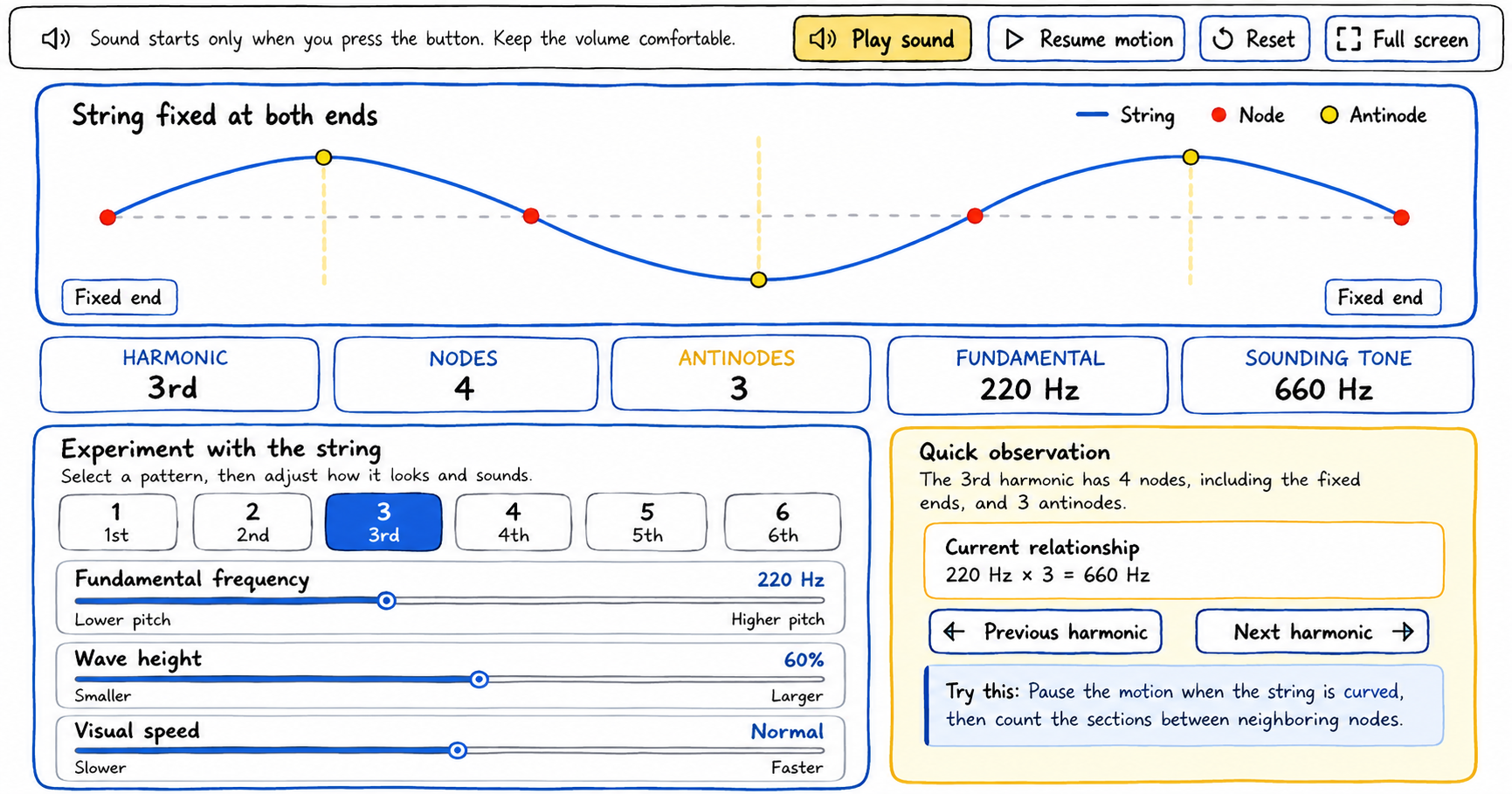
The Human Hearing Range Explorer

Explore the human hearing range from low bass to very high frequencies, compare pitch and period, and optionally record observations from short quiet tone bursts. How to use the human hearing range explorer 1 Lower your volume Set your device volume very low before playing a tone. Stop immediately if any sound feels uncomfortable. 2 … Read more